Some Cats Fear Your Guests and Approach Them Anyway. Some Babies Do Too
A Kyoto University survey of about 310 cats found a group that is fearful yet curious about strangers, a mix that resembles shyness in human infants.

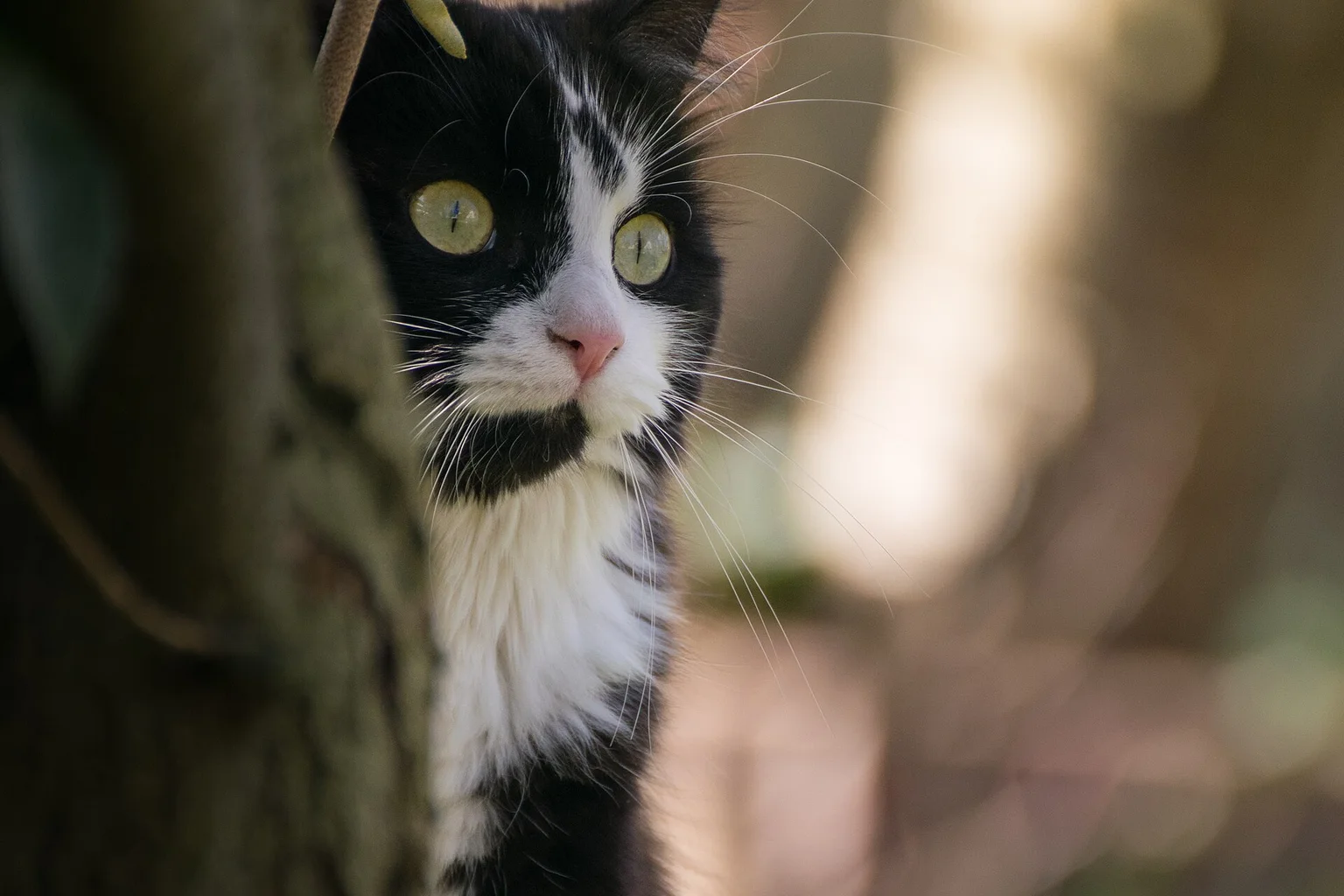
Some cats that seem fearful may actually be shy in a way that resembles human babies, according to a Kyoto University study published Nov. 4 in PLOS One. Researchers led by Madoka Hattori surveyed owners of about 310 cats and found a group that combines high fear with strong curiosity about strangers.23
The findings come from owners’ answers to a survey. Nobody directly watched the cats, and the researchers say more study is needed. Still, the work offers a more generous way to read the cat who wants nothing to do with your guests, right up until it does.3
A baby questionnaire, adapted for cats
Owners filled out an online survey adapted from a questionnaire used to evaluate personality in human infants. In other words, the starting point was a form meant for people whose household members also nap a lot and communicate mostly by yelling.2
The answers sorted the cats into four behavioral profiles: highly sociable, sociable, fearful and shy.1 As Gizmodo described them, the highly sociable cats showed little fear. The sociable group was fearless but less likely to approach strangers. The fearful cats avoided strangers. The shy cats were fearful but still curious, and likely to approach anyway.3
That last group is the interesting one. These cats scored high on fear and high on the urge to approach unfamiliar people or objects at the same time.12
Why babies come into it
Human infants from about nine months old often show a similar push and pull: easily spooked by strangers, but still curious about them.3 Earlier research on infants found that the shyest babies scored high on both approach and fear temperaments, rather than simply being fearful.4
The comparison to infants is an analogy, not a claim that cats and babies are the same. For most cats in the survey, shyness was closely tied to fear alone. Only a subset showed the mix of fear and approach that looks like infant shyness.12
This more complex kind of shyness turned up more often in male cats and in cats born as strays.13
How the team noticed
The researchers first spotted shy, infant-like cats during earlier experiments involving oxytocin, a hormone. They then ran several rounds of owner surveys with more than 300 respondents, according to Gizmodo.3
Hattori hopes the results nudge people past easy assumptions about animals. “I hope this research encourages people to reconsider stereotypes such as ‘dogs are friendly’ or ‘cats are aloof,’” she told Gizmodo.3
“I hope people will take the time to understand each cat as an individual.”
She said that to Gizmodo as well.3
What comes next
Because the study relied on what owners reported, the next step is to watch how cats actually behave. The team would ideally do that at home, with owners helping in a citizen-science approach, meaning ordinary people collect data alongside the scientists.3
The researchers say the work may eventually help improve outcomes for shelter cats.3 For a cat that hangs back at first and then edges closer, being read as shy instead of simply scared could make a real difference.
Did this make your day? Give it a cheer.
Sources
- Some cats are shy, just like human infants Phys.org (PLOS press release), 2026-11-04
- Some scaredy-cats are just shy like human babies Scimex (PLOS press release), 2026-11-04
- Some Cats Are Shy Like Human Babies, Study Finds Gizmodo, 2026-11-04
- Shyness in Early Infancy: Approach-Avoidance Conflicts in Temperament and Hypersensitivity to Eyes during Initial Gazes to Faces PLOS One / PubMed Central, 2013-01-01