Short-Necked Oil Beetle Wants Bare Earth, Thick Cover and a Bee Taxi
Surveyors at Castlemartin Range in Pembrokeshire, the only known Welsh site, found short-necked oil beetle larvae after surveys in 2022 and 2025 found only dead adults.

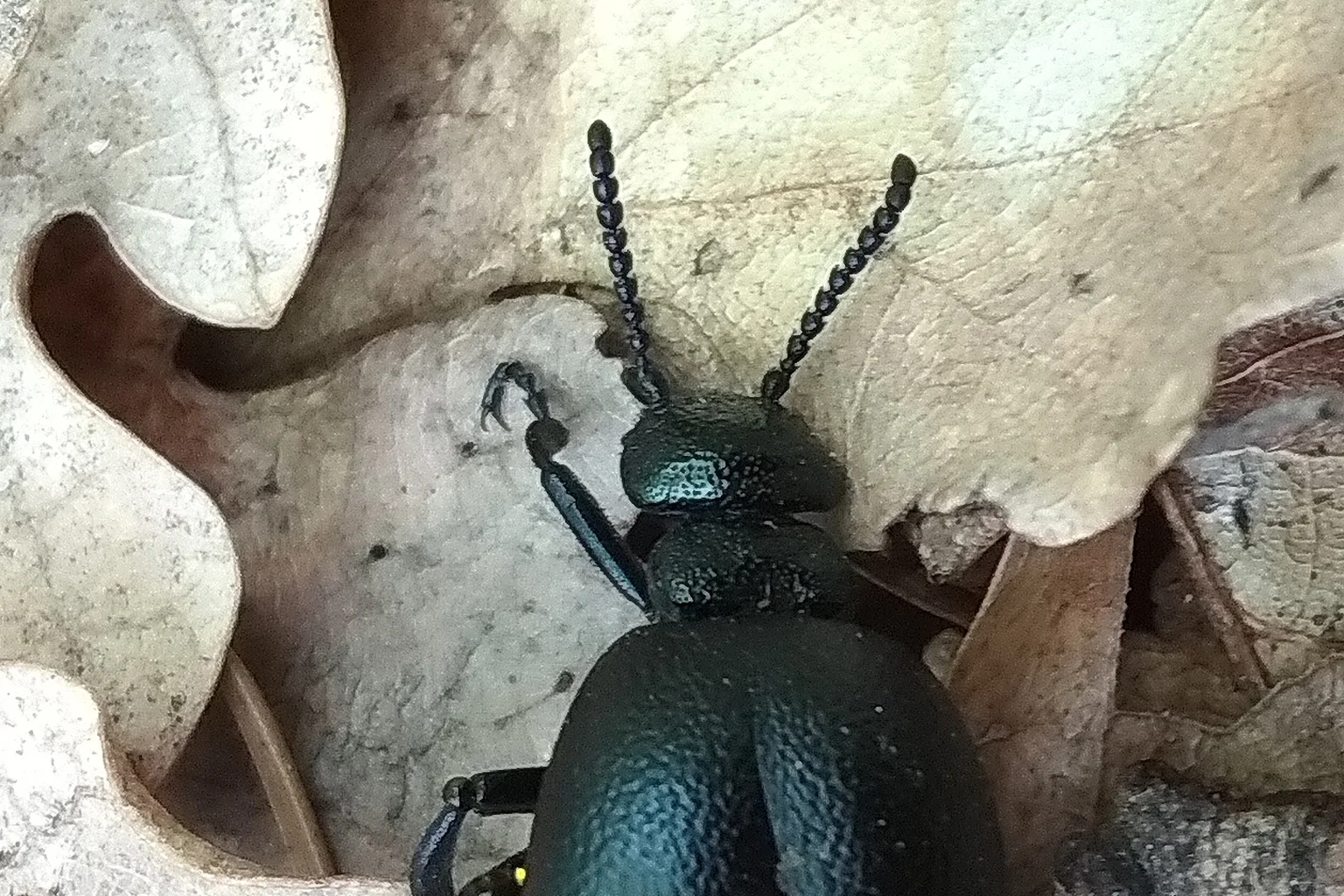
Surveyors at Castlemartin Range in Pembrokeshire have found larvae of the short-necked oil beetle, a rare insect, at the only place in Wales where it is known to live.13
The find matters because the earlier surveys were grim. Surveys in 2022 and 2025 turned up only dead adult beetles, which raised concerns about whether the species was still on the site.12
According to Natural Resources Wales (NRW), the number and spread of the larvae, along with the time of year, suggest the surveyors found hatchlings from a larger batch of immature beetles. That points to the beetle breeding there again.1 The larvae came from a small area of one site, so this is evidence of breeding. It is not a count of how many beetles live there.
A comeback that started in 2020
This is not the beetle’s first reappearance in Wales. In 2020, the charity Buglife announced that Annie Haycock had rediscovered it in Pembrokeshire. That was the first Welsh record since 1944, and the species had been considered extinct in Wales.34
Its record across the UK is patchy too. There were no UK sightings between 1948 and 2006, when it turned up in south Devon. Populations have since been found in the Hebrides and on Salisbury Plain.246
The Guardian reports that habitat loss during the 20th century pushed the species to the brink of extinction in Britain.2 GB News reports that NRW classes it as nationally rare in Great Britain, and that it is listed as vulnerable on the IUCN Red List, the global register of threatened species.5
A beetle that can’t grow up without a bee
The short-necked oil beetle grows up to 24mm long and is one of five oil beetle species in the UK.4 Its defense made the Guardian’s headline: the beetle oozes a substance from its knees when attacked.2
Its childhood is even stranger. Newly hatched larvae climb onto flowers and hitch a ride on visiting solitary bees. Back at the bee’s nest, the larvae eat the pollen the bee has collected.1
That arrangement makes the beetle picky about real estate. It needs bare earth for egg laying, thick vegetation for shelter and dense flower cover. Only a handful of suitable sites exist in the UK.1
“The Short-Necked Oil Beetle is an amazing creature and not only depends on a very specific habitat to survive, but the presence of solitary bees as well,” said Anna Hobbs, project delivery officer at the Bumblebee Conservation Trust, in the NRW announcement.1
Who did the surveying, and what comes next
The surveys were carried out by the Bumblebee Conservation Trust as part of its Shrill Carder Bee project. The project is funded by the National Lottery Heritage Fund and is part of Natur am Byth, Wales’s flagship species recovery programme.1
“It was very exciting to find this species and evidence of its breeding again, especially considering it will be the last survey for the species for our project,” Hobbs said in the announcement.1
NRW says surveying of the beetle will continue.1

Did this make your day? Give it a cheer.
Sources
- Patience pays off for rare species in only Welsh location Nation Cymru (carrying the NRW announcement; original NRW release not seen), 2026-10-29
- Rare beetle that oozes substance from its knees when attacked rediscovered in Wales The Guardian (via AOL UK), 2026-11-01
- Rare beetle found breeding at its only known Welsh site Pembrokeshire Herald, 2026-10-29
- Rare beetle rediscovered in Wales Countryfile.com, 2021-01-01
- Rare creature rediscovered in Wales after nearly 60 years as conservationists hail 'remarkable' find GB News, 2026-11-02
- Rare animal rediscovered in UK country after nearly 60 years Press News Agency (PA-style wire copy), 2026-11-02
- One of the UK's rarest oil beetles found in Wales Discover Wildlife