A Monkey Debuted in 2010 With 4 Skulls, a Skin and a Photoshopped Portrait
In 2010, scientists described a new snub-nosed monkey from Kachin State, Myanmar. Hunters say it sneezes in the rain. It is Critically Endangered.

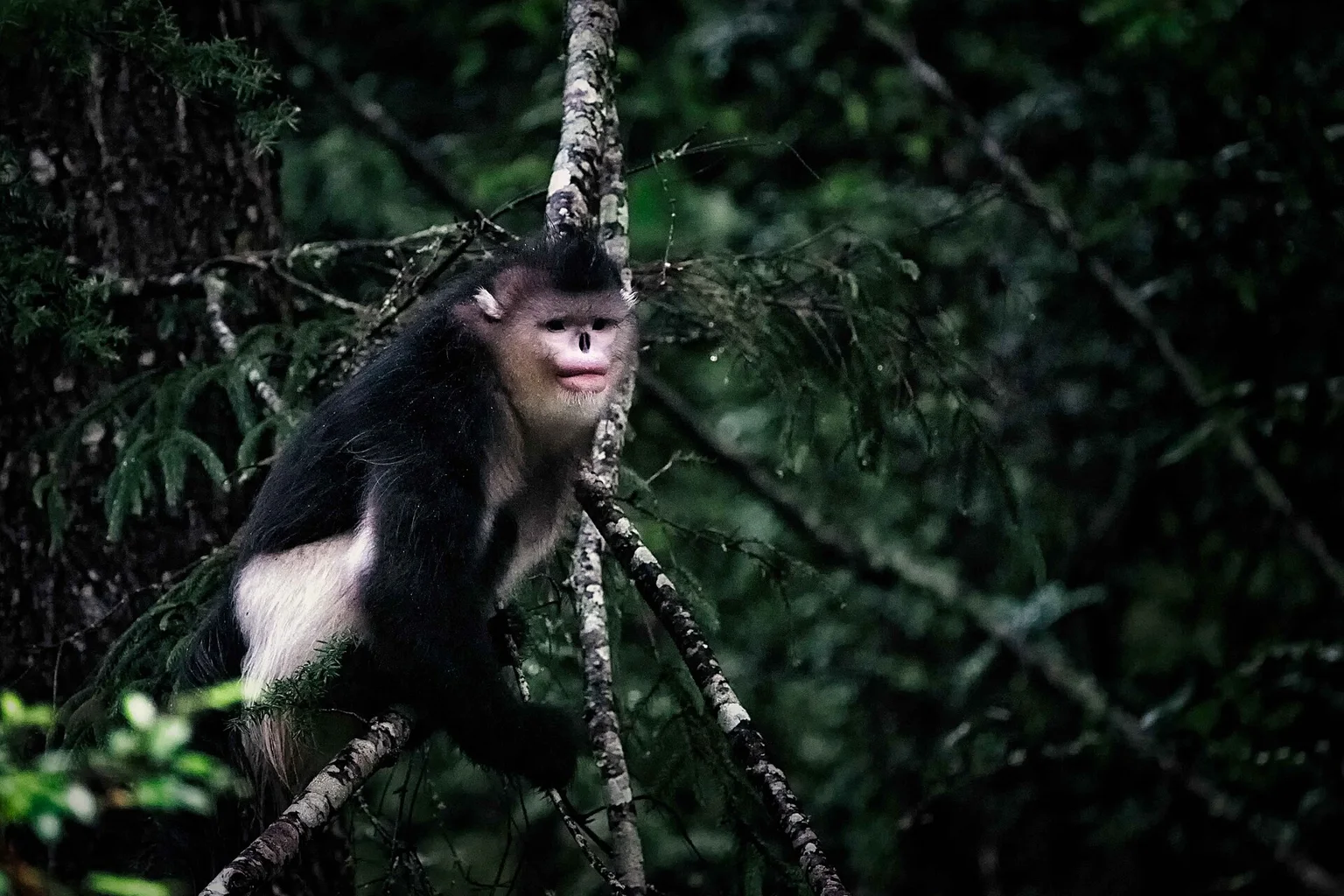
Some animals hide well. According to hunters in northern Myanmar, one monkey has a design flaw: its nose turns up so sharply that rainwater gets in, and the monkey sneezes.1
That monkey is Rhinopithecus strykeri, the Myanmar snub-nosed monkey. An international team of primatologists announced it as a new species in October 2010, in a study in the American Journal of Primatology.2 It was the first snub-nosed monkey reported in Myanmar.15 The discovery matters because the species was in trouble from the moment science learned it existed.1
Found through local hunters
The monkey turned up while researchers were looking for something else. Field biologists led by Ngwe Lwin of the Myanmar Biodiversity and Nature Conservation Association were working on a nationwide review of hoolock gibbons in early 2010. They had backing from Fauna & Flora International and the People Resources and Biodiversity Foundation.1
Local hunters had reported a monkey with prominent lips and wide, upturned nostrils. Follow-up surveys found a small population.1 The formal description rests on a skin and the skulls of four animals obtained from local hunters.2
Locally, the animal is called mey nwoah, meaning a monkey with an upturned face. Science named it after Jon Stryker, president and founder of the Arcus Foundation, which supported the project.1
What the monkey looks like
Thomas Geissmann, who led the scientific description, reported fur that is almost entirely blackish. The only white is on the ear tufts, the chin beard and the perineal area. The tail is about 140% of body size.1
Nobody had photographed a living one when the species was announced. The first pictures were an artist’s impression and a Photoshop reconstruction built from a Yunnan snub-nosed monkey and a carcass.35
The sneeze, according to locals
The rainy-day behavior comes from local people, not from scientists watching the animals. Locals say the monkeys are easy to find in wet weather because rain gets into their noses and sets off sneezing. They also say the monkeys spend rainy days sitting with their heads tucked between their knees.16
Hunters also say the monkeys spend May through October high up in mixed temperate forest. In winter, when snow makes food scarce, they come down closer to villages.1
Why nobody had described it before
Geography may have kept the secret. The Mekong and Salween rivers isolate this monkey from other snub-nosed monkeys, which live in China and Vietnam, and that may explain why it went unrecorded for so long.1
Frank Momberg of Fauna & Flora International, who interviewed hunters during the surveys, suggested at the time that the species was limited to the Maw River area.1 Later research confirmed it in Nujiang prefecture in China, in forest that connects with Myanmar’s.8
Rare from day one
The distribution area was believed to be roughly 270 square kilometers (about 104 square miles), with an approximate population of 260 to 330 animals. That original estimate was based largely on interviews with hunters rather than a field count. It led the International Union for Conservation of Nature to list the species as Critically Endangered.17
The pressure was already rising. The release said hunting was increasing because of logging roads built by Chinese companies moving into the once-isolated forest.1 At least 13 of the monkeys were hunted and killed in 2009, and the species is on CITES Appendix I.7
Fauna & Flora International promised quick action when the discovery was announced. “We are committed to taking immediate conservation action to safeguard the survival of this important new species,” chief executive Mark Rose said in the Wiley release.3
The group says it took conservation action after the discovery and now monitors the monkey with camera traps and intensive surveys.6 The good news here is not a population comeback. It is that a rare primate got a name and people watching out for it.
Did this make your day? Give it a cheer.
Sources
- Newly discovered snub-nosed monkey sneezes in the rain ScienceDaily (Wiley-Blackwell release), 2010-10-27
- A new species of snub-nosed monkey, genus Rhinopithecus Milne-Edwards, 1872 (Primates, Colobinae), from northern Kachin state, northeastern Myanmar American Journal of Primatology (Wiley Online Library), 2011-01-01
- New snub-nosed monkey discovered in Northern Myanmar EurekAlert! (Wiley release), 2010-10-26
- Snub-nosed monkey can't stop sneezing when it rains Christian Science Monitor, 2010-10-27
- Picture: new monkey discovered in Myanmar Mongabay, 2010-10-27
- Myanmar snub-nosed monkey Fauna & Flora
- Rhinopithecus strykeri Geissmann 2011 (Handbook of the Mammals of the World account) Zenodo
- Evolutionary History of the Odd-Nosed Monkeys and the Phylogenetic Position of the Newly Described Myanmar Snub-Nosed Monkey Rhinopithecus strykeri PLoS ONE (via PubMed Central), 2012-05-01