Octopuses Squeeze Through Tight Holes in 3 Steps, or 4 When It's Snug
A small study filmed common octopuses at Vienna's Haus des Meeres slipping through acrylic holes, a routine researchers hope could guide soft rescue robots.

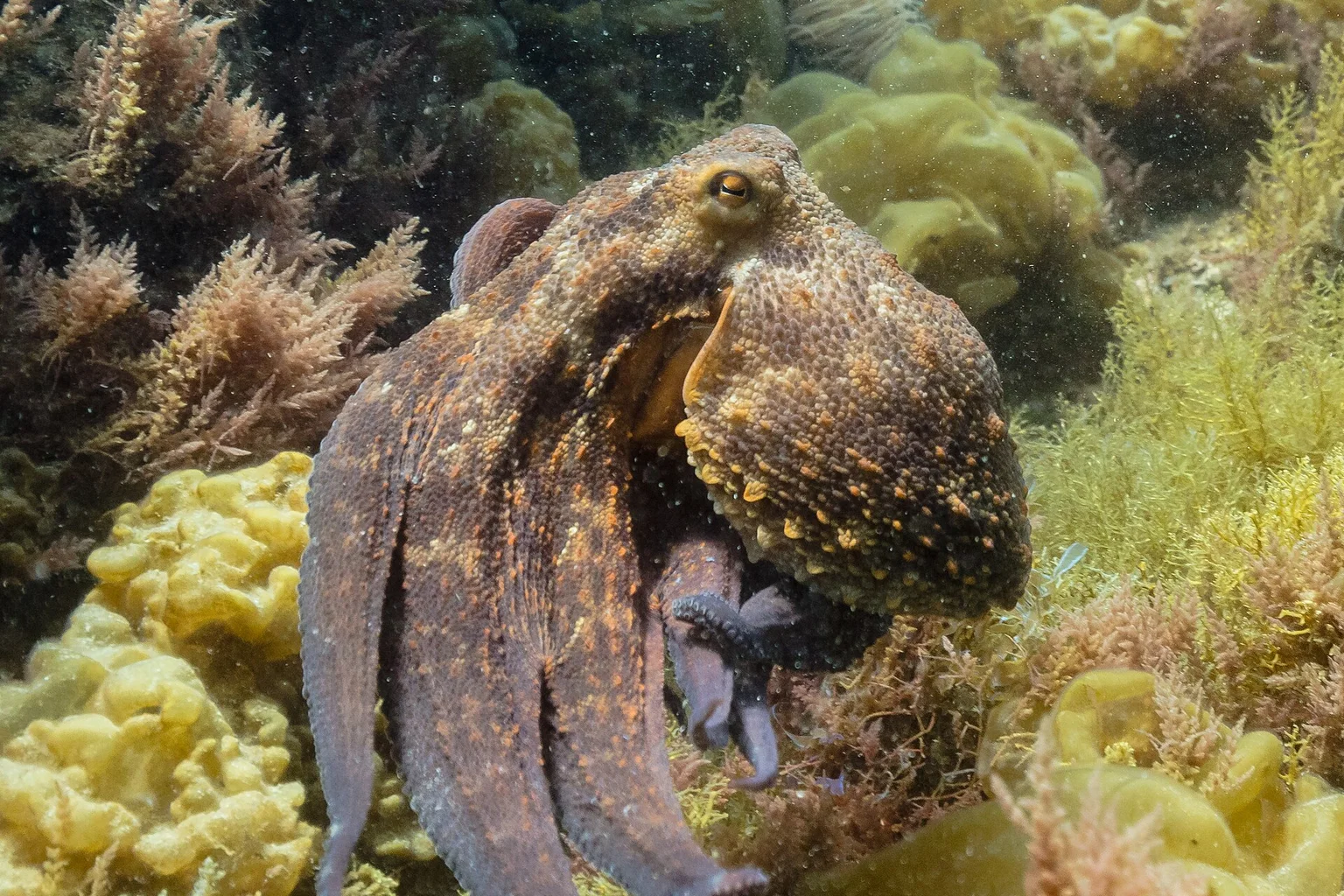
Common octopuses squeeze through small holes with a consistent three-step routine, and they add a fourth step when the opening is narrower than the distance between their eyes. That is the finding of a small study published Nov. 5 in the Journal of Experimental Biology. Researchers from Singapore, Italy and Austria filmed the animals at the Haus des Meeres aquarium in Vienna.1
An octopus pouring itself through a gap is one of the most famous things an animal can do, yet nobody had broken it down carefully. “It’s one of the most characteristic behaviors of octopuses in popular awareness, but the strategies octopuses use have not really been examined systematically,” Robyn Crook, an evolutionary biologist at San Francisco State University who was not involved in the work, told Science News.2 The authors also hope the moves could one day help engineers build soft robots that reach into tight spaces, though no such robot exists yet.1
Probe, shift, squeeze
The study, by Wenci Xin, Michael J. Kuba, Tamar Gutnick, Daniel Abed-Navandi and Cecilia Laschi, set up a clear acrylic partition with a hole in it. The octopuses’ route through it came in stages.1
- Probing: one arm goes through first.
- Shifting: three to five more arms follow.
- Squeezing: the arms already through push against the partition and haul the rest of the body over in one motion.
When the hole was tighter, the last step split in two. The octopus pulled its remaining arms through first, then brought its head and mantle (the baglike body) through in a separate move.12
The researchers used eye-to-eye distance as a stand-in for the size of the rigid cartilage capsule that protects an octopus’s brain, the one part of the animal that does not bend much. In the roomier setup, the hole was 20 millimeters across and the octopus’s eyes sat 15 to 20 millimeters apart. In the snug setup, the hole was 30 millimeters and the eyes were 30 to 35 millimeters apart.1
The animals also showed preferences. The second arm on the left did the probing in 47% of trials, and the first left arm in 28%. Four arms were shifted through most often, in 14 trials.1 The octopuses actively narrowed their mantles as they squeezed. The authors suggest the real bottleneck may be more than the hard beak, which is usually blamed. The combined thickness of the arms where they join the body may also matter.1
A very small sample
The study is a short communication, and its main comparison rests on three young common octopuses collected near La Ciotat, France. They made 33 recorded attempts. Each animal was tested with only one hole size: one with the roomier hole and two with the snug one. So the authors say they cannot yet tell whether the extra step comes from the hole size or from individual habit.1
One of the snug-hole octopuses took longer and longer as the trials went on, which the authors attribute to growth or flagging motivation.1 Four juvenile Mayan octopuses (Octopus maya) were tested only in an exploratory way. They made no attempt at the smaller holes. Only two were tested on a larger one, where the three-step routine appeared. The four-step version was seen only in common octopuses.12
The experiments ran in 2023 and 2024 as behavioral enrichment tasks under European Union rules. The authors say larger groups and several hole sizes per animal are needed.1
From aquarium to rescue robot
Today’s search-and-rescue robots built for tight spaces tend to be long and snakelike, a shape that limits how much they can sense and handle. Xin and colleagues describe the octopus routine as a biological blueprint for soft robots that could do better.12
“This incredible capability could enable robots to overcome environmental limitations and enter spaces that are difficult to reach,” Xin, a robotics researcher at the National University of Singapore, told Science News.2
Xin has called this an initial study. Open questions include whether squeezing can harm the animal and what sets the smallest gap an octopus can get through.4
Did this make your day? Give it a cheer.
Sources
- Overcoming environmental constraints: octopus uses 3-step or 4-step strategies to squeeze through small holes Journal of Experimental Biology (The Company of Biologists), 2026-11-05
- How octopuses squeeze through tiny openings, step by step Science News (Nora Bradford), 2026-11-05
- How octopuses squeeze through too-small gaps Phys.org, 2026-11-05
- Researchers discover the clever tactics octopuses use to fit through holes much smaller than their bodies Earth.com, 2026-11-03