Hawaiian Bird Almost Looks Like It’s Yelling at the Wood It Gouges
A new study of Hawaiʻi Island's rare ʻakiapōlāʻau finds that its two-tool bill gets help from its legs and even its ankles when it digs for insects.

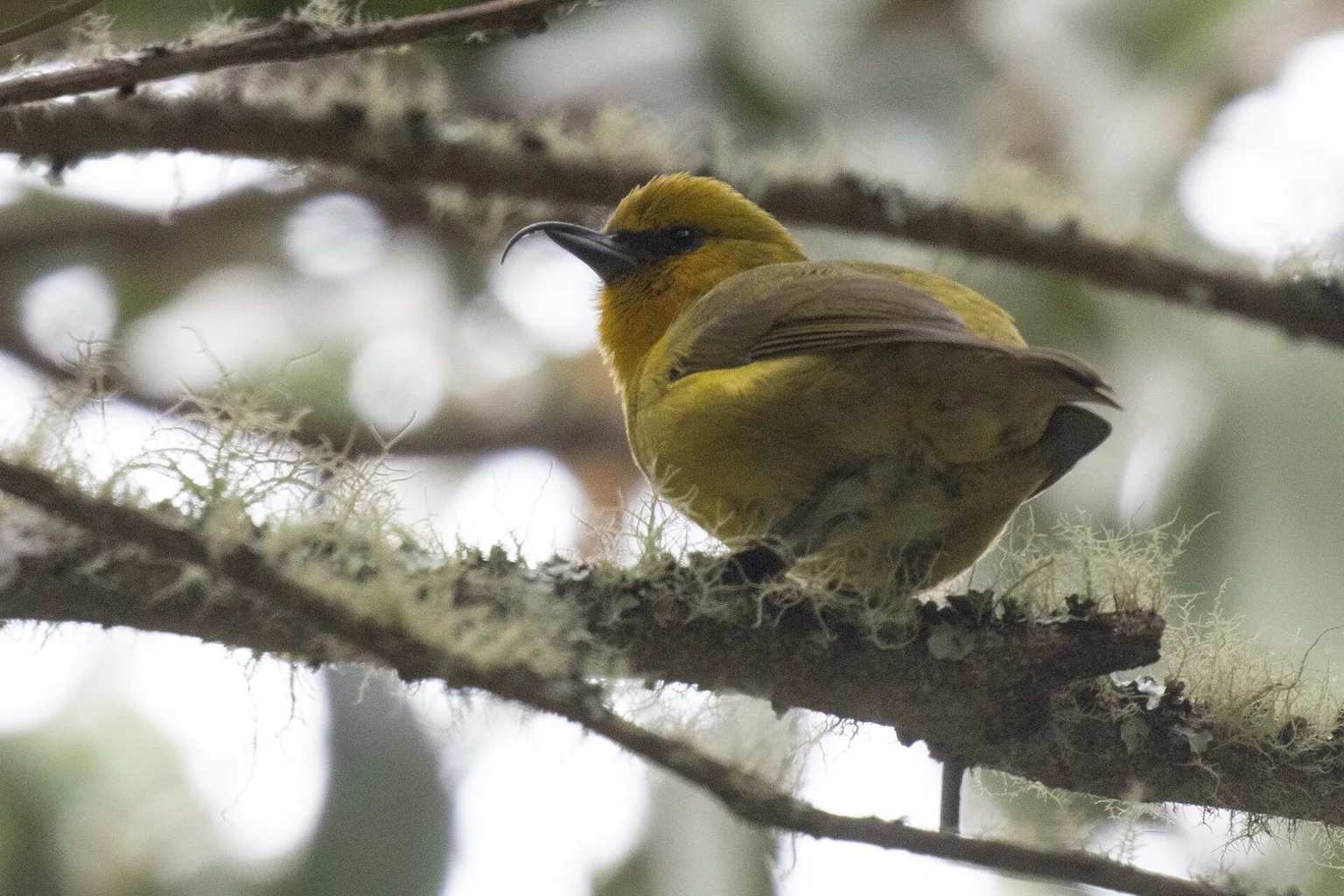
A study published in early November in the journal Ornithology looks closely at the skeleton and anatomy of the ʻakiapōlāʻau, a rare honeycreeper found only on Hawaiʻi Island. Researchers led by Alexander Clark found that the bird’s whole body, from its ankles up, is built to drill into tree branches for insects.15
The Hawaiian Islands have no woodpeckers. The ʻakiapōlāʻau has evolved its own way to get at the insects hiding inside wood, and it does so with a bill that is really two very different bills stuck together.1
The Field Museum, where Clark works, calls the work the most in-depth look yet at the bird’s anatomy. Its announcement nicknamed the bird a Swiss Army knife.1
Two bills, one bird
The lower half of the bill is short and stout, and the bird uses it to gouge wood. The upper half is long, thin and curved, and it is used to pull insects out.1 The Cornell Lab of Ornithology’s Birds of the World describes the top as curving down like a hook and the bottom as working like an awl, and notes that no other bird has, in a sense, evolved two bills in one.7
According to Reuters, the bird starts by tapping a branch, sometimes gently with its upper bill, to feel for hollow spaces. Then it switches tools, gouging the wood and probing for insect larvae.2
Part of the upper bill has no bone in it, so it can flex as the bird swings its head from side to side. The study also found that the bird has a proportionally short femur (the thigh bone), and that its legs are involved when it strikes the wood.23 In other words, it isn’t just pecking. It is putting its back into it, or at least its legs.
Clark described the effort to Reuters in a way that is hard to improve on.2
“With its mouth fully agape, it almost looks like the little bird is yelling at the wood it’s gouging,” Clark said.
Why a bird like this exists at all
Co-author Paul Banko, a former researcher at the US Geological Survey’s Pacific Island Ecosystems Research Center, says a bird this specialized points to a crowded neighborhood. “For a bird like the ‘akiapōlāʻau to evolve, there had to have been intense competition in the ecosystem,” he said in the Field Museum’s announcement.1
Clark spent 15 months in Hawaii studying native birds. His usual subject at the Field Museum is fossil birds, which do not demonstrate their feeding technique. With a living species, he says, researchers can actually watch strange adaptations at work instead of inferring them from bones.1
“It’s really cool to study this species while it’s still alive,” Clark said in the museum’s announcement.1
A rare bird with a narrow range
That “still alive” carries weight. The ʻakiapōlāʻau faces habitat loss, predators and avian malaria, and it typically raises only about one fledgling a year, which makes those threats harder to survive. A population that once lived on Maunakea has disappeared.36
Estimates of how many remain vary. The Field Museum’s release puts the wild population at fewer than 2,000 birds, all on the northeastern slope of one mountain on Hawaiʻi Island. IUCN figures cited by Hawaiʻi Public Radio in 2020 put the number of mature birds at about 800.46
The Field Museum says the findings highlight how unusual Hawaii’s ecology is, and how urgent it is to keep its native species from going extinct.1 For now, on one mountainside, a small bird is still tapping, listening and yelling at the wood.

Did this make your day? Give it a cheer.
Sources
- Swiss Army knife of the Hawaiian Islands—how an endangered bird drills into trees to find food Phys.org (provided by Field Museum), 2026-11-05
- How does this endangered Hawaiian bird scrounge its prey out of tree trunks? Reuters via CTV News, 2026-11-05
- Endangered Hawaiian bird uses beak and body to dig out its dinner Devdiscourse (Reuters copy), 2026-11-05
- Endangered Hawaiian Bird Uses Whole Body to Drill for Food Mirage News (Field Museum release copy), 2026-11-05
- Ornithology – Latest Articles (Clark et al., ukag060) Oxford Academic / American Ornithological Society, 2026
- Manu Minute: ʻAkiapōlāʻau, The Would-Be Woodpecker Hawaiʻi Public Radio, 2020-11-18
- Akiapolaau - Hemignathus wilsoni - Birds of the World Cornell Lab of Ornithology