An AI Beat 3 Former Drone Racing Champions Flying a Drone It Didn’t Even Build
TU Delft's MonoRace flies at about 100 km/h on a tiny onboard chip, a sign that smart robots may not need big, power-hungry computers.

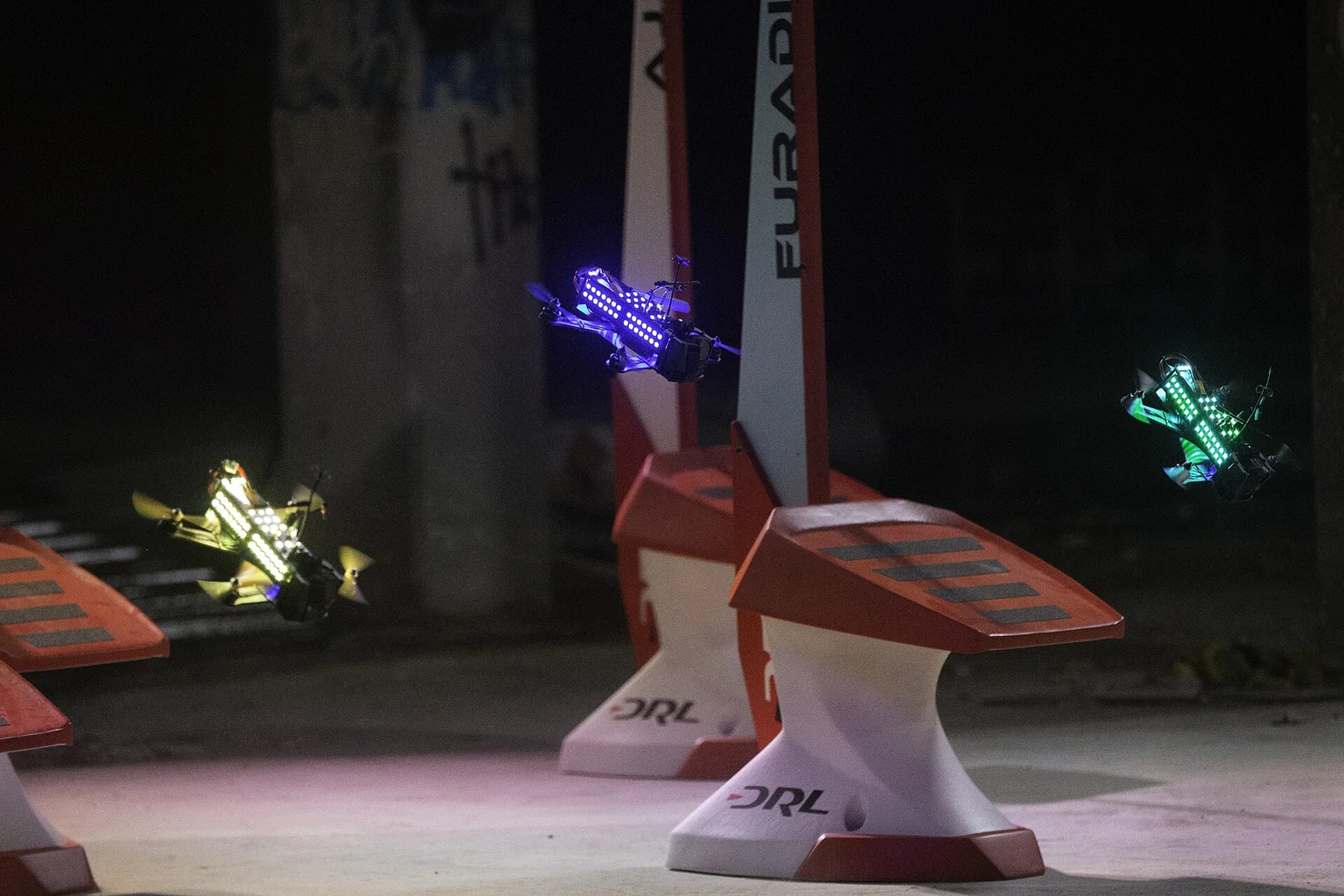
A racing drone that navigates with a single camera and a tiny onboard chip beat three former world-champion human pilots at a 2025 competition in Abu Dhabi. Researchers at the Micro Air Vehicles Lab of Delft University of Technology in the Netherlands explained how it works in a study published Oct. 14, 2026, in the journal Science Robotics.1
The win itself is fun. The more useful part is how little the drone needed. Its system, called MonoRace, uses no GPS and no external motion tracking. The team says the same approach could help other low-power robots do more with less.13
One camera, a lot of blur
MonoRace sees the course through one forward-facing camera. It also uses an inertial measurement unit, or IMU, a sensor that feels the drone’s acceleration and rotation.1
A neural network picks out the racing gates in each camera image. Meanwhile, the IMU and a computer model of the drone estimate where it is and how it’s moving.1
That is harder than it sounds at racing speed. “Flying at very high speed with only one camera is challenging because the images are blurry, deformed and the AI system has very little time to precisely determine where the drone is,” Stavrow Bahnam, the study’s main author, said in the university’s release.1
Learning to fly in a simulator
The part that actually flies the drone is a small neural network that sends commands straight to the motors, 500 times per second. It runs on the flight controller, a tiny microcontroller-class chip, not a big computer.13
“Instead of first planning a desired flight path and conventional commands, our neural network learns to directly control the motors,” study author Robin Ferede said in the release.1
The network was trained with reinforcement learning, a trial-and-error method where software is rewarded for doing better. That training happened in a stripped-down, fast physics simulator over millions of attempts, not on the real drone. “It actually learns to fly from scratch,” co-author Guido de Croon told Live Science.3
To keep the controller from depending on one perfect machine, the researchers kept changing the simulated drone’s weight, battery voltage, drag, sensor noise and propeller condition. The result is meant to work across different drones.3
The race in Abu Dhabi
The test came at the 2025 A2RL autonomous drone racing event in Abu Dhabi. The drone and the track were designed and run by the organizers, not by the Delft team.12
The Delft AI won the Grand Challenge against the other autonomous teams. It then won a knockout tournament against human pilots, beating three former world champions.2
Reported top speeds vary by source. TU Delft’s 2025 release said up to 95.8 km/h, its 2026 release says up to 100 km/h, and Live Science reports about 63 mph (102 km/h).123 Live Science also reports that the 966-gram drone flew two laps through 11 gates in 16.56 seconds.3
This was not the first time an AI beat human champions. The University of Zurich’s drone did it in 2023, in a flight lab the researchers controlled. TU Delft calls Abu Dhabi the first such win at an international competition, on hardware and a track it didn’t control.2 The university also describes MonoRace as the “world’s fastest autonomous racing drone,” its own description rather than an independent ranking.1
From race gates to vacuum cleaners
“Instead of giving the robot increasingly powerful sensors and computers, we wanted to find out how much intelligence we could extract from very limited resources,” Christophe De Wagter of TU Delft said in the release.1
The team says the method could be used for energy-efficient control of other machines, such as robot vacuums or ship-to-shore cranes. That is a wide range for a technique first tested chasing gates at highway speed.13
De Croon also suggested MonoRace could become a training tool for human pilots.3

Did this make your day? Give it a cheer.
Sources
- The science behind the world's fastest autonomous racing drone Delft University of Technology via EurekAlert!, 2026-10-14
- Autonomous drone from TU Delft defeats human champions in historic racing first TU Delft, 2025-04-15
- World's fastest AI-powered racing drone outflies the best human pilots Live Science, 2026-10-19
- AI drone outpaces former world champions using one camera and no GPS Tech Xplore (TU Delft release), 2026-10-14