Mars Soil Has a Best Candidate on Paper. On Paper Is Doing a Lot of Work
University of Sydney researchers modeled 2,000 Martian soil classes across almost 800 million locations, flagging clay-rich areas to study first for plant growth.

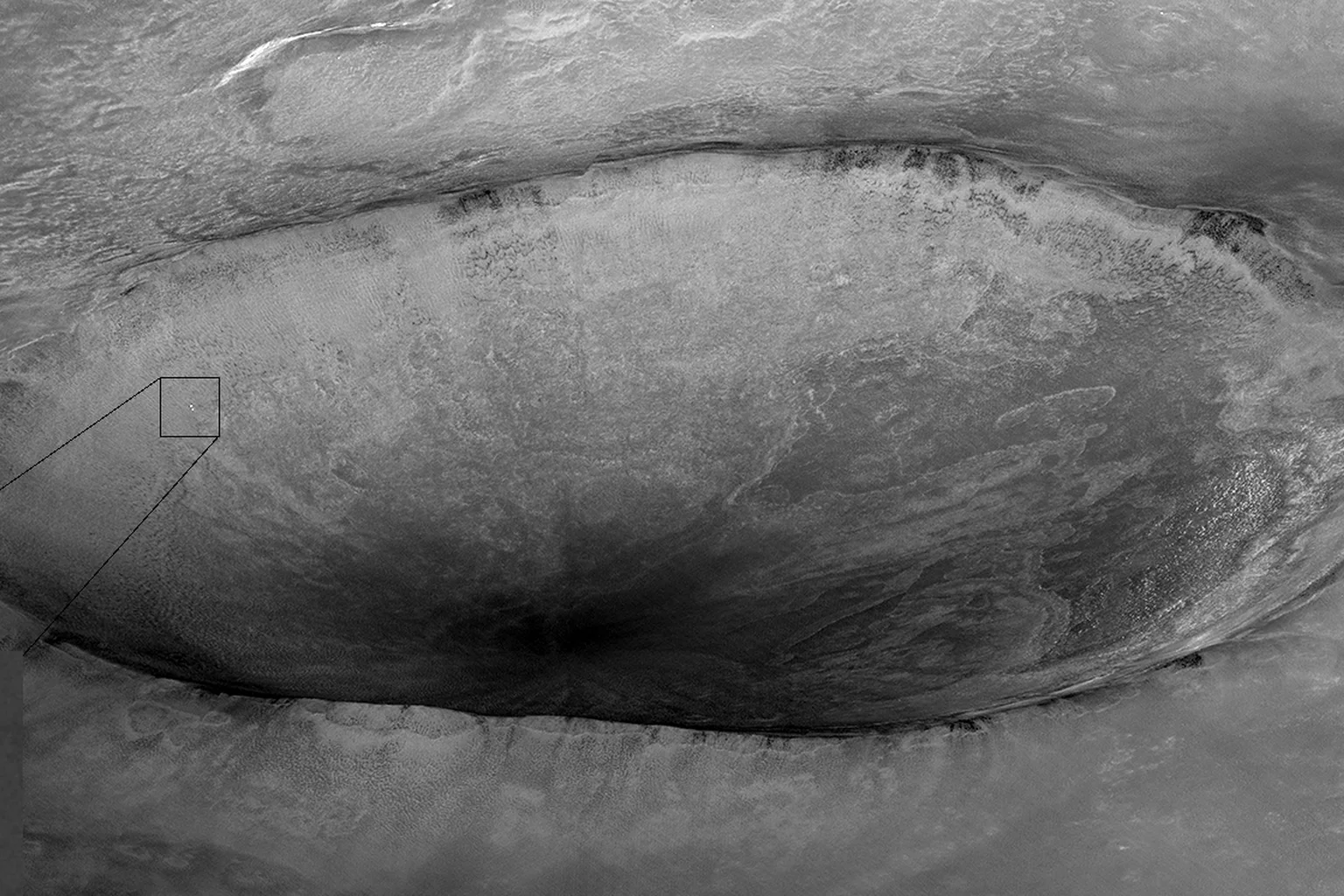
Researchers at the University of Sydney have sorted almost 800 million locations on Mars into 2,000 soil classes, and given those classes a name of their own: “areths,” from Ares, the Greek name for Mars.1
The university calls it the first comprehensive classification system and map of Martian soils. That claim comes from the team and its university.1
The goal is practical. A shared way to describe Martian soil lets scientists compare one place with another and pick out areas worth studying first, including for experiments on growing food.1
There is a big caveat. The soil classes are modeled from orbital observations and from soil relationships known on Earth, not measured on the ground, and the paper calls its system “provisional.”124
“This is the first time a classification system of this scale has been developed for Martian soils,” Daniel Irving, a PhD student at the Sydney Institute of Agriculture and the Faculty of Science, said in the university’s announcement. The university says Irving led the research. The paper, published in the soil science journal Catena, lists Professor Alex McBratney first among its authors, followed by Irving, Nicolas Francos and others.12
How the system sorts a planet
The system, formally the Provisional Polythetic Areth Classification System (PPACS), works like a family tree with three levels. At the top are 10 realms. Each realm splits into 10 assemblages, and each assemblage into 20 forms, for 2,000 forms in all.12
Classes are based on properties such as texture, mineral makeup, pH (how acidic or alkaline the soil is) and profile thickness, meaning how deep the soil layer goes. The map that goes with it covers 92% of the Martian surface.1
“Scientists have mapped Mars’ geology, mineralogy and chemistry before, but our system brings together multiple properties into a single framework, helping us understand how different Martian soils relate to one another and where they’re found,” Irving said in the announcement.1
Scoring the dirt for plants
As a test of what the system can do, the team scored all 2,000 classes on traits that matter for growing plants: water-holding capacity, pH, profile thickness, clay content and gravel content. The top scorer was a clay-rich class called Nohibareth, at 0.93 on a scale of zero to one.1
On paper, Nohibareth looks almost friendly. Its modeled average profile has a pH of 6.8, 72% clay, minimal sand or gravel, and a water-holding capacity of about 202 millimeters per meter of soil. It covers just 0.14% of the planet, mostly in the mid-latitudes around Tharsis, central Arabia Terra and Elysium Planitia.1
Elsewhere the scores were lower. Water-holding capacity was the limiting factor in 73% of the forms studied, and every class in the realms running from Fareth to Mareth scored below 0.3.1
Not a greenhouse address yet
The researchers are clear that the high scorers are candidates for closer study, not chosen greenhouse sites. They also say the results do not mean crops could be grown directly in Martian soil. Future habitats would need controlled environments, water, nutrients and treatment of harmful substances.15
The map also leaves some important things out: perchlorate toxicity, nitrogen availability and depth profiles. Because many inputs are inferred from orbital data and relationships observed on Earth, the classification will need revision as direct measurements improve.1
“A future greenhouse on Mars would need more than air, water and light. Its builders would also need to know what lies beneath to understand better starting points for growing plants,” McBratney said in the announcement.1
Next, the team wants to test Mars-like soil mixtures in controlled growing spaces on Earth. Later, rover measurements and samples from Mars could show whether the promising classes really sit where the models put them.1

Did this make your day? Give it a cheer.
Sources
- Sydney student creates first map of Martian soils - The University of Sydney University of Sydney, 2026-10-16
- Areths and the Provisional Polythetic Areth Classification System (PPACS): a hierarchical and nomenclatural framework for Martian soil classification CATENA (ScienceDirect), 2026-10-07
- First comprehensive Mars soil classification offers framework for exploration and future farming Phys.org, 2026-10-16
- Planetary Scientists Create Classification System and Map of Martian Soils Sci.News, 2026-10-19
- Study creates first comprehensive map of Martian soils Xinhua, 2026-10-17
- Scientists identify places where future astronauts could grow food on Mars Earth.com, 2026-10-26