NASA’s Perseverance Rover Breaks the Record for Driving on Another World
Built to drive 20 km on Mars, the rover has gone 45.22 km, mostly steering itself, and could reach about 100 km if nothing breaks.

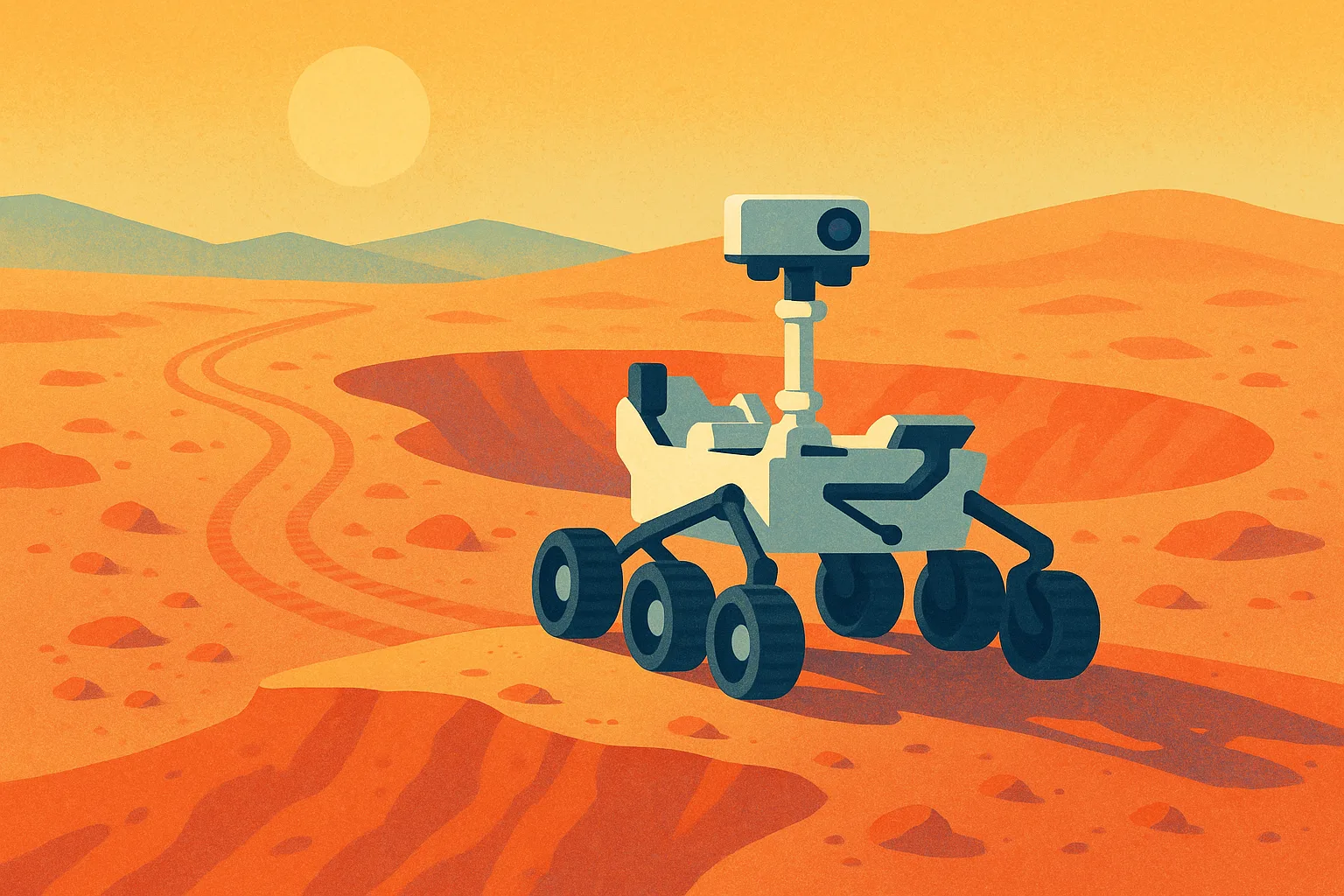
A robot on Mars has now driven farther than any vehicle has ever driven on another world. For most of the trip, nobody was holding the wheel. On Earth, that gets you pulled over. On Mars, it gets you a press release.
On Oct. 11, 2026, the odometer on NASA’s Perseverance rover reached 28.10 miles (45.22 km).1 That nudged it past the old record of 28.06 miles (45.16 km), held by NASA’s Opportunity rover, which explored Mars from 2004 to 2018.2
The winning margin is only about 60 meters, which is shorter than the very drive that broke the record. The real story is speed. Perseverance covered that distance in about five and a half years. Opportunity needed almost 15, which in rover terms is the scenic route.4
The record fell on the rover’s 2,006th sol (a sol is one Martian day), during a 299.6-foot (91.31 m) drive.1 That is a football field, minus roughly the width of a sandwich. Perseverance has been rolling around Mars since it landed in Jezero Crater on Feb. 18, 2021.7
Look, No Hands: How a Rover Drives Itself on Mars
Perseverance has driven more than 90% of its total distance on its own, using a self-driving system called AutoNav.3 Human planners on Earth pick waypoints, which are stops along the route. The rover handles everything in between, snapping pictures of the ground ahead and spotting hazards as it goes.5 (Parents of teenage drivers, please contain your envy.)
It does not lack for information. Every time Perseverance looks at the terrain, it processes 600,000 measurement points. Sojourner, NASA’s first Mars rover, used 20. That is roughly enough for one game of Twenty Questions.1
A recent software update made the rover even smarter about the road. It now rolls more and steers less, which saves wear on its parts and is frankly good advice for shopping carts, too. It can also check where it is against maps taken from orbit, right in the middle of a drive, like glancing at your phone at a stoplight, minus the stoplight.3
The team’s next fix is sun glare, a problem any driver heading west at sunset will recognize. Glare causes trouble for the rover’s cameras, and solving it would let Perseverance work longer days. Nobody has offered it a visor.3
“It is an honor to be working on Perseverance at a moment when the technology has evolved to the point that drives like these are routine,” said Steven Lee, project manager of the Curiosity and Perseverance rovers at NASA’s Jet Propulsion Laboratory, in NASA’s announcement.1 Translation: breaking an interplanetary record is now just part of the commute.
Built for 20 Kilometers, Now Eyeing 100
Nobody planned for this much driving. The original mission called for no more than 12.4 miles (20 km).1
“We’ve more than doubled that already … and we’re looking really good to go for up to 100 kilometers total,” rover driver Mark Maimone of NASA JPL told Space.com.6
That 100 km figure is a hope, not a promise, a distinction anyone who has owned a used car will respect. In December 2025, mission scientists said engineering tests had certified the motors that steer the rover’s wheels for at least another 60 km. They said Perseverance could reach about 100 km (62 miles) in total if nothing breaks.7
So far, so good. “We are very fortunate that all of Perseverance’s original capabilities are more or less intact, especially for the science instruments,” deputy project scientist Vivian Sun of NASA JPL told Space.com. She also gave the team some credit: “The magic sauce for our operations team is how cohesively we work together.”6 The recipe remains classified, presumably.
Perseverance had already lapped the Moon’s driving records. The Apollo 17 astronauts drove 35.7 km in 1972, and the Soviet Lunokhod 2 rover covered 39 km in 1973.4 Its sibling Curiosity, still working in Gale Crater, has driven roughly 38 km3 and is presumably being very gracious about all this at family dinners.
Next Stop: Rainbow Falls (Yes, on Mars)
The team plans to keep heading south along the rim of Jezero Crater, toward an area called Rainbow Falls. Scientists think it holds kaolinite, a clay mineral that forms when water interacts with rock.6 Other reports say the rover is currently crossing a region called Lac de Charmes on its way to a site named Idubi.4
Each new stop is another chance to learn about Mars’s watery past. With its wheels and science tools still in good shape, the record-holder has plenty of road ahead. Well, plenty of rocks. And still nobody holding the wheel.
Did this make your day? Give it a cheer.
Sources
- NASA's Perseverance Sets Off-World Record for Total Distance Driven NASA Science, 2026-10-12
- NASA's Perseverance Sets Off-World Record for Total Distance Driven NASA Jet Propulsion Laboratory, 2026-10-12
- NASA's Perseverance rover breaks record for off-world driving distance Engadget, 2026-10-13
- Perseverance Becomes Farthest-Traveling Vehicle on Another World Sci.News, 2026-10-13
- Perseverance overtakes Opportunity to become Mars' longest-driving rover NewsBytes, 2026-10-13
- NASA's Perseverance Mars rover breaks interplanetary driving record — and it's far from done Space.com, 2026-10-13
- NASA's Perseverance Mars rover could break the record for miles driven on another planet Space.com via Yahoo News, 2025-12-17