Japan Sent a 5-Ton Spacecraft to Fetch One-Third of an Ounce of Mars’ Moon Phobos
The MMX spacecraft is on its way to Mars. If the hard parts go to plan, it would make the first sample return from Mars or its moons, in 2031.

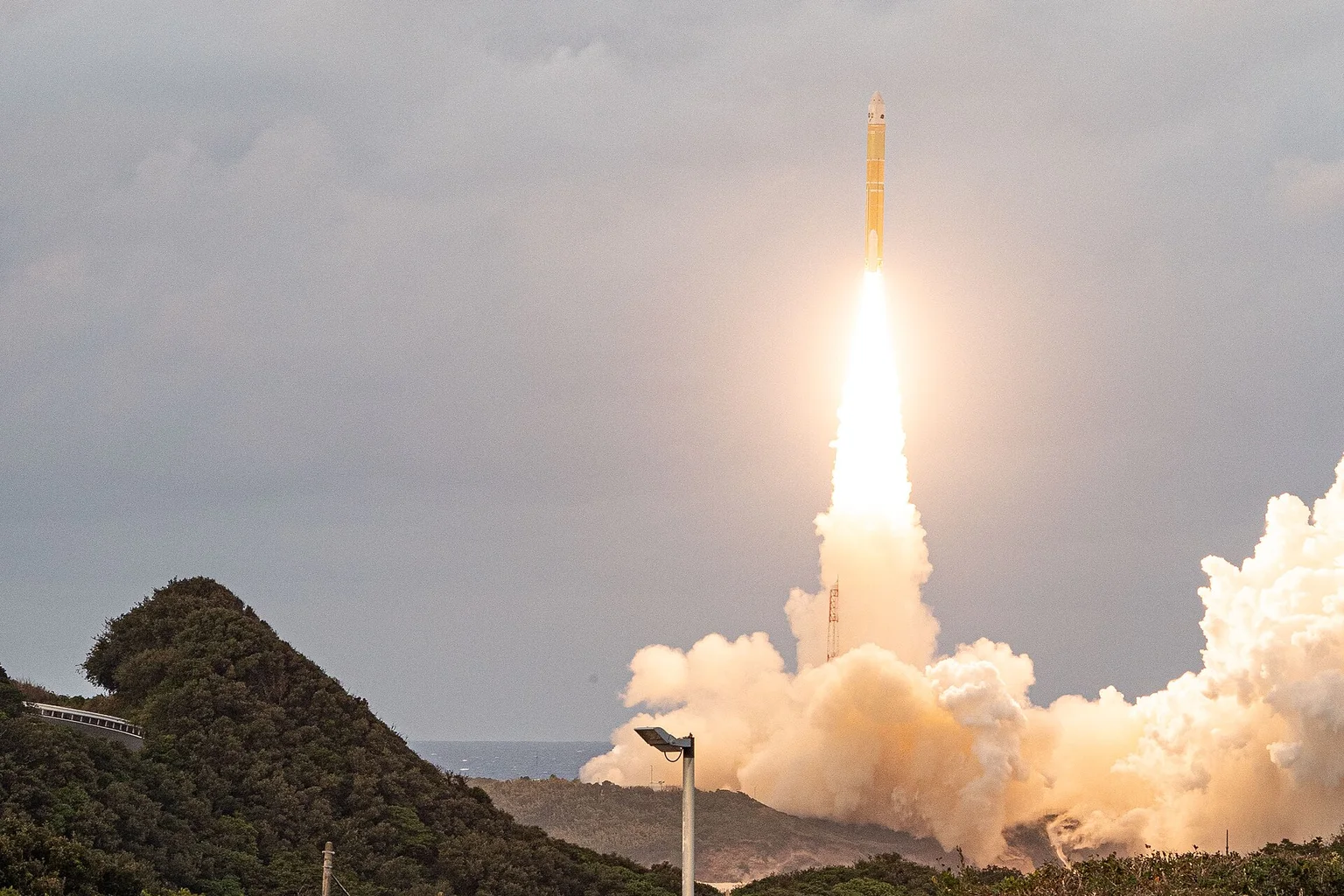
Japan’s space agency has launched a spacecraft to Mars with an unusually specific shopping list: at least 10 grams of a lumpy little moon called Phobos, carried back to Earth.
The Martian Moons eXploration mission, or MMX, lifted off on an H3 rocket from Tanegashima Space Center at 3:41 p.m. EDT on Monday, Oct. 19, 2026. In Japan it was 4:41 a.m. on Tuesday, Oct. 20.24 About 71 minutes after liftoff, the spacecraft separated from the rocket’s upper stage and headed for Mars.25
Only the launch has succeeded so far. The landing and the trip home are still ahead, and they carry real risk.1 If they work, MMX would be the first mission to land on either of Mars’ moons and the first to bring back samples from Mars or its moons.1
Why scientists want a piece of Phobos
Phobos is a potato-shaped rock about 14 miles (22 kilometers) across, the larger and closer of Mars’ two moons. Its sibling is Deimos.1
Nobody is sure where the two came from. One idea is that they formed from debris after something huge slammed into Mars. Another is that they are asteroids Mars captured. Rock from Phobos should help answer the question.12
“It is a once-in-a-lifetime chance. We are part of the first sample return mission from the Martian system,” Markus Grebenstein, rover chief at the German Space Agency, told the Associated Press.1
A slow rover and a quick grab
The roughly 5-ton spacecraft should reach Mars in August 2027 after about 10 months of travel, then settle into a special orbit that keeps it close to Phobos.16
First down will be Idefix, a French-German rover no bigger than a microwave oven. Phobos has so little gravity that the rover is expected to bounce for several minutes before it comes to rest.1
Idefix will then spend about 100 days scouting for safe landing spots at about 1 millimeter per second. It also cannot flip itself back over once its solar panels are out, according to AP, so careful driving is not optional.1
Later, the main lander will touch down for about two hours, drilling and vacuuming up at least 10 grams of material, about one-third of an ounce.1 NASA supplied the air-powered sampler, built by Honeybee Robotics, along with a spectrometer from Johns Hopkins APL and Deep Space Network support. At least 15% of the sample is set aside for NASA scientists.2
After that, the spacecraft will study Deimos during flybys and leave for Earth in 2030. The samples are due to land in the Australian desert in 2031.12
Five agencies and a track record
JAXA leads the five-year mission, working with NASA, France’s CNES, Germany’s DLR and the European Space Agency.1 AP reports a total budget of $578 million: $350 million from Japan, $87 million from NASA, about $68 million from CNES, about $56 million from DLR and about $17 million from ESA.1 Space.com also reports NASA’s share at about $87 million.2
Japan has done this kind of thing before. Its Hayabusa mission returned less than a gram from the asteroid Itokawa, and Hayabusa2 brought back 5.4 grams from another asteroid.16 By those standards, 10 grams is a haul.
Phobos has been a hard target. Russia’s Phobos-Grunt launched in November 2011 but never left Earth orbit, and it crashed in January 2012. AP notes that all three of Russia’s Phobos attempts failed.12
MMX may have company by the end. China plans to launch its own Mars sample-return mission in 2028 and is also aiming for a 2031 return. NASA is still debating how to bring home the rock samples its Perseverance rover has collected.1
For now, the mood is simple. “There’s a lot of adrenaline and a lot of excitement and a lot of wow,” NASA astrophysicist Tom Statler told AP.1
Did this make your day? Give it a cheer.
Sources
- Japan launches spacecraft to Mars' moon in mission to bring back soil samples PBS NewsHour (Associated Press, Marcia Dunn), 2026-10-19
- Japan launches historic MMX sample-return mission to Mars' moon Phobos (video) Space.com, 2026-10-19
- Martian Moons eXploration - JAXA (official MMX site) JAXA, 2026-10-19
- Mars' two tiny moons shouldn't exist. A new mission has launched to reveal their secrets CNN, 2026-10-19
- Japan's MMX Spacecraft Begins Its Journey to Fetch Rocks from Mars' Moon Phobos TechEBlog, 2026-10-20
- Japanese MMX mission set for launch to study Martian moons NASASpaceFlight.com, 2026-10-19