Brittle Star Fossil Gets a Heavy Metal Name. The Mud Is Probably Related.
A new brittle star species, found as tiny plates beside a 9.5-million-year-old whale in Denmark, may be the first fossil sign of the animals at a whale fall.

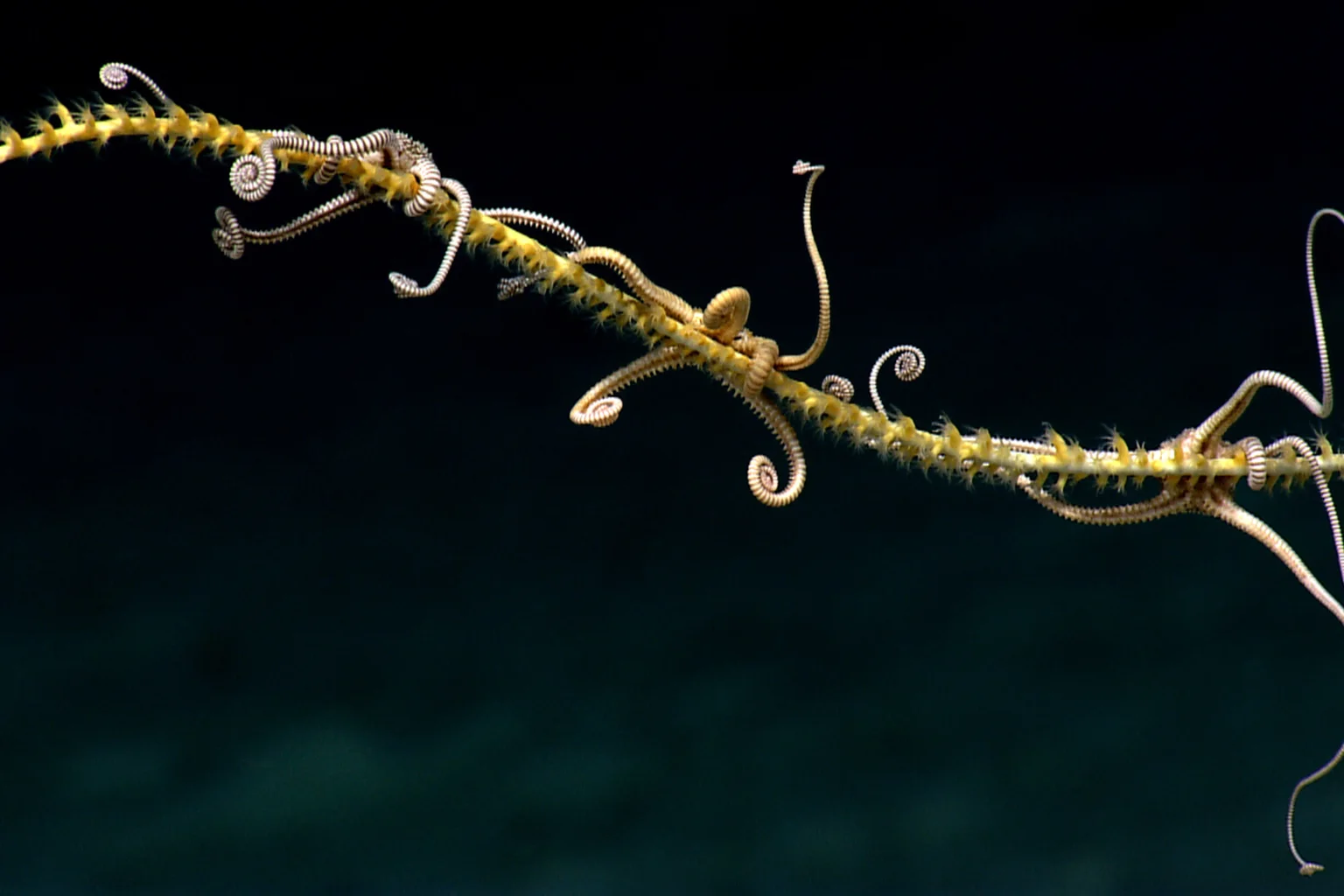
Scientists have described a new species of brittle star, Ophiura huebnerjenseni, from tiny fossil plates found in clay beside a 9.5-million-year-old beaked whale carcass at the Gram Clay Pit in southern Denmark. The study was published on Oct. 19. The authors suggest it is the first fossil record of brittle stars at a whale fall. That claim comes from the research team, and we found no independent confirmation of it.1
To be clear about who is new here: it’s the brittle star, not the whale. The whale is the setting. A whale fall is what happens when a dead whale sinks to the seafloor and becomes a feast for whatever lives nearby. Brittle stars are common around whale falls in today’s oceans, but that connection had been missing from the fossil record. This find suggests it already existed in the Late Miocene.1
Treasure in the leftover dirt
The whale itself came out of the ground years ago. In 2018, excavators recovered its lower jaw and four vertebrae from the Gram clay pit, which was once part of the North Sea.2 The brittle star was only identified now, from the sediment collected around those bones.2
The researchers washed and sieved that sediment, picked out microfossils under a microscope and examined selected pieces with a scanning electron microscope, which uses a beam of electrons to show very fine surface detail.1 Gram is famous for several fossil whale skeletons and the largest megalodon vertebrae ever found. Until this study, nobody had detected a single brittle star there.1 It took a site known for giants to produce a species identified from crumbs.
The team came from Museum Sønderjylland (the Museum of Southern Jutland), Luxembourg’s national natural history museum and the Dinosaurierpark Teufelsschlucht in Germany.1
Why the scientists think they were at the carcass
The link between the brittle stars and the whale is an inference. Only three samples taken directly beside the bones contained brittle star remains. Samples from the same layer farther from the skeleton, and other comparison samples, had none.1
That raised an obvious question, as lead author Ben Thuy of the Musée national d’histoire naturelle Luxembourg explained in the museum’s announcement:
“We considered whether currents had simply concentrated the plates around the bones, or whether local chemical conditions had helped preserve them.”
The clue was sea urchin fragments of similar size and mineral makeup, which turned up in every sample. If currents or preservation alone were responsible, the urchin bits should have behaved the same way. Thuy said this “makes a preservation-only explanation less likely and supports the interpretation that the brittle stars lived on or close to the whale carcass.”1
The fossils do not reveal what the brittle stars ate, or whether they depended only on whale falls. The researchers favor the idea of a generalist species that normally lived on the surrounding seabed and gathered at the carcass.1
The setting matters, too. Deep-sea whale falls can go through later stages where communities run on sulfide chemistry, but the team found no sign of that here. “We interpret the site as a shallow-water whale fall at a stage when enrichment from the carcass supported opportunistic animals,” Mette Elstrup of the Museum of Southern Jutland said in the announcement.1
The mud connection
The species name honors Holger Hübner and Thomas Jensen, founders of the Wacken Open Air heavy metal festival in Germany. The festival’s dark gray mud probably comes from the same geological deposits as the fossil.12
Lea Numberger-Thuy of Dinosaurierpark Teufelsschlucht put it this way in the announcement: “The clay that accumulated on the bottom of the ancient North Sea not only preserved the remains of a 9.5-million-years old brittle star, it also turns Wacken Open Air into the muddy battlefield renowned by metalheads worldwide.”1
So the same ancient seabed that quietly kept a record of a whale’s last party now ruins a great many festival boots each summer.
Did this make your day? Give it a cheer.
Sources
- Tiny fossils show brittle stars gathered around a dead whale 9.5 million years ago EurekAlert! (release from Museum Sønderjylland), 2026-11-03
- A New Species Emerges From a 9.5 Million-Year-Old Whale Carcass Nautilus, 2026-11-09
- Newly Discovered Brittle Star Species Found Beside a 9.5-Million-Year-Old Whale Fall Discover Magazine
- Tiny fossils show brittle stars gathered around a dead whale 9.5 million years ago Phys.org, 2026-11-03