He Mapped Every Kind of Dirt on Mars. One Spot Looks Almost Friendly.
Our 8-minute film: a Sydney PhD student sorted 800 million spots on Mars into 2,000 kinds of soil, and told us what surprised him.

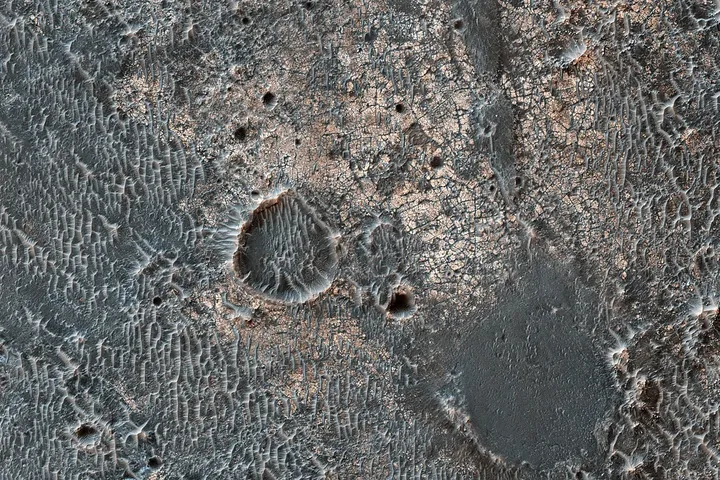
Mars is the most studied planet we've never stood on. Orbiters have photographed almost every square mile of it, and scientists have mapped its mountains, canyons, minerals and chemistry. Until this year, nobody had put its soil on one map.
Daniel Irving, a PhD student at the University of Sydney's Sydney Institute of Agriculture, asked a soil scientist's question about a planet. With a team that includes Professor Alex McBratney, he modeled four properties (texture, mineral makeup, pH and profile thickness) for almost 800 million locations covering 92% of the Martian surface, then sorted them into 10 realms, 100 assemblages and 2,000 forms. The university calls it the first comprehensive classification system and map of Martian soils. The work was published in the journal Catena.
Every soil got a name of its own: an areth, from Ares, the Greek name for Mars. The names are built so that neighbors sound alike, which is why Nohibareth and Mohibareth, one letter apart, are extremely similar soils. Irving told Hooray News he was surprised by how similar the northern plains and southern highlands are, even though they differ in height by about a Mount Everest. One reason he offered: Martian dust storms help homogenize the surface material.
When the team scored all 2,000 soils for growing plants, a clay-rich class called Nohibareth came out on top, at 0.93 on a scale of zero to one. It covers just 0.14% of Mars. The researchers are clear that this is a starting point, not a farm: the map is modeled from orbit, it doesn't yet include toxic perchlorates, nitrogen or deeper layers, and crops could not be grown directly in this soil.
Next, Irving told us, the team is comparing the Mars soils with soils on Earth to find the closest matches. And if a rover could bring back one scoop, he would pick the realm Bareth, which the models predict is unlike any other soil on Mars, with about 72% clay.
Our film tells the story in under eight minutes, with Irving's own words, his maps and NASA footage of the planet. Read our earlier coverage of the map and our interview with Daniel Irving.
Did this make your day? Give it a cheer.
Sources
- Interview with Daniel Irving Hooray News, 2026-11-03
- Sydney student creates first map of Martian soils The University of Sydney, 2026-10-16
- Sydney student creates first map of Martian soils (with journal and DOI) EurekAlert / University of Sydney, 2026-10-16