Your Cat’s Whereabouts Tracked Energy More Than Your Years Together, a Small Study Found
Kyoto researchers put Bluetooth beacons on 29 cats for a month. Owners whose cats stayed close reported more vigor, though the study can't show cause.

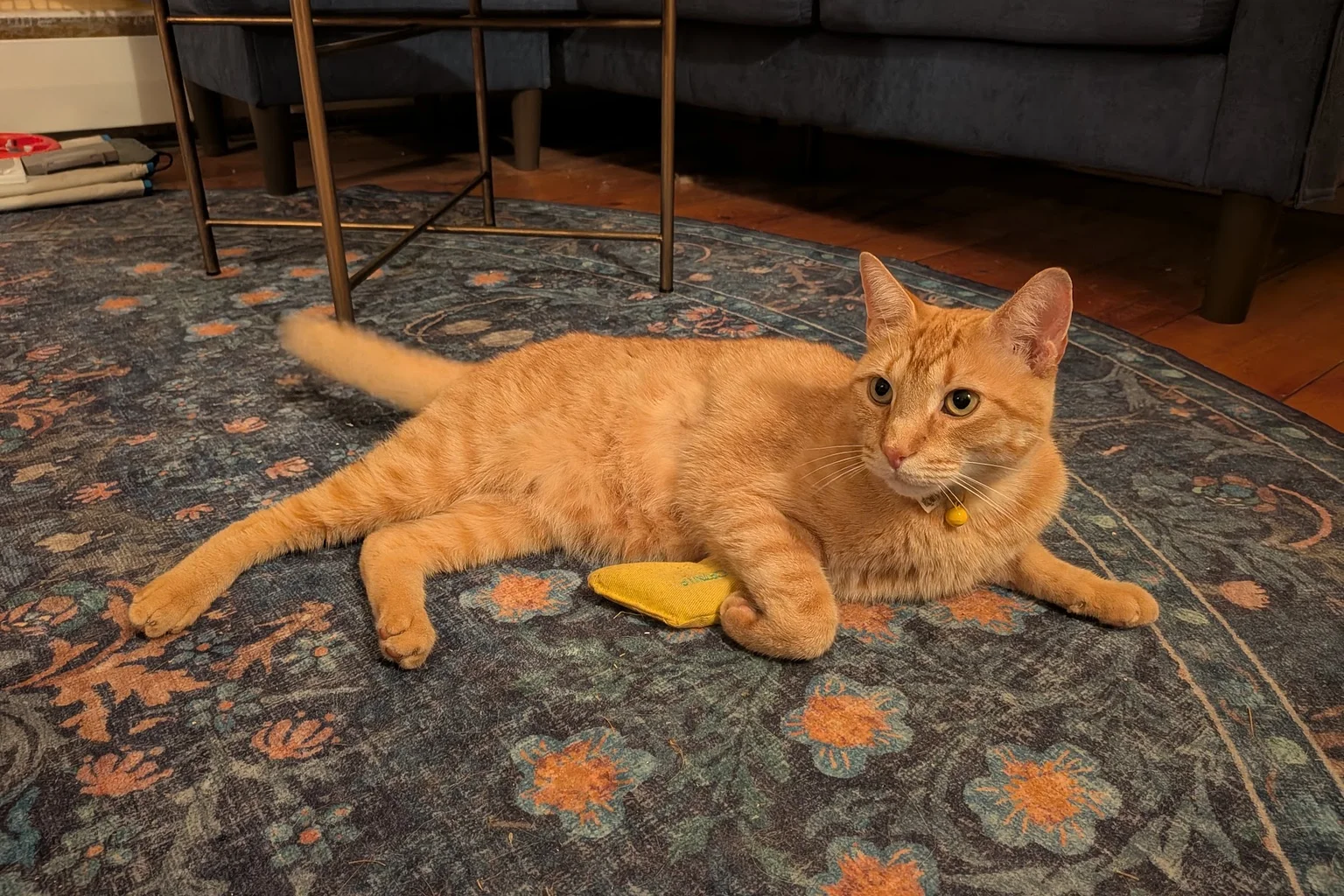
Cat owners who spent more time physically close to their cats tended to report more energy, according to a one-month study of 29 cats and their 19 owners by researchers at Kyoto University.1 How long people had owned their cats made no difference.1
The study is small and observational. It shows that closeness and mood went together, not that one caused the other. The researchers say so themselves.1 Still, it hints that the everyday company of a cat may be linked to how its person feels, and that kind of company costs nothing.
How do you measure a cat’s closeness?
With a small Bluetooth beacon on its collar. The team fitted the cats with these devices to estimate each day how near they stayed to their owners. They also tested urine from cats and owners for hormones, had owners fill out mood questionnaires, and watched how the cats behaved toward their owners and toward strangers.1 Participants were recruited through flyers and social media.3
The beacons read signal strength, so they recorded how near the pair were, not how many minutes they spent together or what they were doing. A sleeping cat and a cat being stroked could send similar signals, which means the data can’t tell a nap from a belly rub.36
What the researchers found
The university’s announcement describes the link as one with positive mood. Press coverage of the study specifies that closeness was tied to higher scores for vigor and energy, not to every positive-mood measure.346 An early hint that longer ownership went with more negative mood disappeared once the researchers accounted for owners who had several cats.46
The hormone results centered on oxytocin, a body chemical associated with bonding. Cats’ and owners’ oxytocin levels were positively correlated, and higher oxytocin in cats was linked to lower levels of the stress hormone cortisol and fewer negative feelings in their owners.13 According to the researchers, no earlier study had measured oxytocin in both cats and their owners.3
That comparison rests on even fewer animals: 24 cats whose urine could be collected and their 17 owners.3 Because some owners had more than one cat, the data were also grouped by household. In that analysis, only the links between cat oxytocin and owner confusion and anxiety held up statistically. Cat and owner urine were collected at different times, which may have hidden a cortisol link.
The authors call the findings preliminary evidence.4 The paper, by Saho Takagi, Taisuke Tsubomura, Miho Nagasawa and Takefumi Kikusui, appeared in the journal iScience on Oct. 13, 2026.2
Why it might happen
Takagi, the corresponding author, started from a feeling plenty of people will recognize.
“I think many cat owners are familiar with the sense of comfort and peace they feel when their cat climbs onto their lap seeking affection, they start to pet it, and the cat begins purring contentedly,” Takagi said in the university’s announcement.1
Takagi offered petting as one possible explanation, not a finding. “I think this may be because oxytocin rises in both the owner and the cat through the petting-and-being-petted interaction, and that this interaction helps to form their bond,” Takagi told ScienceAlert.3 How the associations actually arise is still unclear.3
What cat owners can take from it
- Nearness, not history, tracked mood. In this study, years of living together didn’t predict owners’ energy scores. Overall closeness did.16
- The kind of closeness is an open question. Takagi suggested time close together, plausibly reflecting petting, play or other engagement, may be associated with more immediate positive feelings, but the beacons couldn’t tell those activities apart.46
- It’s a link, not a prescription. The researchers say the findings show associations only, so whether closeness actually lifts mood is unclear.1
Next, the team plans to explore how cats and humans influence each other through everyday interactions.1

Did this make your day? Give it a cheer.
Sources
- Owners who spend more time close to their cats tend to have more positive moods Kyoto University, 2026-10-16
- Owners who spend more time close to their cats tend to have more positive moods EurekAlert! (Kyoto University release), 2026-10-16
- Cats And Their Owners Seem to Share A Weird, Hormonal Connection ScienceAlert, 2026-10-20
- Cat Hormones and Owner Moods Appear to Move Together: Study Sci.News, 2026-10-19
- Cat happiness chemically linked to happiness of its owner, new study shows AOL (The Independent), 2026-10-22
- Time spent close to a cat tracked positive mood, not the years of ownership, in a one month Kyoto University study... ScienceBlog.com, 2026-10-24