Dolly Parton’s Worm Was Not Quite a Coat of Many Colors. It Was Purple.
London museum scientists named a 14 mm worm from 1,020 meters down in Antarctica's Amundsen Sea after Dolly Parton, and DNA hints it ranges far across the Southern Ocean.

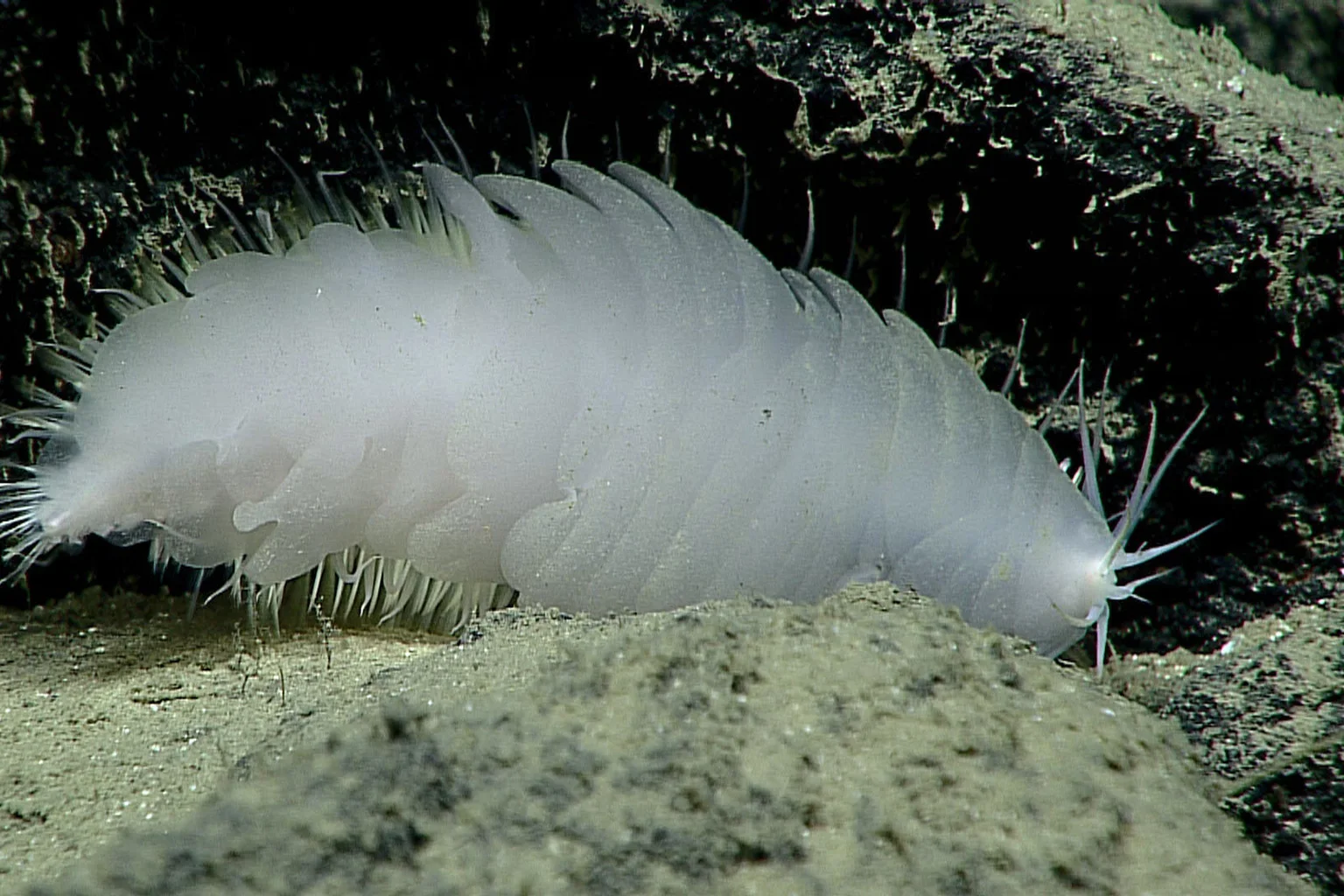
Scientists at the Natural History Museum in London and the University of Gothenburg have named a new deep-sea worm from Antarctica’s Amundsen Sea after Dolly Parton. The 14-millimeter worm, Bathyadmetella dollypartonae, was collected in 2008 and formally described in the journal Taxonomy on Nov. 17, 2026.1
The tribute came after Parton’s death. She died on Aug. 25, 2026, at age 80.4 The paper says news of her passing arrived while the researchers were examining the worm, and that the name honors her as a musician, author and humanitarian.1
The resemblance is in the head. The worm has long, flat, see-through, strap-like sheaths on its antennae and tentacles, edged with ruffles and tiny bumps. The authors compared them to Parton’s famous blond hair.1
“News of Parton’s passing reached us while we were describing this species, and, while it may not have the flaming locks of auburn hair she once sang about, its long appendages reminded us of her flowing blond locks,” lead author Lenka Neal said in the museum’s announcement.2
A small worm with big eyes
The worm belongs to the family Polynoidae, within the annelids. The main specimen is 14 millimeters long (about half an inch) and 4.5 millimeters wide, with 39 segments. Its body is soft and jellylike, and it turns pale to nearly transparent when preserved in alcohol.1 The authors note it may not be fully grown.
It also has very large, crescent-shaped, dark red eyes, plus 12 fleshy lobes arranged like a rosette around its mouth.1 That is a lot of styling for something living a kilometer down in the dark.
In alcohol it may be pale, but it did not start that way. “It didn’t quite have a coat of many colors, but, according to the notes from the original expedition, Bathyadmetella dollypartonae was purple when it was collected,” Helena Wiklund, of the Natural History Museum and the University of Gothenburg, said in the announcement.2
From a 2008 expedition to a 2026 name
The worms came from the BIOPEARL II expedition, which visited the previously unsampled Amundsen Sea off West Antarctica in the 2007/2008 southern summer. The voyage, organized by the British Antarctic Survey aboard the research ship RRS James Clark Ross, hauled them up from about 1,020 meters (roughly 3,350 feet) using an epibenthic sledge, a sampling device towed along the seafloor.1 The two specimens are now kept at the Natural History Museum in London.1
The long wait between collection and naming is not unusual. The authors point to it as an example of the “taxonomic impediment,” the backlog that builds when there are far more unknown species than time and experts to formally describe them.2
For this particular group, the backlog is impressive. The genus Bathyadmetella was created nearly 60 years ago, and until now it held exactly one species: B. commando, described in 1967 from a single Pacific specimen.1 Going from one to two species in six decades counts as a growth spurt.
What the DNA adds
The paper includes the first published DNA sequences for the genus. Those sequences support Bathyadmetella as separate from a closely related genus, Admetella. They also give the first genetic evidence that the wider subfamily the two belong to is one family branch with a single common origin.1
DNA also turned up the species near the East Scotia Ridge, at a site about 1,500 meters deep and roughly 4,000 kilometers (about 2,500 miles) from where the main specimen was found. That suggests the worm may live widely across the Southern Ocean. The authors note this second record rests only on DNA from a damaged body fragment.1
The authors say documenting life in the Amundsen Sea is critical because the region is warming quickly and its glaciers are melting as the climate changes.1 Knowing what lives there now gives scientists a baseline for whatever changes come next.
Did this make your day? Give it a cheer.
Sources
- Dazzling in the Deep—Bathyadmetella dollypartonae sp. nov. (Annelida, Polynoidae) with Emendation of the Genus and Its Phylogenetic Placement Taxonomy (MDPI), 2026-11-17
- Dolly Parton gets a deep-sea namesake: Bathyadmetella dollypartonae (Natural History Museum release) Phys.org (provided by Natural History Museum), 2026-11-27
- Dolly Parton, one of country music's most singular performers, has died at age 80 NPR, 2026-08-25
- Dolly Parton, One of Country Music's Biggest & Brightest Icons, Dies at 80 Billboard, 2026-08-25
- World Polychaeta Database - Bathyadmetella dollypartonae Neal & Wiklund, 2026 World Register of Marine Species / World Polychaeta Database, 2026-11-19