Grasshoppers That May Have Walked on Water Were Probably Vegetarians
Fossils in Myanmar amber suggest a newly named grasshopper family could skate on lakes, making it at least the third insect group to evolve the trick.

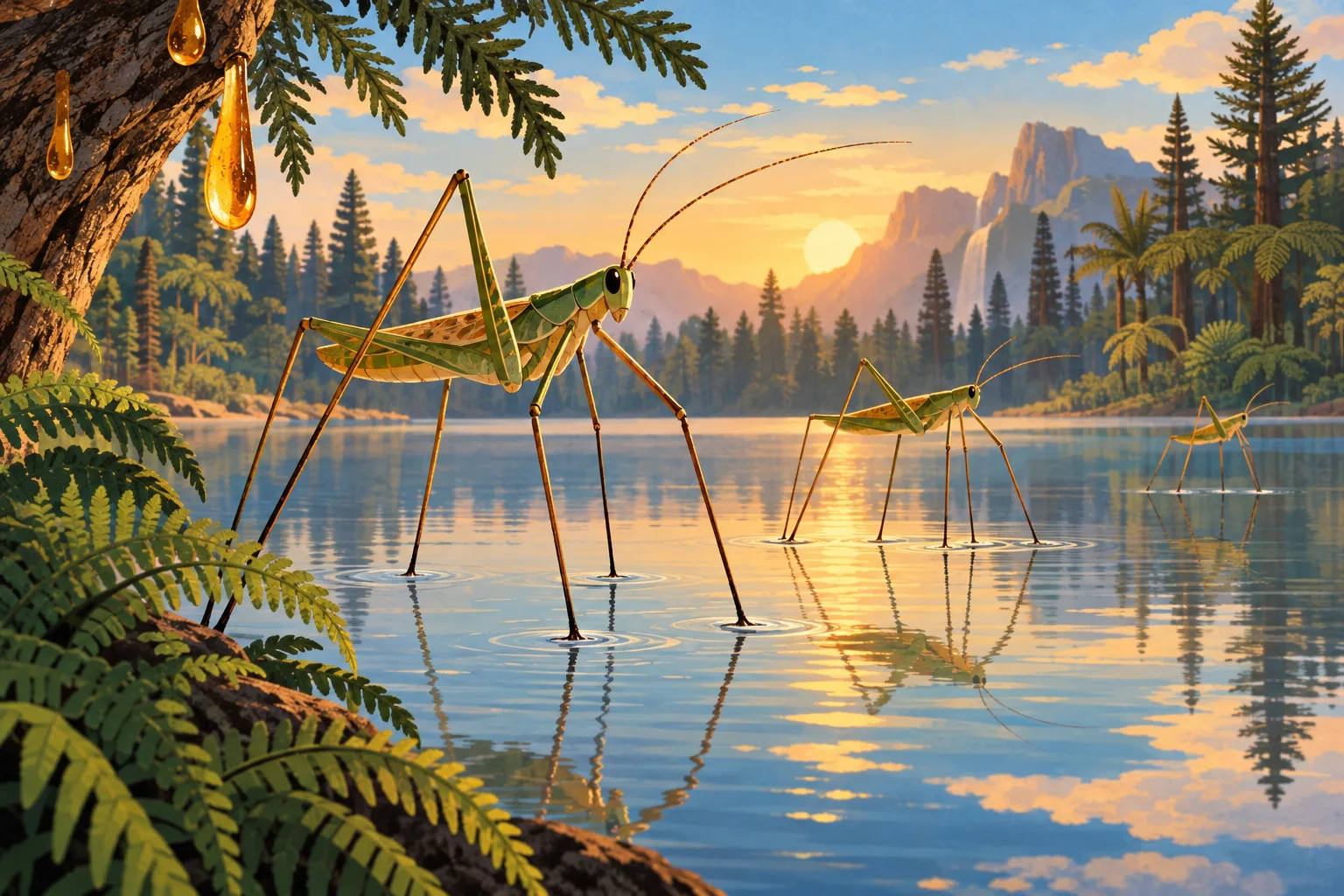
Researchers led by paleontologist Chunpeng Xu of the Nanjing Institute of Geology and Paleontology have described a new family of wingless, extremely long-legged grasshoppers preserved in about 99-million-year-old amber from northern Myanmar. Fossil features suggest the insects may have walked on water. The study was published Nov. 24 in Proceedings of the Royal Society B.12
The species is named Hydrelcana zhangi, and it gets a whole new family to itself, Hydrelcanidae. The paper describes a semi-aquatic group with body modifications in both adults and young that are unknown among any other living or fossil insects.1
If the interpretation holds, it would make these grasshoppers at least the third insect group to independently evolve a life on the water’s surface. Until now, only water striders and their relatives, plus an extinct group called Chresmodidae, were known to have pulled it off.23
“Walking on water is a pretty rare skill in nature,” Xu told Science News.2
Not what they looked like at first
Three amber pieces hold the insects, which have short bodies and very long, thin legs. Xu first thought he might be looking at harvestmen or stick insects, which is roughly the opposite of what most people picture when they hear “grasshopper.”2
“I was genuinely amazed,” Xu said in the Science News article. “They are among the most bizarre insects.”2
The amber came from Tanai Township in Kachin State, Myanmar.1
How a grasshopper could stay afloat
Nobody watched these insects skate, so the case rests on their anatomy. Under the microscope, the front legs carry water-repellent hairs, and the lower rear legs have leaf-shaped structures that work like paddles.2
Weight estimates suggest the insects were light enough to ride on surface tension, the thin “skin” that forms where water meets air. The hairs and a wide-spread stance would have helped, and the paddles could have pushed them forward.2 The authors say their analyses of the insects’ body shapes and of how they would move through water give numerical evidence that the grasshoppers lived on the water surface without sinking.3
Their method of travel would have looked different from today’s pond skaters, which row with their middle legs. These grasshoppers appear to have done the work with their back legs.2
Vegetarians in a crowd
Modern water walkers are mostly predators and scavengers. Judging from their mouthparts and their lack of claws, these grasshoppers were probably plant eaters, which would have made them the salad course of the lake surface instead of the hunters.2
One amber chunk holds nine of them. That suggests the insects may have gathered in large numbers, and it could be the earliest fossil record of grasshoppers or crickets clustering together.23
Why it matters
The find fills in a picture of Cretaceous lakes as busier places than anyone knew. The authors say the era of the dinosaurs hosted a lively lake-surface habitat with at least three unrelated groups of water-walking insects.3
The findings come from a single study. The international team also included Rolf Beutel of Friedrich Schiller University Jena in Germany and Thet Tin Nyunt of the Myanma Gems Museum.3
Did this make your day? Give it a cheer.
Sources
- Extreme morphological specialization in Mesozoic water-walking grasshoppers Proceedings of the Royal Society B (Royal Society Publishing), 2026-11-24
- Extinct, long-legged grasshoppers walked on water alongside dinosaurs Science News (Jake Buehler), 2026-11-24
- Amber fossils reveal how grasshoppers may have walked on water 100 million years ago Phys.org, 2026-11-25