
A Likely White Dwarf Pulses Every 7.9 Minutes Beside a Sun-Like Star
Astronomers using a radio telescope in Western Australia found a star pair flashing every 7.9 minutes, a new kind of host for a cosmic radio puzzle.

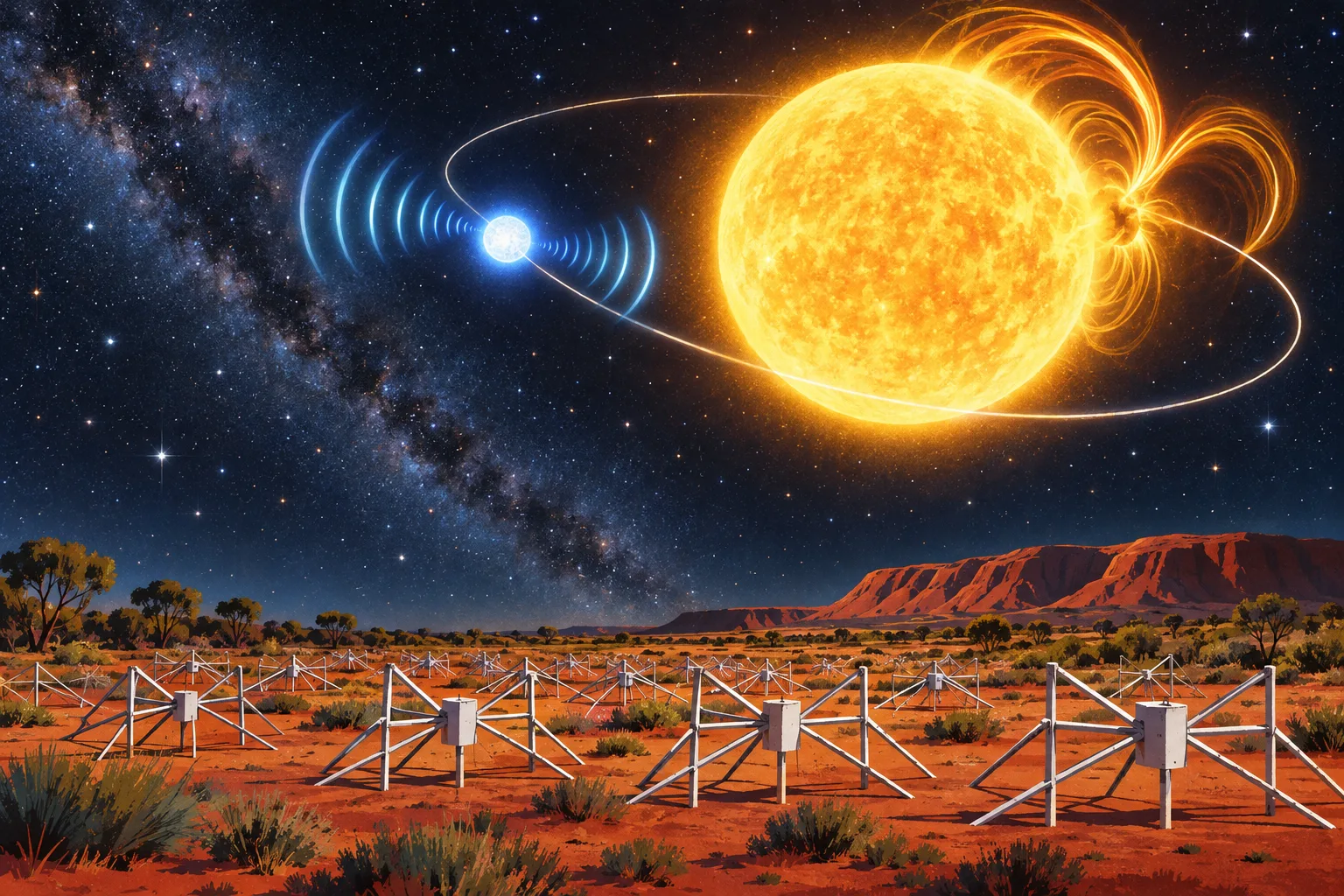
Astronomers using the Murchison Widefield Array radio telescope in Western Australia have found a star system, GPM J071507−114153, that flashes radio waves every 7.9 minutes. In a study published Nov. 12 in Nature Astronomy, the team says the pulses come from a likely white dwarf orbiting a Sun-like star.12
The authors describe it as the first identified candidate white dwarf pulsar with a Sun-like companion.2 A white dwarf is the small, dense core a star leaves behind after it burns out. A pulsar, here, means an object that sends out radio pulses on a steady schedule. “Candidate” is doing real work in that sentence: the team says the white dwarf is likely, not certain.
Why astronomers care
Since 2022, astronomers have been trying to explain long-period radio transients. These are objects that send out bright radio flashes every few minutes to every few hours.1
Only a few of them have had their source stars identified. Those usually turned out to be a white dwarf paired with a small, cool red dwarf.1 This one breaks the pattern. The partner is a G-type star, the same class as the Sun.2
That matters because a white dwarf parked next to a bright star is easy to miss. The authors suggest that if more long-period transients are hiding white dwarfs beside bright stars, radio surveys could turn up a whole population that optical and X-ray telescopes overlook.2
How the signal turned up
The team was combing for new long-period transients in late 2024 with the Murchison Widefield Array. A search method developed by PhD student Csanád Horváth picked out short radio flashes arriving every 7.9 minutes.12
According to the release from ICRAR and Curtin University, the work drew on more than 100 hours of radio data plus observations from several telescopes, with the Murchison Widefield Array and MeerKAT making the discovery. The release puts the system more than 5,000 light-years away.4
The two stars circle each other every 32 hours.2 By the standards of stars, that is a cozy arrangement: a full orbit takes about a day and a third.
Pinning down the source
The timing of the pulses shifts in step with the white dwarf’s motion around its orbit. That told the team the flashes start near the white dwarf, or possibly on it.3
“We know that the pulsations are coming from a region close to the white dwarf,” lead author Dr. McSweeney, a commissioning scientist at the Square Kilometre Array Observatory, said in the ICRAR release.3
The pulses also turned out to be useful for studying the neighbor. They let the team detect flares on the Sun-like star, similar to the kind of activity that produces aurorae on Earth. The radio observations also pointed to a likely magnetic prominence on that star, a loop of material held up by its magnetic field.3
A rough history
The authors propose a dramatic backstory. Long ago, the star that became the white dwarf swelled into a giant and engulfed its companion. The companion spiraled inward, shrinking the orbit, before the giant threw off its outer layers.1
Put plainly, the Sun-like star may have been swallowed by a giant and then ended up orbiting the leftovers.
More could be coming. The ICRAR release says the completed SKA telescopes, the much larger radio observatories that the Murchison Widefield Array and MeerKAT helped pave the way for, should find many more systems like this one.4
Did this make your day? Give it a cheer.
Sources
- A dead star is flashing radio waves every 8 minutes, and its partner looks a lot like the Sun The Conversation (by the study authors), 2026-11-12
- A dead star is flashing radio waves every 8 minutes, and its partner looks a lot like the sun Phys.org (republished from The Conversation), 2026-11-14
- A rare star system emits radio signals every 8 minutes Phys.org (ICRAR/Curtin University release), 2026-11-12
- Researchers Discover Rare Star System That Emits Radio Signals Every Eight Minutes Eurasia Review (ICRAR release), 2026-11-13
- Rare Star Duo Flashes Radio Waves Every Eight Minutes, Shedding Light on Bright Space Phenomenon Discover Magazine, 2026-11-13