Sea Otters Are Stabilizing a Marsh for Free. The Fee Is Crab, in Quantity
At Elkhorn Slough, returning sea otters eat the burrowing crabs that chew marsh roots, and creek banks erode more slowly, though how much is debated.

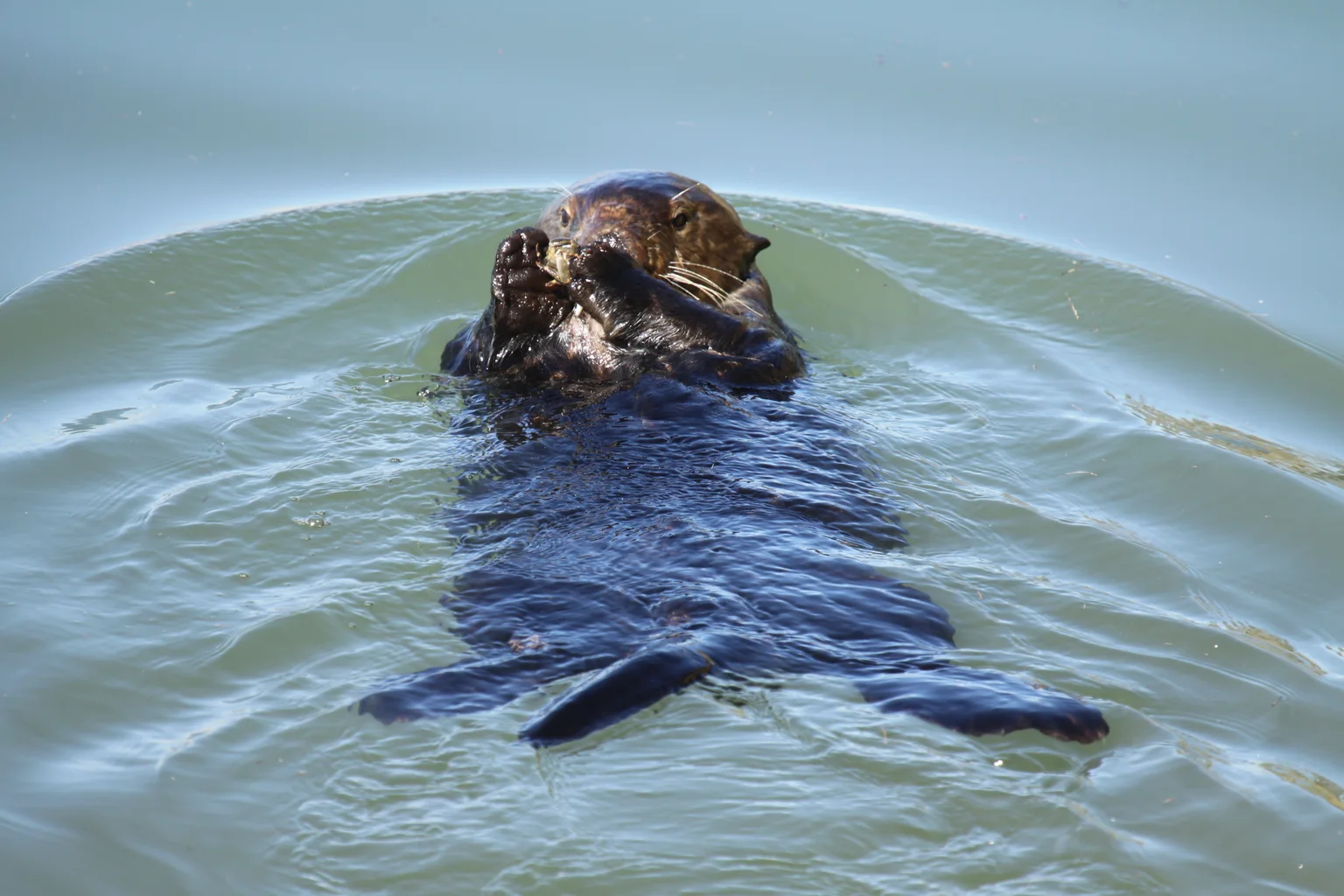
Southern sea otters returning to Elkhorn Slough, an estuary in Monterey County, California, are linked to slower erosion of its salt marsh creek banks. Their method is lunch: they eat the shore crabs that chew marsh roots and burrow into the banks.1
That is the finding of a study published in Nature on Jan. 31, 2024. Brent Hughes of Sonoma State University led it, with senior author Brian Silliman of Duke and co-authors from UC Santa Cruz and UC Santa Barbara.2 A fresh look at the paper’s data by ScienceBlog in October 2026 supports the general pattern but suggests the headline number is softer than first reported.3
It matters because marshes are under pressure from rising seas, and rebuilding eroded banks would cost millions of dollars, according to Silliman.1 “The sea otters are stabilizing them for free in exchange for an all-you-can-eat crab feast,” he said in UC Santa Barbara’s announcement.1
How a crab eats a marsh
“Crabs eat salt marsh roots, burrow into salt marsh sediments, and over time can cause a marsh to erode and collapse,” Hughes said in the announcement.1
Fur traders once hunted the local otters nearly to extinction, and the crab population exploded. Otters recolonized the estuary in the mid-1980s and spread into the salt marshes over the past decade. Marsh and streamside plants are now rebounding with denser root mats.1
What the researchers measured
The team surveyed 13 tidal creeks, pulled together erosion records reaching back to the 1930s and otter counts from the 1980s, and fenced otters out of test plots in five marsh creeks.12 The fences stood from September 2013 to December 2016, according to ScienceBlog’s reading of the paper.3
Fenced plots held more crabs and less plant life, with 48% less above-ground and 15% less below-ground plant material.4 Those experiments measured crabs, plants and soil, not how fast banks retreated. The link to erosion itself rests on the long-term records and the comparison between creeks.3
The long-term record is striking. Creeks widened about 0.09 meters a year from 1937 to 2000, jumped to 0.35 meters a year from 2000 to 2007 as otter numbers fell, then eased to about 0.10 meters a year from 2008 to 2018 as the count climbed past 100. Otters in the slough roughly doubled, from an average of 62 in 2009 to 2012 to 128 in 2017.3
How big is the slowdown?
According to the study’s authors, erosion slowed by 69% on average, even though rising seas, stronger tidal currents and nutrient pollution should have pushed it the other way.1 ScienceBlog reports that figure compares creeks rather than tracking change over time: eight high-otter creeks averaged 0.05 meters a year in 2015 to 2017, against 0.16 meters for five low-otter creeks.3
Recalculating from the creek-by-creek data the authors posted, ScienceBlog got a smaller gap of about 45%. The same 13 creeks, measured in 2009 to 2011 and again in 2015 to 2017, slowed by about half. The paper’s own discussion puts the drop at about two-thirds, and Hughes had not answered ScienceBlog’s emailed question.3
Duke’s release put the slowdown at as much as 80 to 90% at otter-rich sites, but ScienceBlog says that figure does not appear in the paper.35
The effect was also uneven. Ten of the 13 creeks slowed, two eroded faster (including the creek with the most otters), and one had banks building outward. Across the 13 creeks, the relationship between crab-eating and erosion had a P-value of 0.054 after one creek where seals haul out was excluded. That is just above the 0.05 cutoff scientists usually use to call a result statistically significant.3
A help, not a cure
Hughes is plain about the limits. “The return of the sea otters didn’t reverse the losses, but it did slow them to a point that these systems could restabilize despite all the other pressures they are subject to,” he said in the announcement. He called otters a potentially effective and affordable conservation tool.1
Kerstin Wasson, research coordinator at the Elkhorn Slough National Estuarine Research Reserve, told ScienceBlog that sea-level rise remains the biggest future threat. “Bringing back top predators is an essential part of restoring healthy estuaries, but sea otters only help marshes a little bit at the margins,” she wrote in an email.3
Next, UC Santa Barbara’s Kathryn Beheshti has started restoring eelgrass in natural and restored tidal creeks at Elkhorn Slough, to test whether it can cut bank erosion further.1
Did this make your day? Give it a cheer.
Sources
- More Sea Otters Less Erosion UCSB Marine Science Institute, 2024-01-31
- Top-predator recovery abates geomorphic decline of a coastal ecosystem Nature, 2024-01-31
- As sea otter numbers doubled in California's Elkhorn Slough, its creek banks eroded approximately half as fast ScienceBlog.com, 2026-10-13
- Do sea otters slow erosion? These Duke researchers think so The Duke Chronicle, 2024-02
- Where sea otters play, salt marshes stay, new study shows Mongabay, 2024-02
- Feasting sea otters help reduce erosion, study says Courthouse News Service, 2024-02
- Sea Otters' Appetite for Crab Is Helping Strengthen Estuary Banks Eos (AGU), 2024-02