The Amazon Conservation Pilot That Paid People Without Asking Them to Save a Single Tree
A small Peruvian pilot paid 211 Indigenous people a modest basic income, and hunger eased and replanting grew, though the forest itself wasn't measured.

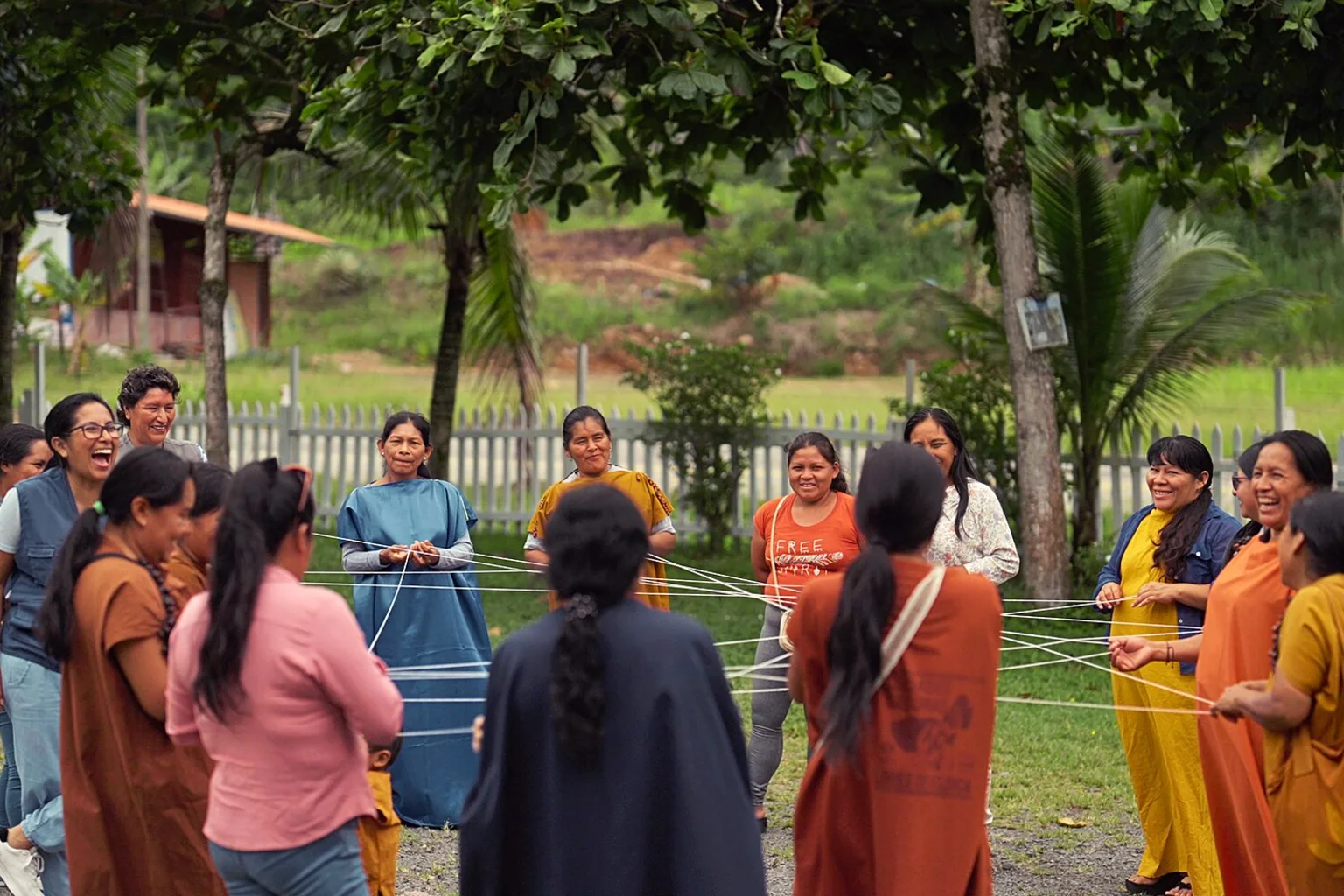
For two years, 211 Asháninka and Yanesha people in three communities in Peru’s Amazon received regular cash payments with no conditions. They did not have to plant a tree or promise to skip a burn to get paid. The money came with optional training. By the end, fewer families were skipping meals, fewer were leaving home for casual work, and more were joining community projects to replant springs and protect water sources.1
Those findings come from an evaluation published by the University of Bath in October 2026. The authors present it as early, preliminary evidence for an idea they call “conservation basic income.” The evidence comes from a small pilot with no comparison group, and it did not measure the forest directly.1
How the pilot worked
The charity Cool Earth ran the pilot in Junín Province, in the central Peruvian Amazon, with the Indigenous women’s organizations ONAMIAP and OMIAASEC.1 Starting in November 2023, each adult received a payment every four months, six in all. Each transfer was S/1,032 (about $280).1 The Guardian describes that as roughly £2 a day (about $2.70).2
The money came with an optional training program the organizers called “Cash Plus,” covering money management, Indigenous rights, governance, conservation and climate change. Community coordinators visited monthly. Attendance was voluntary, and most people went anyway: 96% of survey respondents attended at least one session on Indigenous rights.1
Cool Earth says the pilot was funded by Liberty Specialty Markets and People’s Postcode Lottery.5
What changed for families
The household numbers moved a long way. The share of households that could not afford nutritious food fell from 73% to 26%. Skipped meals fell from 49% to 22%.1
Households sending someone away for casual labor dropped from 43% to 18%. The share with savings rose from 49% to 70%, and loan requests fell from 19% to 6%.1 The report credits the cash with letting people spend less time working for wages outside the community and more time on their own farms and shared projects.1
What changed for the forest, as far as anyone can tell
About 80% of the people interviewed described taking up environmentally helpful practices, according to the report. The Guardian put the figure at almost 90% of participants.12 The examples included group reforestation, restoring water sources and less burning of forest.2 In the final survey, nearly 60% said they often joined collective environmental work and 27% said they sometimes did.1
Those are people’s own accounts of what they did. The evaluation did not measure forest cover, vegetation or soil, and the authors say future studies need direct environmental measures.12
The conservation projects are also tied to the training, not just the cash. The report says the training “appears particularly important,” and links it to work such as replanting around springs, community planting, seed banks and fish farms.1
“The findings suggest that when communities have greater security and autonomy, they are better able to protect the ecosystems they depend on,” co-author Nick Langridge said, as quoted by the Guardian.2
The fine print
The report lists its own limits. There was no control group, so it cannot firmly say the pilot caused the changes. The timeframe was short, and the report cannot say whether the gains last after the payments stop.1 The final survey reached 82 of the 211 participants. The interviews (24 people, plus three focus groups) were chosen deliberately rather than at random. The report also warns that survey answers may be skewed because a partner organization ran the survey.1
Cool Earth, which ran the pilot, commissioned the evaluation. The University of Bath team also gave free advice on the pilot’s design and ethics. The report calls the evaluation independent.1 The Guardian notes that the authors did not account for separate projects that might have influenced behavior. It also reports that other academics are more cautious, because cash payments elsewhere have sometimes increased deforestation.2
Earlier payment programs, such as Brazil’s bolsa família and bolsa verde, came with conditions. The study’s authors say this pilot is the first to give an unconditional basic income to an Indigenous community in the Amazon. The report itself, more modestly, calls it one of the first pilots anywhere.12
Lead author Neil Howard told the Guardian that “this is an experimental pilot” and that “we could do with something much larger.”2 He argues the approach puts people “front and centre with respect and dignity, which contrasts sharply with the colonial history of conservation and Indigenous policy.”2
Did this make your day? Give it a cheer.
Sources
- Fighting the climate crisis with reciprocity: Towards Indigenous autonomy – Conservation Basic Income Pilot Evaluation University of Bath, Centre for Development Studies (Bath Papers in International Development), 2026-10-20
- Giving £2 a day to people in the Amazon helps protect rainforest, pilot project finds (Guardian article, AOL syndicated copy) AOL UK, reprinting The Guardian (Jonathan Watts), 2026-10-20
- University of Bath homepage: 'World-first basic income trial boosts Indigenous livelihoods and Amazon rainforest protection' University of Bath, 2026-10-20
- Can a basic income keep rainforests standing? University of Bath researchers are finding out University of Bath
- World's First Basic Income Pilot for Indigenous Peoples in the Amazon Cool Earth