Waves Are Digging Up a Lost Forest Floor Off Mozambique, and Reef Fish Moved In
Peat from coastal swamps and forests up to about 5,000 years old now gives young fish and lobsters rare solid ground on a sandy coast, a small study finds.

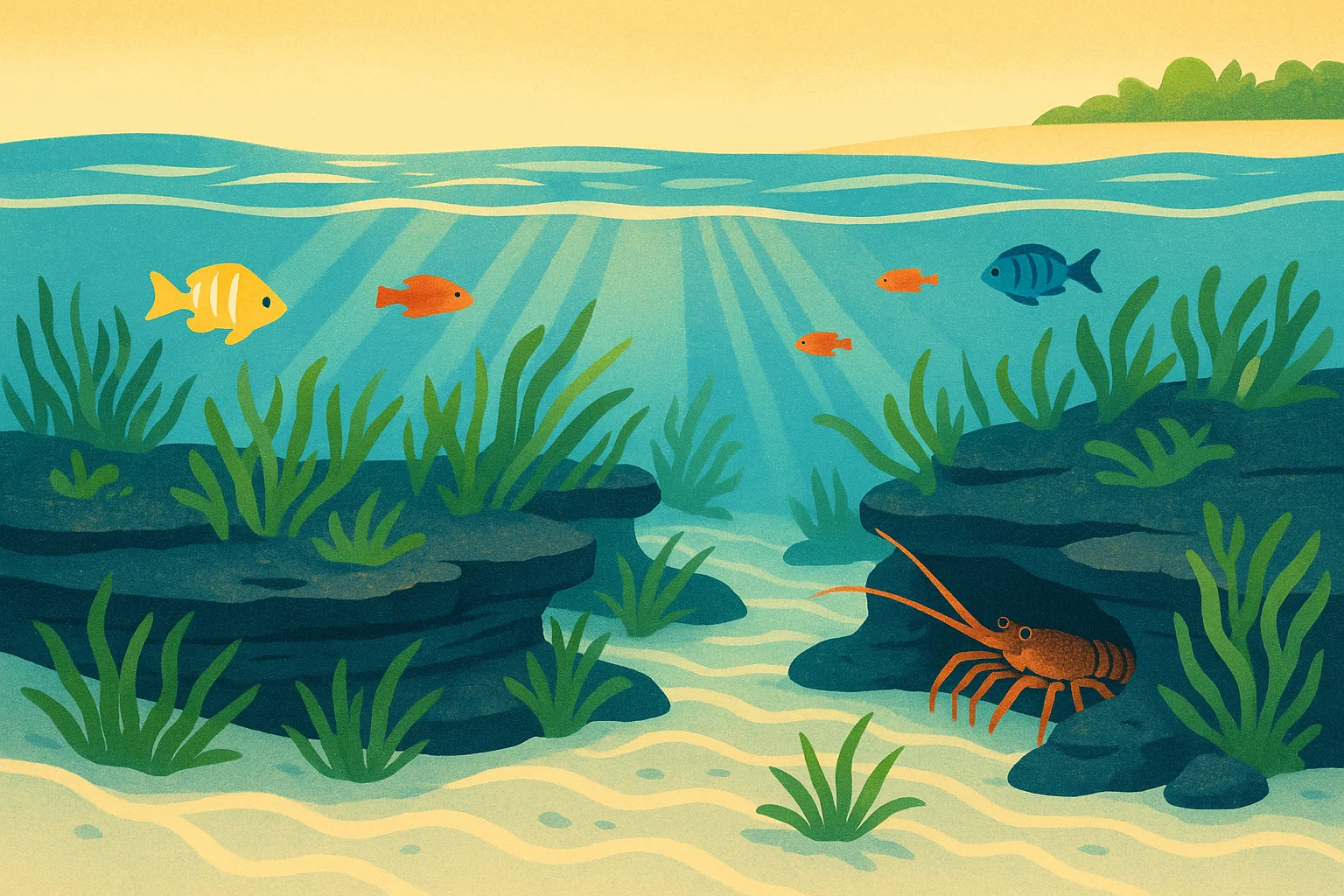
Off the coast of Mozambique, waves are scouring sand from the seabed and uncovering something that began life on dry land: peat from coastal swamps and forests that rising seas drowned long ago. A new study reports that seagrass, oysters, spiny lobsters and young reef fish now use these exposed patches as habitat.1
The study, published Oct. 12 in Scientific Reports, calls these patches “peat reefs.” They matter because this stretch of coast is mostly shifting sand, with very little natural hard seabed. The old peat offers a rare firm surface where marine life can settle. The authors argue the peat reefs belong on coastal habitat maps and in conservation plans.1
“What was once a forest floor is now a nursery for reef fish. We were surprised by how much life these ancient peat deposits support, and how many species move between them and the coral reefs nearby,” lead author Mario Lebrato, co-founder of the BCSS Ocean Observatory, said in the center’s announcement.2
From forest floor to seafloor
The work comes from the Bazaruto Center for Scientific Studies (BCSS), set up in Mozambique’s Bazaruto Archipelago in 2017, with collaborators at the Universities of Southampton, Plymouth, Heriot-Watt, Newcastle and New England and at Canada’s Sound Ocean Science.12
Radiocarbon dating put the peat at roughly 300 to 5,000 years old in the paper’s summary. The individual samples dated in the results run from about 800 to more than 4,500 years. The study’s title says the forests were “reborn,” but the authors use that as a descriptive image, not a literal claim.1
The team surveyed the area in 2023, on the southern side of the San Sebastian Peninsula, outside marine protected areas. The peat reefs sit just 2 to 4 meters deep, and their water swung between 24.5 and 28.6 °C within a single day.1
How they compare with a coral reef
The researchers surveyed three peat reefs and one nearby coral reef. The peat reefs had 0% live coral, which is a lot to leave out of a reef. Instead they were covered mainly by seaweed (about 25 to 30%), seagrass (about 20%) and bare peat.1
Each peat reef held 26 to 36 species of small fish, against 54 on the coral reef, and fewer fish overall. The peat reefs scored slightly higher on a diversity measure that weighs how evenly fish are spread across species. The two habitats shared 41 small-fish species and 44 species of larger animals.1
Juvenile snappers, grunts and damselfish turned up on the peat, along with spiny lobsters. The authors read that as a nursery and hiding place for young animals. Green turtles and dugongs live in the area and could graze the seagrass patches.12
Some headlines have described the peat reefs as matching coral reefs for biodiversity, and the numbers don’t stretch that far. The coral reef recorded 25 species of larger animals, against 6 to 11 per peat reef. Its 28 invertebrate species compared with 12 to 14 per peat reef, and the two habitats had no invertebrate species in common.1
The sample is small: three peat reefs, each surveyed once, compared with a single coral reef. Statistical tests comparing the overall fish and large-animal communities did not find significant differences.1
Open questions and caveats
Peat reefs don’t stay put. Cyclones and storms bury them, uncover them and break them apart.1
The peat holds up to 40% organic carbon by dry weight, and chemical clues show it came mostly from land plants.1 Even so, the reefs’ role in storing carbon is unresolved. The authors do not count them as “blue carbon” habitats, the coastal ecosystems valued for locking carbon away. They say answering the question would take measurements of peat thickness, density, total carbon stocks, erosion rates and greenhouse gas release.12
The authors call their paper, to their knowledge, the first quantitative ecological assessment of tropical marine peat reefs. Submerged peat reefs have already been described in cooler, temperate waters.1
The study was funded by the BCSS-Kisawa Sanctuary resort-to-research initiative, which also funds BCSS, and the authors declare no competing interests. News coverage so far draws on the center’s own announcement rather than outside scientists.12
The authors suggest similar drowned-forest habitats may exist in Southeast Asia, the Caribbean and West Africa.1
Did this make your day? Give it a cheer.
Sources
- Ancient terrestrial forests reborn as modern marine ecosystems under shifting sea levels Scientific Reports (Nature Portfolio), 2026-10-12
- Drowned 5,000-year-old forests reborn as thriving peat reefs and biodiversity hotspots off Mozambique Phys.org (provided by Bazaruto Center for Scientific Studies), 2026-10-15
- 5,000 years ago, these forests drowned. Now they're thriving reefs Discover Wildlife, 2026-10-15
- Ancient Submerged Forests off Mozambique Found Teeming with Marine Life ECO Magazine
- Ancient Submerged Forests Found to Rival Coral Reefs in Biodiversity Off Mozambique Coast ATTA (Adventure Travel Trade Association)