Octopus Brains Hold Connections With a Gas That Keeps Its Own Factory Running
Hebrew University researchers report a nitric oxide loop keeps octopus brain connections strengthened without new proteins, unlike many vertebrate mechanisms.

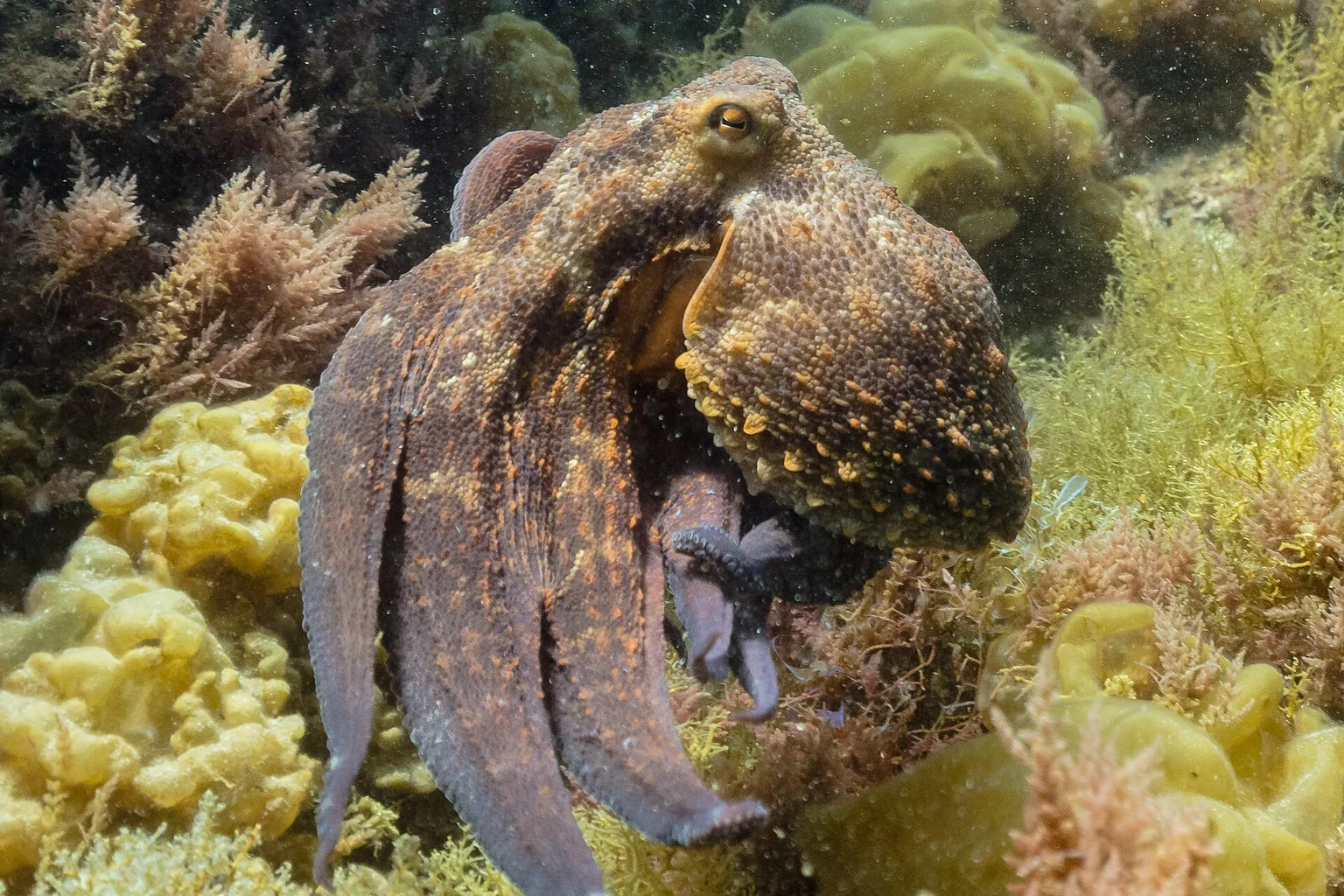
Researchers at the Hebrew University of Jerusalem and Ruppin Academic Center report in the Journal of Neuroscience that the common octopus keeps strengthened connections between brain cells going with a self-sustaining loop driven by nitric oxide, a gas. The paper appeared online Oct. 14, and the university announced it Nov. 5.1
The finding matters because it shows a very different brain solving a familiar problem a different way. Many well-studied mechanisms in vertebrates, the animals with backbones, depend on building new proteins to make a change last. The octopus, according to the study, gets by without that step.12
A switch that keeps itself on
The team, led by Dr. Ana Luiza Turchetti-Maia, Dr. Tal Shomrat and Prof. Binyamin (Benny) Hochner, studied the octopus vertical lobe. That brain region works much like the hippocampus, a region tied to learning and memory in vertebrates.1
The vertical lobe can strengthen connections between neurons through a process called long-term potentiation, or LTP. Scientists widely consider LTP a basic cellular mechanism behind learning and memory. Put simply, a connection that gets used in the right way starts passing signals more strongly, and stays that way.1
Nitric oxide does two jobs in this process. First, it helps strengthen the connection by boosting the release of neurotransmitters, the chemical messengers neurons use to talk to each other. Second, it keeps reactivating nitric oxide synthase, the enzyme that makes nitric oxide in the first place.1
That second job is the clever part. The gas keeps switching on the machinery that makes more of the gas, which keeps the connection strong, which is why the researchers call it a “molecular switch.” Once flipped, it stays flipped.12
So the octopus holds on to a lasting change in its brain partly by keeping a puff of gas in circulation. It is an unusual filing system, but apparently a functional one.
A different road to the same place
In the classic vertebrate picture of memory consolidation, making a change stick requires switching on genes and building new proteins. The octopus vertical lobe maintains LTP without producing new proteins at all.12 Earlier research had also found that octopus vertical-lobe LTP works without NMDA receptors, a type of receptor on nerve cells, and differs from the standard mammalian mechanism.5
Hochner said in the university’s announcement that octopuses have evolved “a fundamentally different molecular solution” to the problem of turning a brief experience into a lasting change in the brain.1
“It is a remarkable example of how evolution can give rise to similar principles of learning and memory through very different biological mechanisms,” Hochner said in the announcement.1
What the study does and doesn’t show
The idea itself is not brand new. The same research group proposed the nitric oxide switch in a 2018 preprint and posted an early version of this paper as a preprint in December 2024. A preprint is a study shared publicly before peer review. The new Journal of Neuroscience paper is the peer-reviewed version of a model the group has been building for years.34
The university says the mechanism may help explain how octopuses remember.1 That “may” is doing honest work. The study is about LTP in the vertical lobe, and other researchers in the field have noted that this kind of LTP may not map directly onto long-term memory storage, which is thought to happen outside the vertical lobe.
This is basic science, and the researchers have not claimed any direct practical use. What it offers is a clearer look at how one of the animal kingdom’s most unusual brains keeps hold of what it learns, using a method its backboned relatives mostly don’t.

Did this make your day? Give it a cheer.
Sources
- How do octopuses remember? Scientists uncover a surprising secret The Hebrew University of Jerusalem via EurekAlert!, 2026-11-05
- How Octopuses Lock in Long-Term Memory Without New Proteins Neuroscience News, 2026-11-06
- A novel nitric oxide (NO)-dependent ‘molecular switch’ mediates LTP in the Octopus vulgaris brain through persistent activation of nitric oxide synthase (NOS) (preprint) bioRxiv, 2024-12-25
- Neurotransmission and neuromodulation systems in the learning and memory network of Octopus vulgaris bioRxiv / Journal of Morphology, 2021-11-12
- Neuroanatomy & the Distributed Nervous System The Octopus Mind (octopuscognition.org)