Brain Implant Lets a Man With ALS Communicate Nearly 2 Million Words
Experimental implants that decode attempted speech are helping a few people with ALS and related diseases email, work and call the grandkids.

Casey Harrell has communicated nearly 2 million words through a brain implant. He uses it to send emails, answer Slack messages and play Wordle with his family, which means some of the most advanced neuroscience on Earth is now devoted to five-letter word puzzles.1
Harrell began losing his speech after he was diagnosed with ALS in 2020. Now he talks again with help from experimental brain-computer interfaces (devices that read brain signals and turn them into actions, like typing words), as described in a new feature from Science News.1
"Speech is so fundamental to who we are," said David Brandman, a UC Davis neurosurgeon and neuroscientist, speaking to Science News.1
How a Brain Turns Into a Keyboard
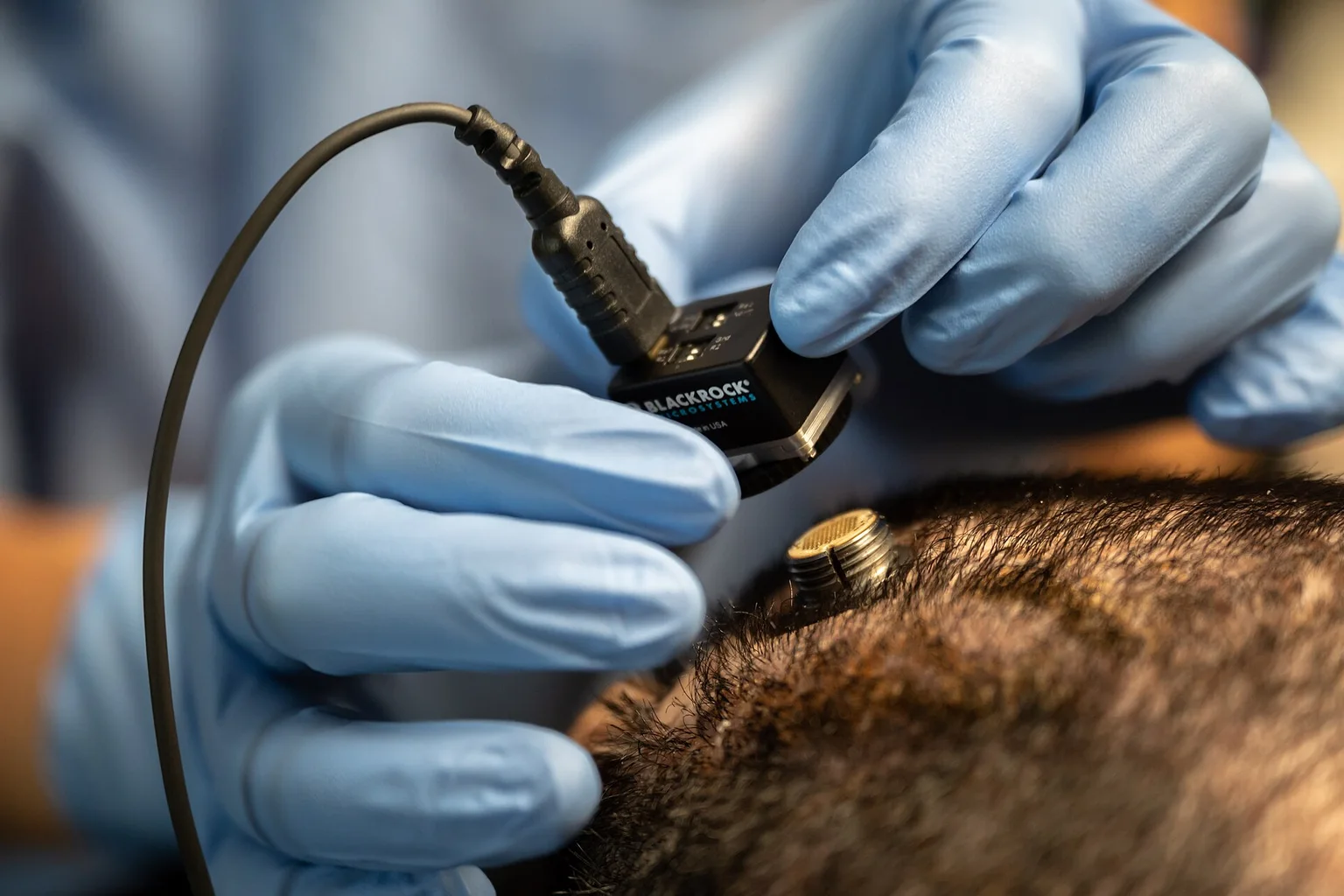
In 2023, as part of a UC Davis clinical trial, surgeons placed four tiny electrode arrays on the left side of Harrell's brain. They sit over the speech motor cortex, the area that controls the muscles used for talking. Together the arrays hold 256 electrodes.12
When Harrell tries to speak, the electrodes pick up his brain activity. Machine learning matches those signals to phonemes, the small sounds that make up words. Language models then assemble the phonemes into sentences on a screen. If he wants, a computer voice can read them aloud, and it was trained to sound like his voice before ALS.12
His reaction to the first successful test fits in two words: "Pure joy."1
The numbers since then are hard to shrug off. A Nature Medicine paper published June 15, 2026, reports that over nearly two years he used the system for more than 3,800 hours at home, with no researchers in the room. He produced 183,060 sentences, or 1,960,163 words, at an average of 56 words per minute.2
He also held down a full-time job with it and has been working on a new climate consultancy project. The implant, in other words, has a better attendance record than most office printers.12
Impressive, With Fine Print
In structured tests where he copied set words, the system decoded his attempted speech with more than 99% word accuracy, drawing from a 125,000-word vocabulary. Everyday conversation is messier. Harrell rated 92% of his sentences as at least mostly correct, and 53.3% came out perfectly.2
The paper is upfront about its limits. The study covers one person. The system is wired, bulky, works only at home and needs trained care partners to set it up each day.2
Wireless options are arriving. In June 2026, University of Michigan Health surgeons Matthew Willsey and Aditya Pandey implanted a wireless device made by Paradromics, with 421 microelectrodes, in a woman in her 60s with motor neuron disease. It was the first human implant in an FDA-authorized early study. Signals travel to a transceiver in her chest, then wirelessly to an outside receiver.35
By September, she was using it for free conversation, including a phone call with her grandchildren, according to New York Times reporting summarized by other outlets. The device reportedly decoded both speech she attempted and speech she only imagined. Those results have not yet been peer-reviewed.451
That trial will focus on long-term safety and follow her for six years. Paradromics says nine more participants, with conditions such as stroke and ALS, will join.35
Other teams are busy too. A UCSF study let two people with paralysis control the words and gestures of digital avatars, and Neuralink says participants with ALS in its study are speaking through synthetic versions of their own voices.17
The Road From Lab to Clinic
Brandman told Science News he is about five years away from being able to tell a newly diagnosed ALS patient that a device can help them communicate. Nothing is guaranteed. Cost, brain surgery, a limited number of trained clinicians and whether brain signals stay steady for years are all open questions.1
"These are real challenges, and the field is working on them," said Sergey Stavisky, a UC Davis neuroscientist and neural engineer. Brown University neuroscientist Leigh Hochberg put it more simply: "It's still early days."1
For now, Harrell's implant has a full-time job, a climate project and a daily Wordle habit, which is a fuller schedule than most gadgets ever get.
Did this make your day? Give it a cheer.
Sources
- Brain implants are helping people who've lost their voice Science News, 2026-10-15
- Long-term independent use of an intracortical brain–computer interface for speech and cursor control Nature Medicine, 2026-06-15
- University of Michigan implants first-in-human Paradromics wireless brain-computer interface, designed to restore communication Michigan Medicine (University of Michigan), 2026-06-17
- Paradromics Patient Holds Real-Time Conversations Using Connexus BCI, NYT Reports Prevail Venture Capital (summarizing The New York Times, Sept 14, 2026), 2026-09-14
- Brain implant enables real-time speech from imagined words Quartz, 2026-09-14
- Brain-computer interface restores real-time speech in ALS patient ScienceDaily / UC Davis Health, 2025-06-12
- Neuralink brain implant helps man with ALS speak using his thoughts MobiHealthNews, 2026-09-23