The Official Face of a New Cat Species Is a 10-Year-Old Ex-House Pet Named Tigrino
Leopardus tilcayo, a kitten-sized spotted cat from Bolivia's cloud forests, is known from just two animals and may draw new conservation attention.

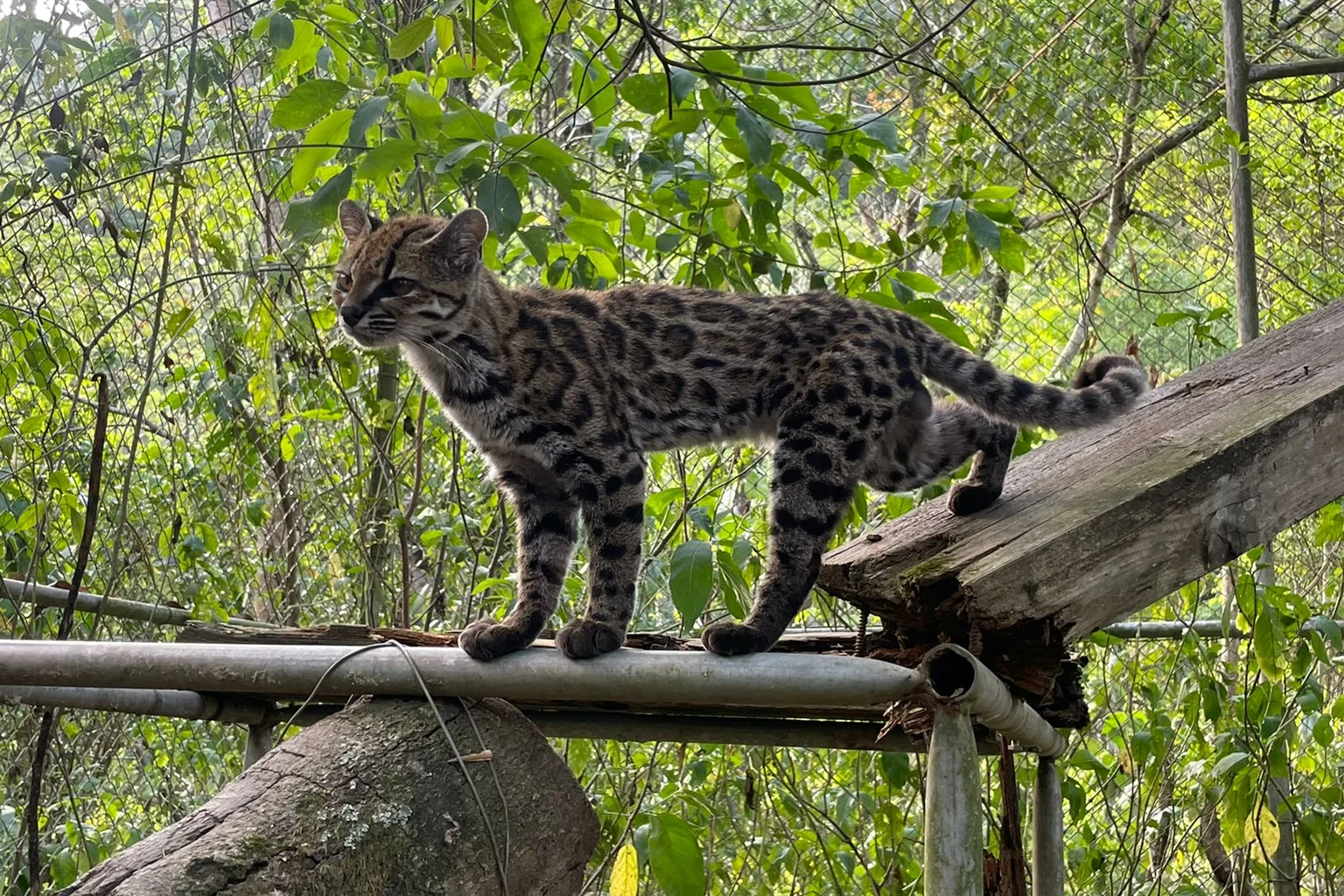
A small spotted cat from the cloud forests of Bolivia has been named a new species, Leopardus tilcayo. Researchers described it in a study published September 17, 2026, in the journal Current Biology.1 The paper calls it the first new cat species discovered in over a century.1
That claim needs one clarification. The last living cat species to be formally described was the Uruguayan pampas cat, in 1923.2 The tilcayo itself was not unknown. People in Bolivian communities already had a name for it, and the researchers chose to keep that name. Paola Nogales-Ascarrunz, a co-author, said the choice preserves traditional community knowledge.34
The new name matters for conservation. Once scientists can tell these cats apart, they can judge how threatened each species is on its own. The new species is also known from only two animals, and nobody yet knows how many exist or where they all live.23
A cat at a wildlife refuge
One of those two animals is Tigrino, a male about 10 years old. He spent a year as someone’s house pet before arriving at Senda Verde, a Bolivian refuge for trafficked wildlife, about a decade ago.23
Tigrino is the type specimen, the individual that officially defines the species.3 Nogales-Ascarrunz, a cat conservationist and National Geographic Explorer, noticed that he looked different from the cats she expected in that region. She had him genetically tested and shared the data with a team led by Jonas Lescroart, an evolutionary biologist at the University of Antwerp.2 According to Science News, the second animal was a female who was treated at a Bolivian sanctuary and then released.2
The cat has a slender body, spotted fur and a ringed tail.2 Live Science reports that these cats weigh about 1.5 to 2 kilograms and reach up to about 50 centimeters long, not counting a tail of about 25 centimeters.3 Science News compares its weight to that of a two-month-old domestic kitten.2
“It’s smaller than a house cat,” Nogales-Ascarrunz told Live Science.3
Reading the family tree in 38 genomes
Tiger cats are small wild cats found in South America. The team analyzed complete genomes from 38 individual cats in the genus Leopardus, 26 of them tiger cats.6 Eight genomes came from museum specimens. That allowed the first genetic check of the place where the original tiger cat species was first described, in the Guiana Shield.6
Lescroart’s team expected to find two, three or four tiger cat species. They found five.2 Four of those had been proposed by earlier researchers, and the study confirmed them. The fifth, L. tilcayo, is the new one.3 According to Live Science, its lineage split from other Leopardus cats about 1.4 million years ago.3 The paper also names a new subspecies from the Peruvian Yungas, Leopardus tigrinus antisuyo.16
“I did not at all expect attention at this scale,” Lescroart told Science News. He also said, “I don’t know if you’ll have to wait another 100 years for a new species.”2
What happens next
Tiger cats face deforestation, wildlife trafficking and diseases spread by domestic dogs.3 The IUCN Red List, the main global ranking of extinction risk, currently lists northern and southern tiger cats as vulnerable with shrinking populations. Lescroart says that assessing the species separately could move some of them up to endangered.3 Co-author Tadeu de Oliveira of the State University of Maranhão in Brazil said the cats’ habitats are vanishing fast.4
Lescroart told Live Science that the discovery “is definitely expected to increase conservation attention,” and then added, “or, we hope so.”3
Scientists still don’t know the tilcayo’s behavior, diet or range. The next steps are better estimates of its population and range.3 Nogales-Ascarrunz is working on camera traps in the Yungas to look for more signs of the cat.4
Did this make your day? Give it a cheer.
Sources
- Phylogenomics and museomics reveal five distinct species of tiger cats in South America: Current Biology Current Biology (Cell Press), 2026-09-17
- Meet the newest living cat species, the first described in 100 years Science News (Meghan Rosen), 2026-09-24
- Scientists name a new cat species for the first time in over a century Live Science (Olivia Ferrari), 2026-09-17
- New wild cat species is identified for first time in 100 years, researchers say NBC News, 2026-09-17
- Meet the First New Cat Species Discovered in 100 Years National Geographic
- Phylogenomics and museomics reveal five distinct species of tiger cats in South America - PubMed PubMed / National Library of Medicine, 2026-10-05