Lab-Raised Sunflower Sea Stars Eat Urchins in First California Ocean Trial
Sixteen lab-grown stars spent the summer on a Monterey Bay reef eating urchins, an early step toward bringing kelp’s best bodyguard back for good.

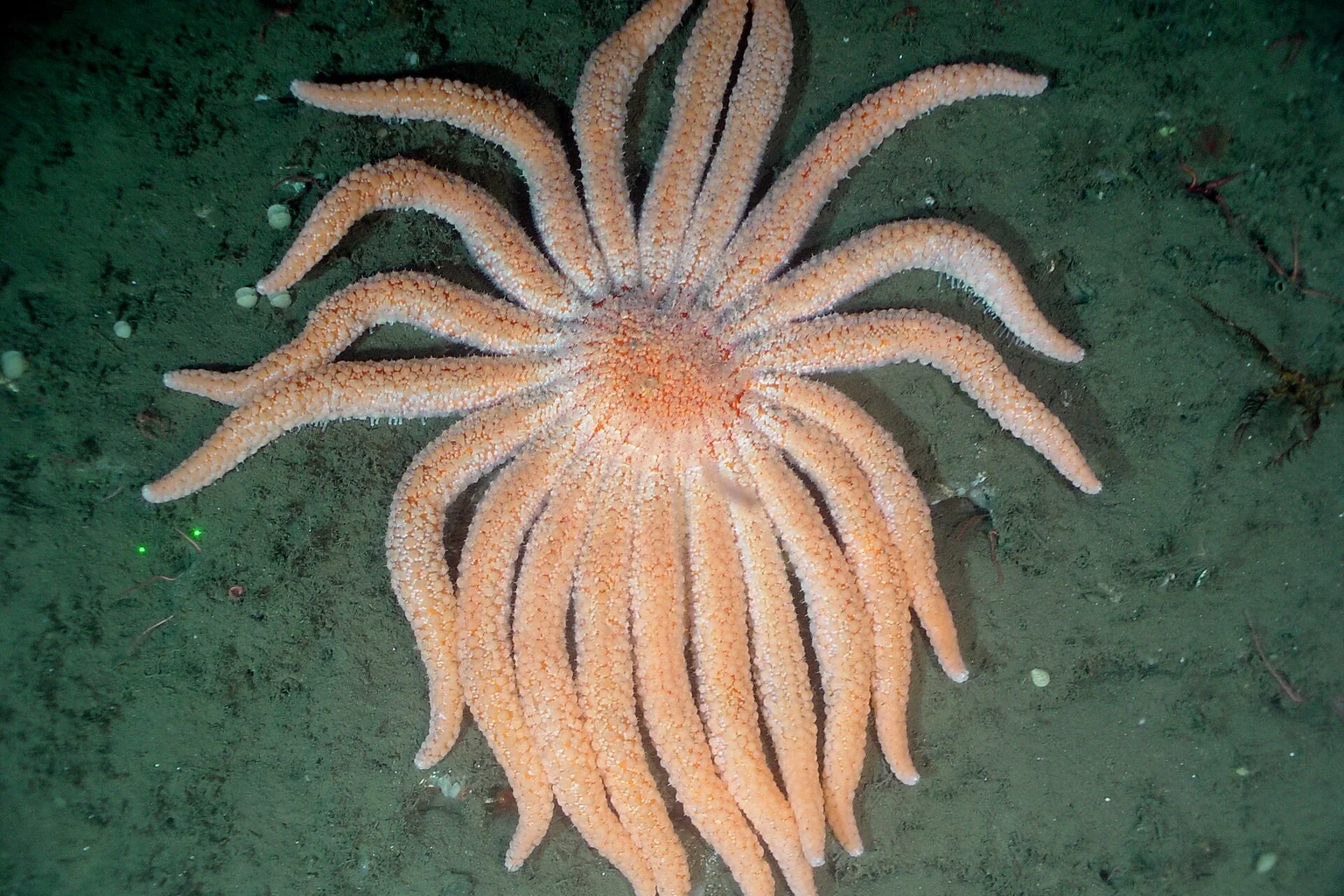
This summer, the purple urchins on one Monterey Bay reef got some new neighbors. Each one had as many as 24 arms, a laboratory upbringing and a very specific dinner plan. The urchins were the dinner plan.
The Sunflower Star Laboratory, a nonprofit in Moss Landing, led a project that placed 16 lab-raised sunflower sea stars on Tankers Reef. It was the first time lab-grown sunflower stars had been released onto the ocean floor in California. The release was temporary, a research run to answer questions before any permanent return. (Think of it as a trial lease, not a mortgage.)1
The stars skipped orientation and went straight to lunch. They ate more than 3.5 urchins a day and grew more than 50 percent in a single month.1 If you grew 50 percent in a month, your doctor would want a word. For a sea star, that’s a strong first performance review.
Why a Sea Star Matters to a Forest (the Underwater Kind)
The sunflower sea star is the largest sea star in the world. It can stretch more than three feet across and has 16 to 24 arms. It was once a top predator on California’s rocky reefs, and it kept purple urchins from getting out of hand.3
Then came sea star wasting disease. It killed around 6 billion sunflower stars along the West Coast, and the species dropped by roughly 92% across its range, from Baja California to Alaska’s Aleutian Islands. No one had spotted one south of the Bay Area since 2018.2 Scientists have since linked the disease to a bacterium called Vibrio pectenicida, a name about as easy to say as it was easy to track down.4
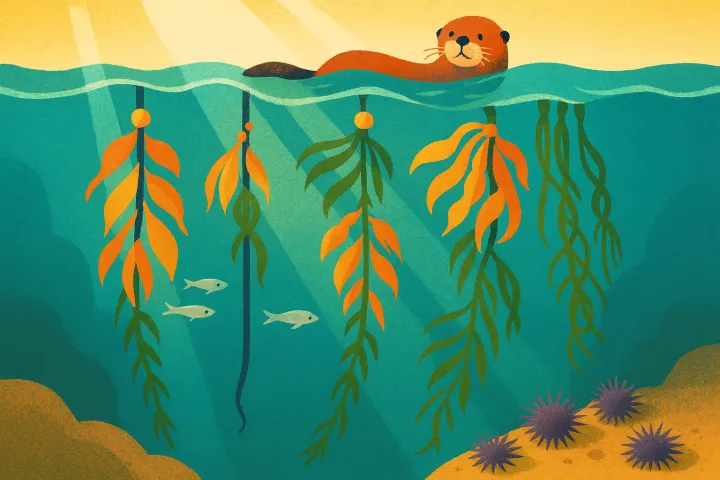
The stars weren’t the only blow. Their loss came at the same time as the 2014 to 2016 marine heatwave, and together the two set off a kelp collapse. The state’s Ocean Protection Council reports a 96% loss of kelp canopy on California’s north coast.3 With fewer predators around, urchins spread across reefs and ate the kelp down to bare rock. That matters to fishing, diving and tourism communities that rely on healthy kelp forests.
What the Divers Saw: Speed, Snacks and Suspense
Divers kept watch over the stars in two-hour sessions.1 One star covered more than 50 meters in two hours. That is more than half a football field, which, for a sea star, is basically a breakaway touchdown.1
The stars didn’t even have to catch an urchin to change its behavior. Urchins up to five meters away (about 16 feet) became less active, like an office going suspiciously quiet when the boss walks by. Researchers call this a “landscape of fear.”1
Most of the stars made it. Survival was 88 percent. Two of the 16 died, and one of those tested positive for Vibrio, so the disease remains a real risk.1
Reuven Bank, the lab’s executive director, summed up the results to Monterey County NOW:
“Across all experiments, what we saw was the strong restoration potential of sunflower stars to be able to transition urchin barrens back into healthy kelp forests.”
Getting to this point took years of breeding work. In 2025, the lab was raising 72 young stars. To get adults to spawn at the same time, researchers injected them with a hormone called 1-methyladenine, which is a lot less romantic than candlelight but apparently more reliable.4
What Happens Next: Moving In for Good
The summer trial was meant to clear the way for something bigger. “We did these studies to answer the key questions that we need to answer before we transition to permanent outplanting in our state, which is going to happen in the next one to three years,” Bank told Monterey County NOW. Outplanting means putting the stars on reefs to stay.1
The team also sees the coming El Niño, a natural pattern that brings warmer water, as a chance to learn how the stars handle heat.1
There is help on the way, too. In September 2025, California’s Department of Fish and Wildlife backed Ocean Protection Council funding for bringing the species back.6 And the wild population hasn’t vanished completely. Divers surveying Greater Farallones National Marine Sanctuary found 18 sunflower stars.5
The kelp forests haven’t come back yet, and 16 stars won’t clear a coastline of urchins. But the stars have now shown they can leave the lab, find dinner and grow. Somewhere on Tankers Reef, presumably, an urchin is drafting a very strongly worded letter to the neighborhood association.
Did this make your day? Give it a cheer.
Sources
- Lab-Grown Sunflower Sea Stars Tested in Monterey Bay Monterey County NOW, 2026-10-06
- These predators may soon restore California's battered kelp forests Los Angeles Times (via Yahoo News), 2026-10-08
- Bringing Back the Stars: California's Effort to Rescue the Sunflower Sea Star California Ocean Protection Council, 2026-03-01
- There's hope for sunflower sea stars, with their killer unmasked and reintroductions pending Mongabay, 2025-08-01
- Sunflower Star Sightings Spark Hope for Future of Kelp Forests NOAA Office of National Marine Sanctuaries, 2026-06-01
- Item 9 Public Comment (CDFW letter on sunflower sea star reintroduction funding) California Ocean Protection Council / CDFW, 2025-09-26