Jumping Spiders Sleep Upside Down, Twitch, and Make Up for Bad Nights
University of Bonn researchers filmed Portia fimbriata spiders sleeping upside down and found a twitchy, REM-like stage they make up after a rough night.

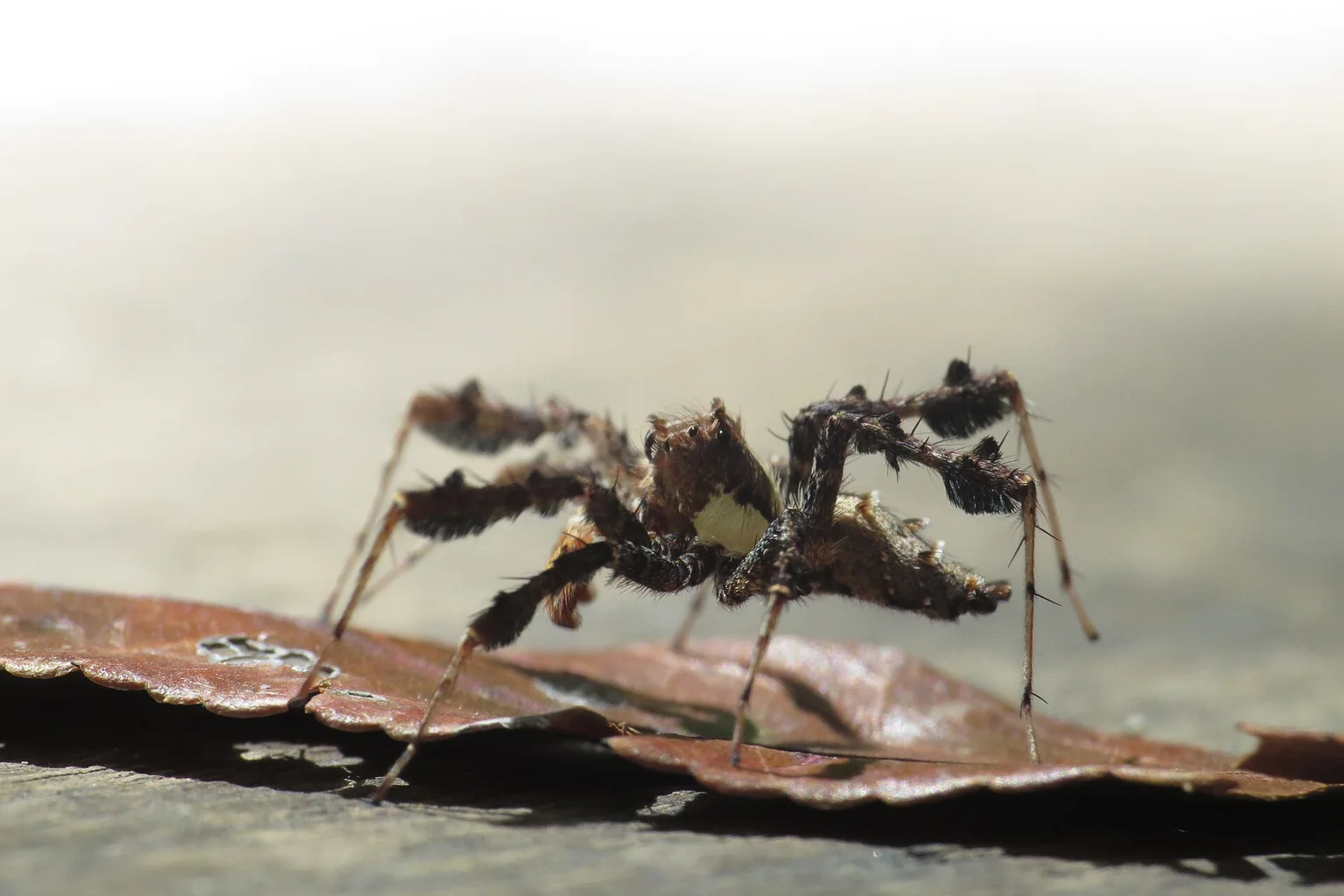
Researchers at the University of Bonn in Germany report that the Australian jumping spider Portia fimbriata has a regulated, two-stage sleep that includes recurring REM-like episodes of twitching, leg curling and eye movements. In their study, published Oct. 26 in PNAS, spiders whose sleep was disrupted made up for it with extra REM-like sleep the next night.13
The finding matters because it suggests that sleep with distinct stages, long studied in mammals and birds, may be far older and more widespread than it looks. It also gives sleep scientists a small, eight-legged new subject to study.3
There is an important limit. The team measured behavior only, not brain activity, so the study cannot say whether a spider experiences anything like a dream.24
Watching spiders sleep, on camera, for days
Behavioral ecologists Nadja Geiger and Daniela C. Rößler and their colleagues kept individual spiders in 12-centimeter plastic dishes and filmed them over several days and nights under changing light. Infrared cameras covered the dark hours.28
At night, a Portia spider settles upside down beneath a little silk platform it has spun. It then stays very still for long stretches, broken by short bursts of twitching, occasional leg curling and movement of the long retinal tubes inside its head.48
In ten test spiders, those REM-like bouts lasted about 83 seconds on average. The group logged 109 episodes in all, roughly 11 per spider per night. The spiders spent an average of about 10.7 hours in the sleeping posture, which is more than plenty of the adults reading about them manage.48
Rößler told NPR that a spider in this state looks “very similar to a dog or a cat when it’s in REM sleep.”6
How the team tested whether it was really sleep
Twitching alone doesn’t prove anything, so the researchers checked how responsive the spiders were. During REM-like episodes, the spiders reacted more slowly to a sound. Four of the ten didn’t respond at all within a 10-second window, then responded right away when the same test was repeated while they were awake.4
The paper also reports that the spiders are active by day, keep a circadian rhythm (an internal daily clock) that runs on its own without light cues, and have a consistent sleep structure. The authors conclude that this is behavioral sleep with a REM-like substate in a land-dwelling invertebrate, meaning an animal without a backbone.1
A rough night, then a catch-up
The most striking result came when the team disrupted the spiders’ sleep. The following night, the spiders spent nearly 80% more time in REM-like behavior, according to coverage of the study. Scientists call this a REM rebound, and people and many other mammals show it too.3
“To our knowledge, this is the first demonstration of REM rebound in an invertebrate,” Geiger and Rößler wrote, as quoted by ScienceAlert.3 A rebound matters because it suggests the REM-like state is something the body regulates and needs, not just random fidgeting.
Building on earlier spider research
The new work follows a 2022 PNAS study of a different jumping spider, Evarcha arcuata. In that study, researchers watched young spiderlings whose see-through exoskeletons let them observe the retinal movements directly. They saw the same periodic eye movements, limb twitches and leg curling.47
The Bonn team argues that its findings suggest distinct sleep stages may have very deep evolutionary roots.36 What a sleeping spider experiences, if anything, is a question the movements alone can’t answer.24
Did this make your day? Give it a cheer.
Sources
- Behavioral evidence for two-stage sleep in spiders Proceedings of the National Academy of Sciences (PNAS), 2026-10-26
- Two distinct sleep stages emerge in jumping spider, including a REM-like state Phys.org, 2026-10-26
- First Evidence of Sleep Rebound Discovered in an Invertebrate ScienceAlert, 2026-10-26
- Highly intelligent spiders may dream like us New Atlas
- These spiders sleep like humans. But do they dream? Science (AAAS) news
- We all need sleep. Even spiders NPR, 2026-11-02
- Regularly occurring bouts of retinal movements suggest an REM sleep–like state in jumping spiders PNAS / PubMed Central (2022 study), 2022-08-01
- Do Spiders Dream? Scientists Discover Their Sleep Is Strangely Similar to Ours ZME Science, 2026-10-28