Tiny Crystals Point to Lost Himalaya-Sized Mountains Under Antarctica
Scientists in Australia and Germany read 1,712 zircon grains from ocean sediments to trace ancient Antarctic ranges that may have helped animal life take off.

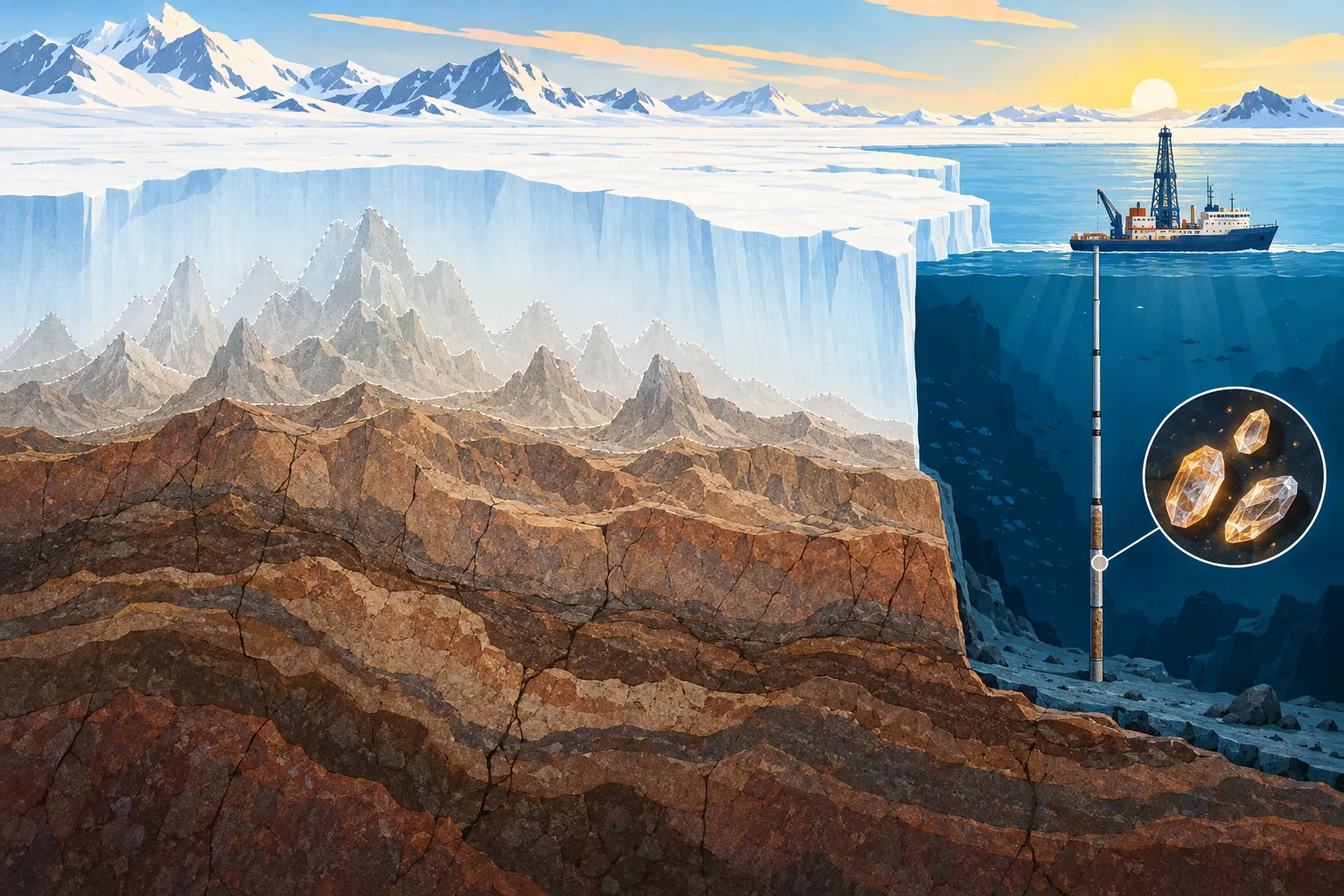
Researchers from the Australian National University and Germany’s GFZ Research Centre for Geosciences report evidence that the eroded roots of Himalaya-scale mountain ranges lie beneath Antarctica’s ice. The ranges formed 650 to 450 million years ago. ANU announced the work on Nov. 18, 2026. The team based it on 1,712 zircon grains from ocean-floor sediments.12
The mountains were not seen or mapped directly. The team inferred them from the age and chemistry of those crystals. Only the worn-down roots remain today, so “Himalaya-sized” describes the ranges as they once stood, not peaks hiding under the ice now.1
The finding matters for two reasons. It shows a way to study Antarctica’s hidden geology without drilling through the ice. The researchers also propose that these mountains, as they wore away, may have helped set the stage for an early burst of animal life. That second part is a hypothesis, not a proven result.1
How to study a continent you can’t see
Geologists who want to study Antarctic rock face a practical problem. More than 99.5% of the continent is covered by thick ice.1
So the team turned to the ocean instead. They used young sediments sampled by ocean drilling of Antarctica’s continental margin. The samples came from the Australian IODP Office’s Scientific Ocean Drilling Program, which also funded the research.12
Zircons are mineral grains whose age and chemistry reveal when major geological events happened and under what conditions their source rocks formed. The team dated and analyzed 1,712 of them. Grains that formed under high pressure mark the roots of Himalayan-style mountains that have since eroded away.12
When Antarctica ran into India and Africa
According to the study, the ranges rose as Antarctica collided with India and Africa while the supercontinent Gondwana was coming together.12
“They are by far the largest mountain-building events to have affected Antarctica,” co-author Ian Campbell, an emeritus professor at the ANU Research School of Earth Sciences, said in the university’s announcement.1
The team calls these ranges the Gondwana Supermountains. The paper appears in the journal Earth and Planetary Science Letters. Coverage of it quotes the authors concluding that Antarctica’s ancient tectonics were dominated by Himalayan-style mountains whose roots now sit under the ice sheet.3
A possible link to the rise of animals
The bigger idea in the study is about life. Rapid erosion of mountains lowers carbon dioxide in the air, raises oxygen and supplies nutrients to the oceans, the ANU release explains.1
The researchers suggest that as the Gondwana Supermountains eroded, organic carbon got buried in large river-delta deposits, which helped sustain higher oxygen levels. They say this may help explain the conditions behind the Cambrian explosion, the stretch of time when complex animal life spread quickly through the oceans.12
Campbell says the mountain-building correlates with the appearance of the first shellfish 539 million years ago, with the Cambrian explosion following some 10 to 30 million years later.1
“It is unlikely to be a coincidence that Earth’s dramatic period of evolution coincides with Earth’s most important period of mountain building: the formation and erosion of the Gondwana Supermountains,” Campbell said in the ANU release.1
The work joins other recent efforts to see under Antarctica. Euronews points out that a separate study, published in Science in January 2026, used satellite and ice-flow analysis to map nearly 72,000 previously unknown hills and ridges beneath the ice.2 For a continent that is almost entirely buried, the landscape underneath is turning out to be fairly busy.
Did this make your day? Give it a cheer.
Sources
- Discovery of previously unknown Gondwana Supermountains found under Antarctic Ice ANU College of Science and Medicine, 2026-11-18
- Himalaya-sized ancient 'supermountains' found beneath Antarctica's ice sheet Euronews, 2026-11-20
- 'Supermountains' Buried Under Antarctica Fueled Explosion of Life, Scientists Discover 404 Media
- Supermountains under Antarctica may have helped life explode Techlicious, 2026-11-20
- Scientists uncover ancient Himalayan-scale mountains beneath Antarctic ice Xinhua, 2026-11-20