Self-Compassion Break: A Free Berkeley Exercise for Your Harshest Critic, You
UC Berkeley's Greater Good Science Center offers a free five-minute exercise for meeting stress with kindness instead of self-criticism. Here are the steps.


Greater Good in Action, a project of UC Berkeley’s Greater Good Science Center in Berkeley, California, offers a free five-minute Self-Compassion Break. The exercise is based on the work of psychologist Kristin Neff and is meant to help people respond to stress with kindness instead of self-criticism.1 It is part of an eight-week program that a small 2013 trial linked to less stress and more life satisfaction.12
The idea starts with a familiar habit. According to the Greater Good page, people often judge themselves more harshly than they judge others, and that can leave them feeling isolated, unhappy and more stressed.1
Following Neff, the page describes self-compassion as having three parts. The first is mindfulness, which means noticing what you feel without judging it. The second is a sense of common humanity, and the third is self-kindness. The page says research suggests that people who treat themselves with compassion rather than criticism in hard times experience greater physical and mental health.1
The site rates the exercise’s difficulty as Casual and lists it as a once-a-day practice.1
The steps
1. Pick a situation that is hard, but not too hard. Choose something stressful in your life and bring it to mind. The page advises beginners to start with something moderately difficult rather than overwhelming.1
2. Name what is happening. Say to yourself, This is a moment of suffering. You can also say This hurts or This is stress. The page calls this step a form of mindfulness.1
3. Remember that you are not the only one. Tell yourself Suffering is a part of life, or I’m not alone, or We all struggle in our lives. This is the common-humanity part.1
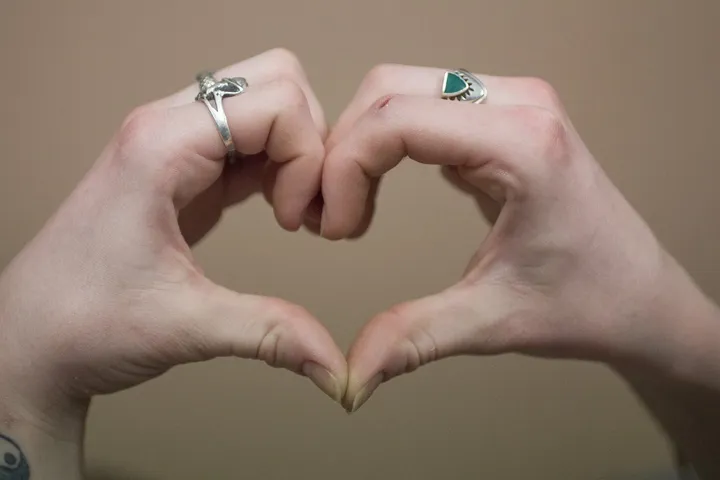
4. Put your hands over your heart. Rest them there and notice their warmth.1
5. Offer yourself a kind phrase. The suggested line is May I be kind to myself. If something else fits better, the page offers swaps such as May I forgive myself, May I be strong or May I be patient.1
6. Practice when things are calm, and start small. The page says the break can be done any time of day or night. Practicing in calmer moments may make the three parts of self-compassion easier to reach for when stress hits. The page also admits that doing it every time stress shows up may be hard, and suggests a first goal of at least once a week, a target clearly set by people who have met humans.1
If you would rather be talked through it, the page links to a guided audio version from Neff’s self-compassion.org. It also offers a free PDF and a print version.1
What the research does and doesn’t show
The main study behind the page is a 2013 paper by Neff and Christopher Germer in the Journal of Clinical Psychology. It tested the full eight-week Mindful Self-Compassion program, which includes the break. It did not test the five-minute exercise by itself.12 The program met for 2.5 hours a week for eight weeks.3
The paper reported two studies. A pilot with 21 community adults found significant gains from before to after the program. A randomized trial then found that people in the program reported larger increases in self-compassion, mindfulness and wellbeing than a control group, along with less depression, anxiety and stress.12
That trial was small. It had roughly 25 people in the program group and 27 on a waitlist. Participants were mostly women with an average age of about 50.3 The Greater Good page notes that they were largely Caucasian and says more research is needed on other groups and cultures.1
A review by the program’s developers reported that the program raised participants’ self-compassion by 43%.3 The page also describes a study in Slovakia, where a program based on Mindful Self-Compassion boosted self-compassion and self-reassurance for two months. It mentions a pilot study with depressed graduate students in China as well.1
The break is a self-help practice, not a treatment for depression or anxiety. As a free, five-minute way to talk to yourself a little more gently, it asks very little. Once a week is a fine place to start.
Did this make your day? Give it a cheer.
Sources
- Self-Compassion Break | Practice | Greater Good in Action Greater Good Science Center, UC Berkeley
- A pilot study and randomized controlled trial of the mindful self-compassion program - PubMed PubMed / Journal of Clinical Psychology (Neff & Germer, 2013), 2013-01-01
- Self-Compassion in Clinical Practice (Germer & Neff) Journal of Clinical Psychology: In Session, hosted on self-compassion.org, 2013-08-01