Red Crab Count Reportedly Tops 100 Million as Christmas Island's March to Sea Begins
Conservationists say over 100 million red crabs on Australia's Christmas Island began their march to the sea in November, up from about 50 million.

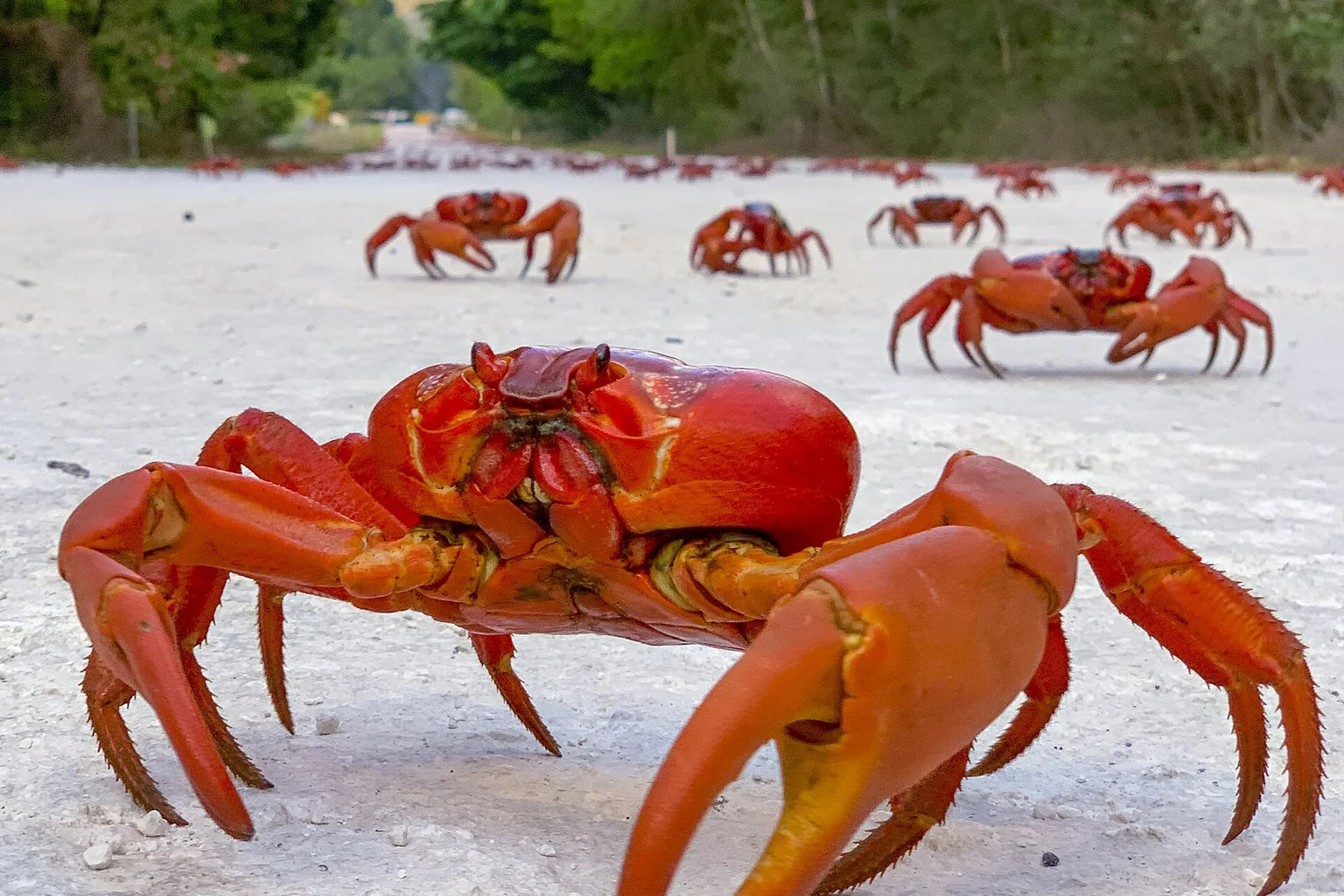
More than 100 million red crabs on Australia’s Christmas Island began their yearly migration from the forest to the sea in mid-November 2026, according to conservationists quoted by AFP. Parks Australia says the population has rebounded from about 50 million after work to control invasive yellow crazy ants.1
The march itself is not new. It happens every year. The news this season is the headcount. The 100 million figure and the 50 million starting point both come from conservationists and Parks Australia, and other outlets covering this year’s migration describe “millions” of crabs on the move.12
Christmas Island covers just 135 square kilometers and sits 350 kilometers south of Indonesia, more than 1,000 kilometers from the Australian mainland. Conservationists there spend months preparing for the migration.1 That is not a lot of island for 100 million of anything with claws.
Rain starts it, the moon times it
The migration begins when the rainy season arrives. Rain is the signal, and the males set off first, with the females joining them on the way to the ocean.2
The timing is tied to the lunar cycle. According to Parks Australia, the crabs aim to spawn before dawn on a receding high tide during the moon’s last quarter.1
By Nov. 15 to 17, the migration was under way. Video from Parks Australia showed crabs crossing the island’s crab bridge over a road.34 Temporary road closures help the crabs cross safely.2 On most islands, a closed road means construction. On this one, it means crabs.
The ant problem behind the comeback
Yellow crazy ants are an invasive species. By occupying the crabs’ burrows, the ants displaced an estimated tens of millions of red crabs. Control efforts have allowed the population to climb back from around 50 million, conservationists said.1
“Ongoing conservation efforts have been crucial to the species’ recovery, particularly work to control yellow crazy ants, one of the biggest threats to red crabs,” Chris Chartres, Parks Australia’s Christmas Island National Park Manager, said in AFP’s report.1 The ants remain among those biggest threats.
Of the rebound, Chartres added: “That’s a great sign the population is thriving.”1
The crabs matter well beyond their numbers. “Red crabs are the island’s keystone species,” Chartres said. A keystone species is one that an ecosystem leans on heavily. Chartres described the crabs as critical to the health of the island’s forest, so when they do well, the whole ecosystem benefits.1
What happens next
The island’s tourism association lists possible spawning dates of Dec. 5 to 6, 2026, and Jan. 2 to 3, 2027. Each female can produce up to 100,000 eggs.5
The schedule is not always tidy. The migration usually begins with rain in October or November, but it can start as late as December or January. In 2024, it was delayed to February, the first delayed migration on record, which was attributed to dry weather.2
Did this make your day? Give it a cheer.
Sources
- Red crabs begin annual march to sea on Australia's Christmas Island AFP (via Yahoo News), 2026-11-19
- Millions of red crabs are on the move in Australia. Here's how rain and the moon set the pace AccuWeather, 2026-11-17
- WATCH: Red Crab migration underway as millions swarm Australia's Christmas Island WFLA, 2026-11-17
- Video: Millions of red crabs take over Australia's Christmas Island as they begin mass migration Fox Weather, 2026-11-17
- Red Crab Migration — Christmas Island Christmas Island Tourism Association