Christmas Island Gave Red Crabs Right of Way. Tens of Millions Took It.
Red crabs began their yearly march to the sea on Australia's Christmas Island in mid-November, crossing bridges and barriers built just for them.

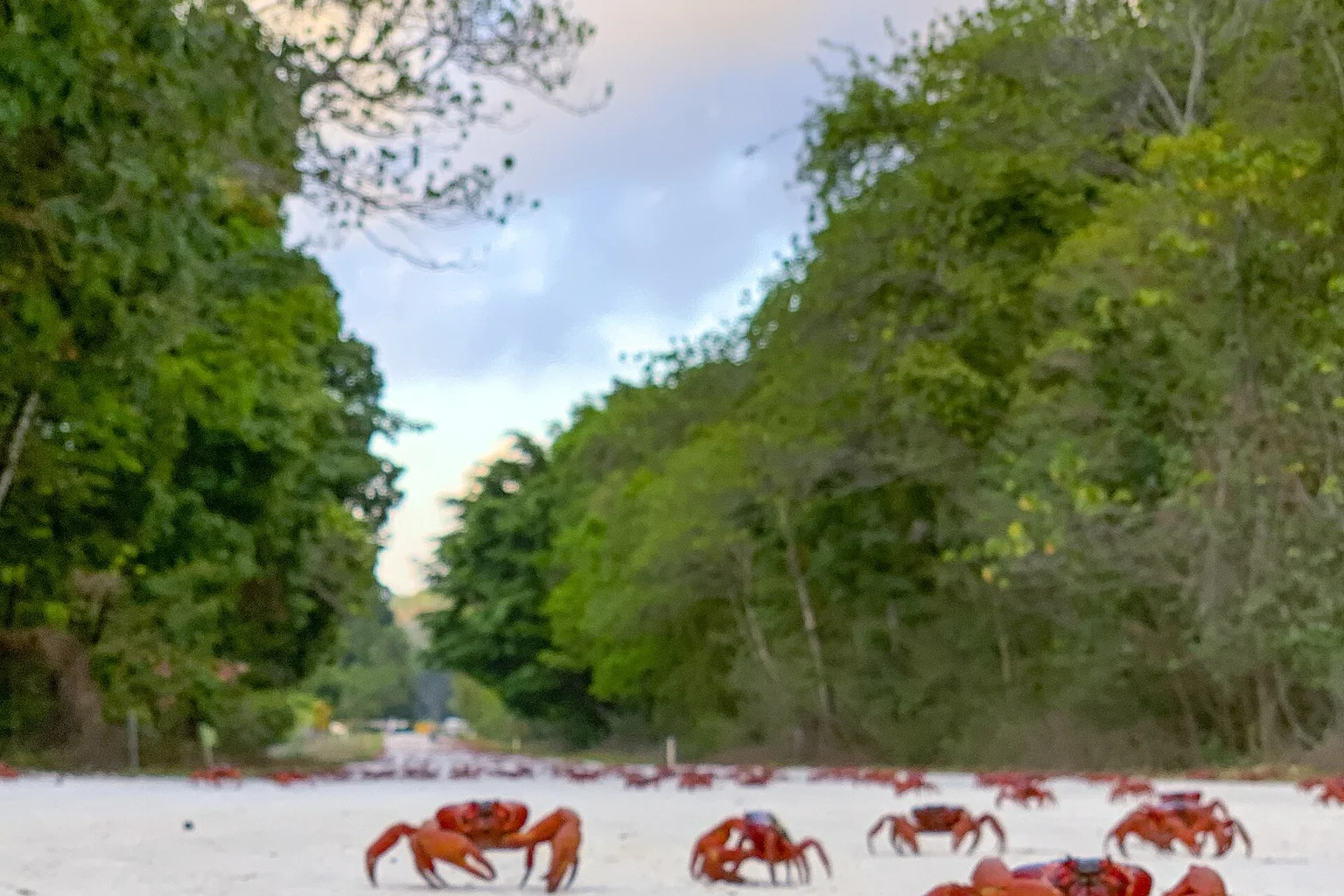
Tens of millions of red crabs began their annual migration on Australia’s Christmas Island on Nov. 14 and 15, leaving the island’s forests for the coast to breed. They spilled across roads and specially built crab crossings, steered by barriers that Parks Australia sets up each year to keep them away from traffic.12
The “tens of millions” figure is a rough estimate from news reports, not a count. Counting would mean finding a volunteer willing to tally a moving red carpet with legs.1
This is the start of the journey, not the main event. The crabs still have to reach the shore, and the egg-laying comes later, timed to the moon.12
A road system with crabs in mind
Parks Australia oversees and monitors the migration. According to the reports, its preparation starts months ahead. Staff clear underpasses, build crab bridges and put up kilometers of roadside barriers along with migration road signs.12
Road closure signs went up this year as well. For a few days, the crabs effectively have right of way, and they use it.1
The crab crossings sit where roads cut across the main migration paths. They are there to cut down the number of crabs killed by vehicles.4
The effort pays off in another way too. The migration is the island’s biggest tourist attraction.4
Rain starts it, the moon sets the schedule
The crabs head for the sea when the big rains of the wet season begin. Once they reach the coast, the timing gets exact.2
Females aim to release their eggs into the ocean before dawn, on a receding high tide, during the moon’s last quarter. Each female can carry up to 100,000 eggs.14
The males lead the march downhill, and the females join them later.4
Because the trip depends on rain, it doesn’t always arrive on cue. In 2024, dry weather pushed the migration back to February. That delay was described as the first in recorded history.5
More crabs than there used to be
The red crab is found only on Christmas Island, which covers 134 square kilometers.3
In October 2025, Christmas Island National Park’s threatened species coordinator told ABC News (Australia) that the population had climbed sharply. In the early 2000s it stood at about 55 million crabs. It is now about 100 million.3
Over the next weeks, the crabs that set out in mid-November will keep working their way down to the shoreline. There they will wait for the right tide and the right moon.12
Did this make your day? Give it a cheer.
Sources
- Video. Millions of red crabs begin annual migration on Australia's Christmas Island Euronews (No Comment), 2026-11-16
- Red crabs begin their annual migration on Christmas Island, Australia ABC7 New York (AP video report), 2026-11-16
- Millions of red crabs begin annual migration on Christmas Island as numbers 'skyrocket' ABC News (Australia), 2025-10-22
- Red Crab Migration — Christmas Island Christmas Island Tourism Association (christmas.net.au)
- 2024 in Christmas Island Wikipedia (citing DW and The Independent), 2024-02-19
- Millions of red crabs begin annual migration on Australia's Christmas Island AOL UK (republished Euronews text), 2026-11-16