Andromeda’s Bao Star Took 7 Years to Fall Into a Giant. Astronomers Watched.
In the Andromeda galaxy, a star lighter than the Sun spiraled into a supergiant 350 times the Sun's radius, in what astronomers say is very likely a stellar merger.

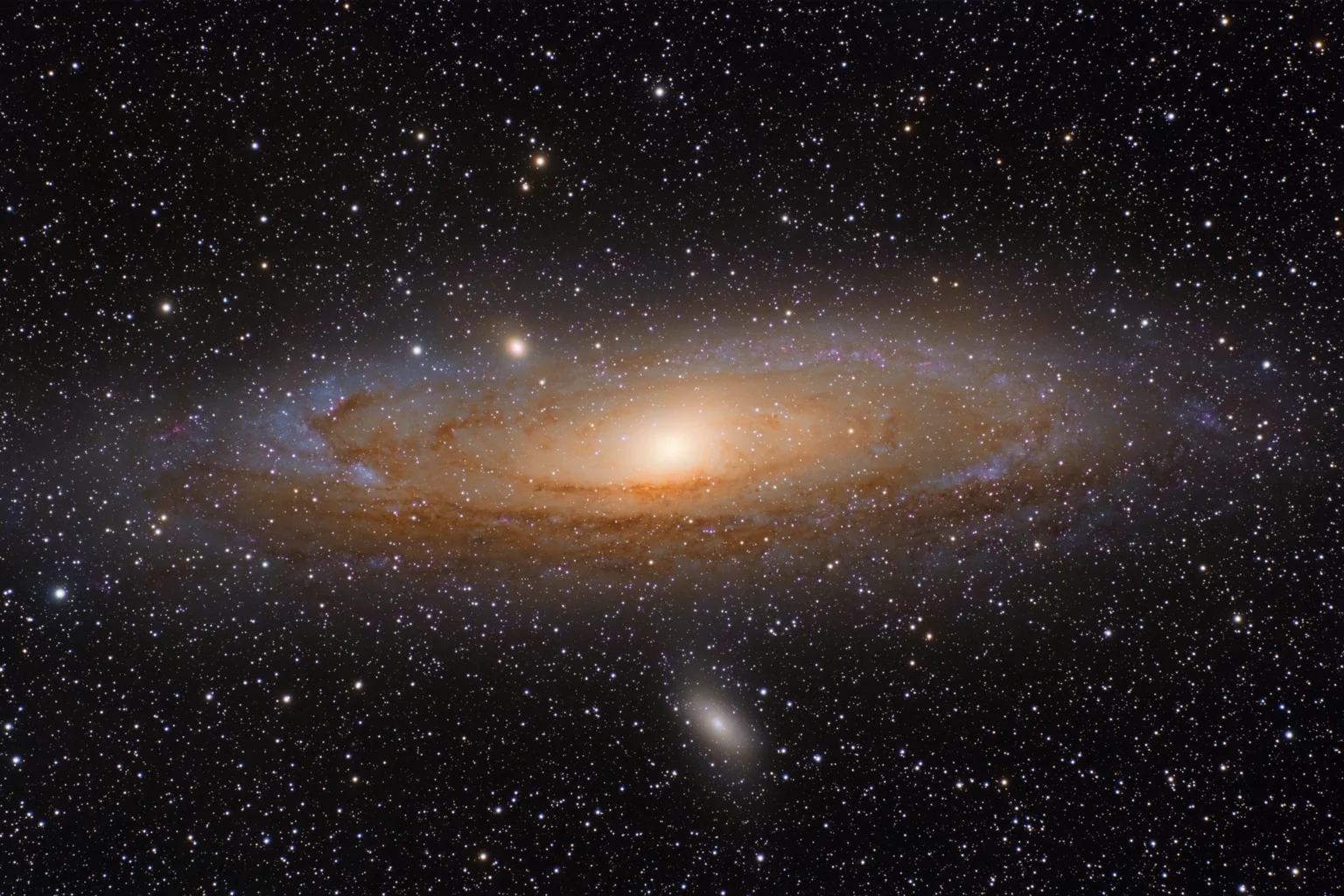
Astronomers led by Viraj Karambelkar of Columbia University reported in the journal Nature in November that a star slightly less massive than the Sun spiraled into a bloated supergiant on the outskirts of the Andromeda galaxy, and the evidence strongly points to the two merging. The system, nicknamed Bao, erupted in October 2025 after years of telescope monitoring.12
Catching a stellar merger in progress is hard. Astronomers have mostly seen only the final outburst, said team member Morgan MacLeod of the Harvard-Smithsonian Center for Astrophysics. This time they followed the whole approach.3
“Stellar mergers are very, very difficult to observe in real time because they are hard to predict,” Karambelkar said, as quoted by Sci.News.2
Big Bao and Little Bao
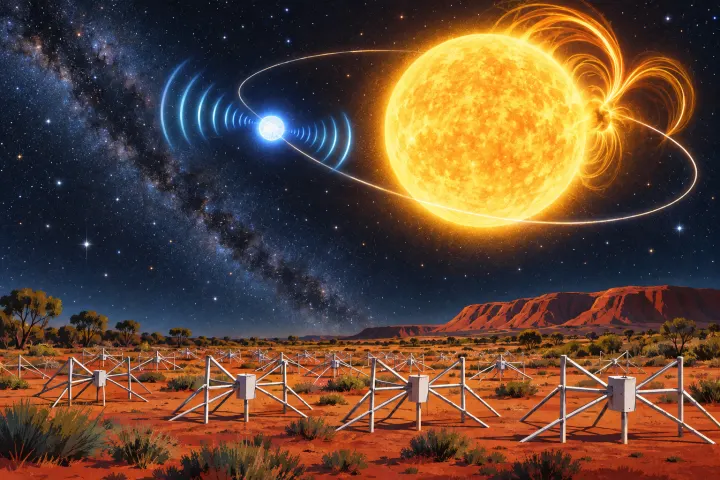
The team’s modeling describes a lopsided pair. “Big Bao” weighed about seven times as much as the Sun, stretched to 350 times the Sun’s radius and shone 18,000 times brighter. “Little Bao” came in at about 0.7 solar masses, which NASA says is the first mass estimate for the smaller companion.12
Once the small star touched the giant’s surface, the end came quickly by stellar standards: seven orbits, or about seven years. The eruption flung out roughly 0.1 to 0.2 times the Sun’s mass in material.2
How the evidence piled up
The team first noticed an oddly behaving star in February 2023 in data from NASA’s NEOWISE infrared survey. Older records showed it had held a steady brightness from 1989 to 2018, then started brightening.1
After that, a long list of telescopes took turns. The WINTER near-infrared camera saw it brighten and shed dust in September 2024. NASA’s SPHEREx saw it fade in visible light and rise in near-infrared in July 2025. The Zwicky Transient Facility caught the eruption in visible light on Oct. 17, 2025, and follow-up came from the Himalayan Chandra Telescope, Swift, Gran Telescopio CANARIAS, Gemini North and NASA’s Infrared Telescope Facility.1
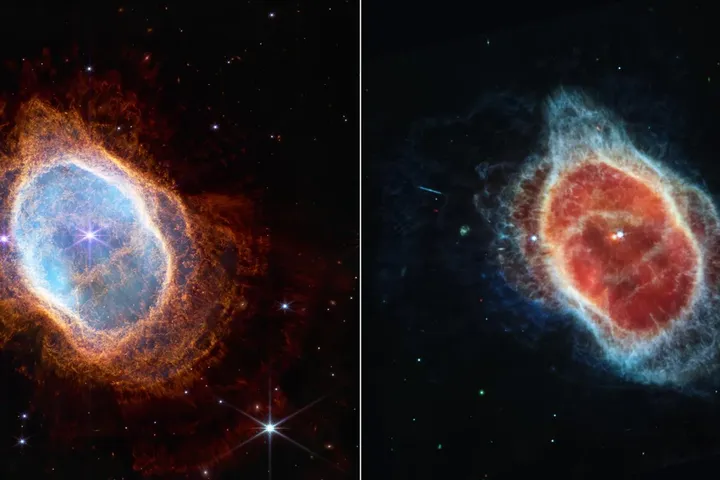
The James Webb Space Telescope came last. On Dec. 24, 2025, it spent about three hours of Christmas Eve looking at Bao in mid-infrared light. That was 47 days after the eruption peaked, which Sci.News describes as the earliest-ever follow-up of an event like this.12
Webb’s view let the researchers trace dust the big star had ejected over centuries, including almost two months after the merger. NASA says matching that data to the team’s simulations proved the stars merged. Webb was the final piece, not the whole puzzle: the case rests on years of data from many instruments.1
Other accounts are more cautious. Sci.News notes that future observations will be needed to confirm conclusively that the two stars fused, and Phys.org says merger was not the only possible outcome before further analysis favored it.24
Why astronomers care
NASA and the authors describe Bao as a first-of-its-kind event. Sky & Telescope backs that up as the first time the full seven-year infall was followed.13
It also gave theorists something they rarely get: a real test. When two stars end up sharing one swollen outer layer, astronomers call it common envelope evolution. NASA says this was the first time telescope data directly measured how efficiently that process works.1
Jason Nordhaus of the Rochester Institute of Technology, who wrote a perspective piece in the same Nature issue, says the observations confirmed theorists’ ideas about how such mergers happen. They suggest convection, the churning of hot gas, helps carry energy outward toward the giant’s surface.3
What Bao is now remains an open question. The team describes the single star left behind as potentially “rejuvenated,” a possibility rather than a finding.12
Did this make your day? Give it a cheer.
Sources
- AT 2025abao in the Andromeda Galaxy - NASA Science NASA Science (STScI/Goddard), 2026-11-18
- Webb Catches Giant Star Swallowing Its Smaller Companion in Andromeda Galaxy Sci.News, 2026-11-19
- Astronomers Watch One Star Swallow Another Sky & Telescope, 2026-11-19
- Webb confirms first-of-its-kind merger of a supergiant and smaller sun-like star Phys.org, 2026-11-19
- NASA Data Clinches First-of-Its-Kind Stellar Merger Newswise (republished NASA release), 2026-11-18