Wildcat Kittens Born in Czech Mountains, but Mom's DNA Is Unconfirmed
Camera traps in Czechia's Lusatian Mountains recorded a DNA-confirmed male wildcat and a female who gave birth to at least three kittens in 2025.

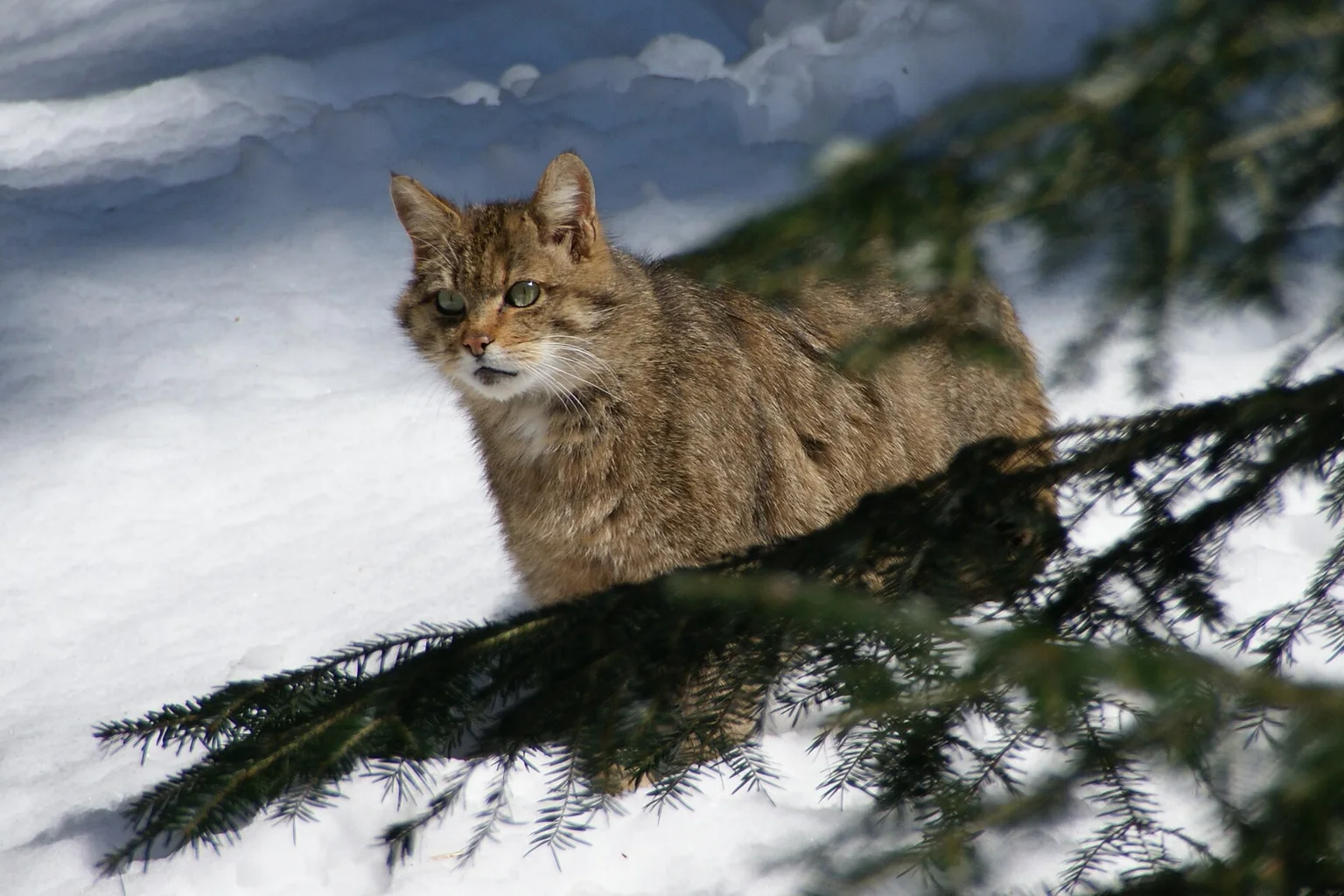
In the forests of the Lusatian Mountains, on the Czech Republic’s border with Germany, camera traps spent 2025 recording two cats called Jonáš and Tonka. In spring, Tonka gave birth to at least three kittens.15
Jonáš is the confirmed part of the story. DNA from hair and scat collected in the field was analyzed at the Czech Academy of Sciences’ Institute of Vertebrate Biology. It showed he is a European wildcat, a forest predator long considered extinct in the country and still critically endangered there.135
Tonka’s ancestry has not been verified, because no suitable genetic sample was obtained. That means nobody knows yet whether her kittens are pure wildcats or hybrids with domestic cats.15
The obstacle was closeness. Zoologist Jarmila Krojerová of the Academy of Sciences explained that the two adults moved around the area so intensively that it was hard to find a sample without DNA from both of them.5 Two cats walking the same paths is nice for a nature story and inconvenient for a geneticist.
Tracks in the snow
The trail began in winter 2022, when volunteers with the Wolf and Lynx Patrols noticed the tracks of a small cat in the snow. The tracks led to a spot where a camera trap later photographed a wildcat. The monitoring is part of long-term work by the conservation group Hnutí DUHA Šelmy.15
Czech conservationists describe genetically confirmed wildcat births in the country as extremely rare. Mongabay reported that the Lusatian litter shows this forest is still suitable for the species.3
Not the first litter, but part of a pattern
For decades, the country had no reliable sign of wildcats at all. A 2013 paper reported that no reliable evidence existed after the last known individual was shot in 1952. It presented camera-trap pictures from Šumava in 2011 and the Western Carpathians in 2013 as reliable proof the animals were present.6
After that, the records added up. A 2022 paper in the journal Lynx, published by the National Museum in Prague, analyzed 616 reliable wildcat records in Bohemia over 11 monitoring seasons, from 2010 to 2021. Camera traps supplied 95% of them, and the rest were verified genetically.4
The paper found wildcats in eight parts of Bohemia, most consistently in the forested border areas of the south and west. It links the western cats to neighboring Germany and names Bavarian reintroduction, a growing population there and climate change as possible drivers.4
The same paper confirmed reproduction in Doupovské hory in 2020 and Český les in 2021, which it called the first documented wildcat reproduction in Bohemia since World War II. So the Lusatian litter is not the first. It adds another place where wildcats appear to be raising young.4
Wildcats are returning to other parts of Czechia too, in low numbers. “This is pure natural dispersal, not assisted by humans,” Martin Duľa, a researcher at Mendel University in Brno, said in Mongabay’s report. He also cautioned that “it’s still an elusive species and very rare.”3
A patchy picture across Europe
Across its whole range, the European wildcat is rated “least concern” on the IUCN Red List. It is recovering in Germany and France, and Italy downgraded its threat status in 2022.23
Elsewhere, things look worse. The wildcat is functionally extinct in the wild in Scotland, where a reintroduction program is under way, and about 100 remain in Portugal, where numbers are still falling. Mongabay notes that interbreeding with domestic cats is a major challenge in Czechia, just as it is in Scotland.3
For now, the origin of Tonka and her kittens stays open, because no suitable genetic sample has been obtained.15
Did this make your day? Give it a cheer.
Sources
- Kočka divoká je zpět: v Lužických horách letos úspěšně vyvedla mláďata Hnutí DUHA Šelmy (selmy.cz), republishing the Czech Academy of Sciences release of 2025-12-08, 2025-12-08
- European Wildcats Are Slowly Making a Comeback in the Forests of Central Europe Discover Magazine, 2026-02-02
- The European wildcat hovers between recovery and local extinction Mongabay, 2026-05-11
- Verified occurrence of Felis silvestris in Bohemia (Czech Republic) in 2010–2021 (Carnivora: Felidae) Lynx, n. s. (Národní muzeum / National Museum, Prague), 2022-01-01
- Kočka divoká se vrátila do Lužických hor iROZHLAS (Czech Radio), 2025-12-08
- New records of Felis silvestris in the Czech Republic (Carnivora: Felidae) ResearchGate (abstract of Lynx paper, 2013), 2013-01-01