The Orca Who Carried Her Lost Calf 1,000 Miles Is Nursing a New Son
The days-old male, J65, shows no signs of health issues so far and brings the endangered Southern Resident orcas to 77, though the first year is hard.

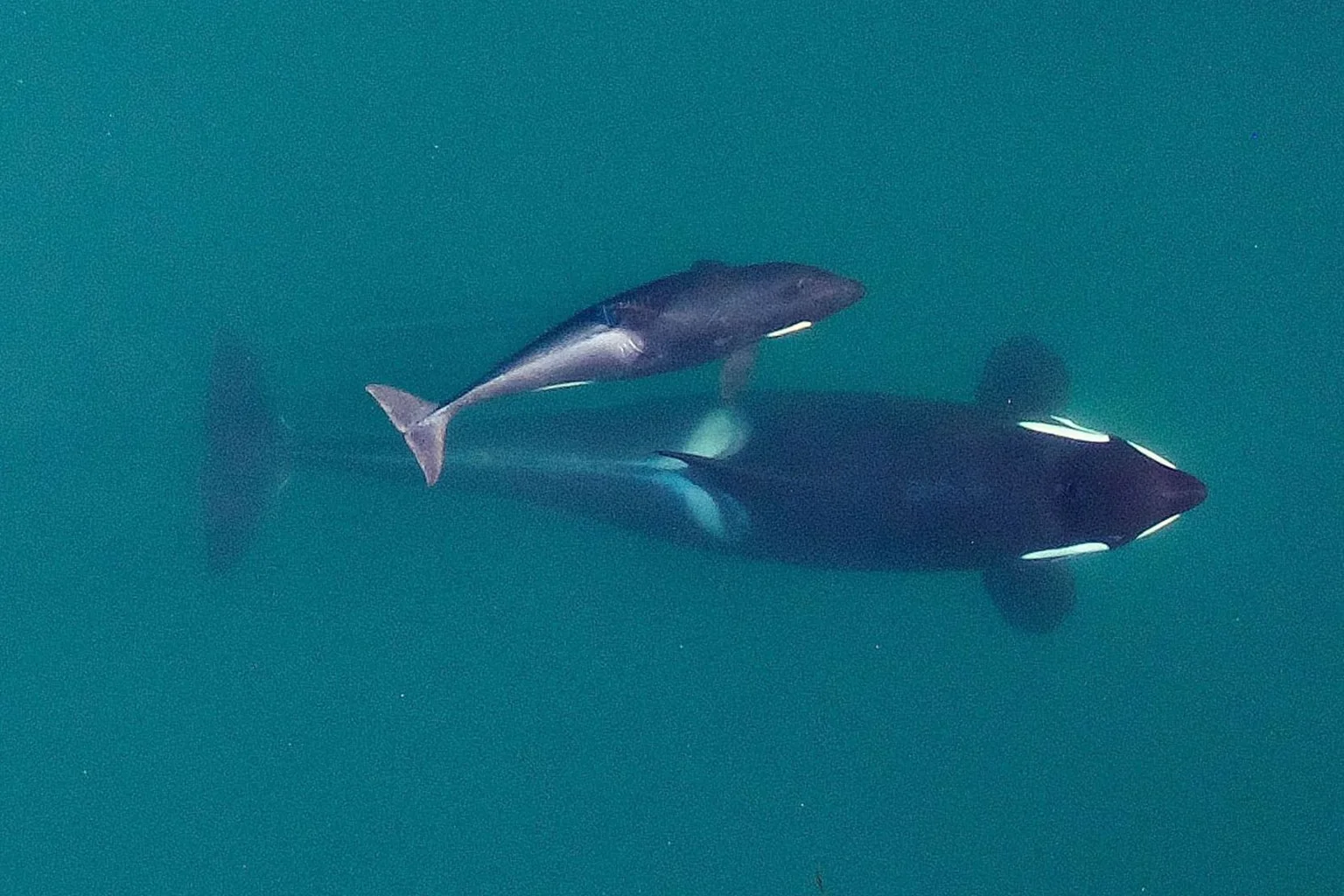
The orca known as J35, or Tahlequah, has a new calf. Researchers with the Center for Whale Research spotted a very young whale traveling with her on Oct. 19, 2026, in the waters of the Salish Sea.1 Based on the calf’s appearance and J35’s earlier sightings, the team judged it to be less than a week old and gave it the name J65.2
The researchers found the pair together again the next day, and drone footage confirmed the calf is a male.1
The birth matters because the Southern Resident killer whales are endangered and few in number. The population stood at 76 as of July 1, so J65 brings it to 77.5
A good start, with an honest caution
So far, the signs are encouraging. The team watched the calf move well, socialize and nurse from his mother, and saw no signs of health issues.3
“Our team saw no immediate indication of health issues in the calf,” Dr. Michael Weiss, research director at the Center for Whale Research, said in the center’s statement.1
That good start comes with a hard number. Only about half of Southern Resident calves survive their first year, and the center plans to keep checking on J65 when it can.2 “Early life is challenging for these whales, with only half of them making it through their first year,” Weiss said, as quoted by KOMO News.3
Why so many people know this mother
J35 became widely known in 2018. After her female calf died, she was seen carrying its body for 17 days.1 According to the center, as cited by CBS News, that journey covered about 1,000 miles.7
The center counts J65 as her sixth documented calf.4 Her firstborn, son J47, arrived in 2010 and is now a teenager. Son J57 followed in 2020.1 In 2024 she gave birth to daughter J61, who did not survive. J35 carried that calf’s body as well, and a 2025 sighting confirmed she was no longer doing so.7
The new arrival comes in a month that has also brought loss. Earlier in October, another Southern Resident, J31, was seen with a dead calf near Sombrio Point on Vancouver Island.4
A population that grows slowly
The center says 2026 is the second year in a row that the Southern Residents have grown. Even so, the population remains smaller than it was historically, and it reproduces more slowly than other killer whale populations.5
These orcas mainly eat Chinook salmon, and their survival depends on how much of that fish is available.5
Did this make your day? Give it a cheer.
Sources
- Center for Whale Research reports new calf in J Pod! The Journal of the San Juan Islands (CWR statement, 'Submitted by the Center for Whale Research'), 2026-10-21
- CWR encounters new baby orca theOrcasonian.com (CWR statement), 2026-10-21
- New baby orca spotted in J Pod of endangered Southern Resident killer whales KOMO News, 2026-10-21
- Mother orca who carried her dead calf for 17 days in 2018 has given birth again CBC News, 2026-10-21
- Southern resident orcas: New calf discovered CP24 / The Canadian Press, 2026-10-21
- Orca mother known for 'tour of grief' welcomes new calf Yahoo News Canada, 2026-10-21
- Orca carrying dead calf Tahlequah killer whale CBS News, 2025-01