PFAS Filters Are Basically Storage Units. A Lab Membrane Is More of a Shredder
Arizona State researchers used palladium and hydrogen to break down six PFAS in a 58-day lab test, though the pricey metal and engineering remain hurdles.

A team led by researchers at Arizona State University says it has built a membrane that breaks “forever chemicals” apart instead of just filtering them out. According to the university’s release, in a 58-day lab test it removed more than 90% of each of six PFAS of regulatory concern from water.1 It is still a lab-scale result, and the metal that makes it work is pricey.
Breaking PFAS apart matters because most common cleanup methods don’t get rid of them. Activated carbon, ion exchange and membrane filters catch PFAS, but the chemicals end up in used filters, salty brines or concentrated waste that someone still has to deal with.1 The problem gets moved, not solved.
Why PFAS are so hard to break
PFAS are built around carbon-fluorine bonds, and those bonds are famously stubborn. “It’s called the strongest bond in organic chemistry,” Bruce Rittmann, director of ASU’s Biodesign Swette Center for Environmental Biotechnology, said in the university’s announcement.1 “PFAS are hard to break down, and normal processes that we use don’t work,” he said.1
PFAS exposure has been associated with cancers, thyroid disease, immune effects, reduced fertility and other health problems. Two types, PFOS and PFOA, are listed under the Stockholm Convention.1 “We all have PFAS in us,” Rittmann said.1
How the membrane works
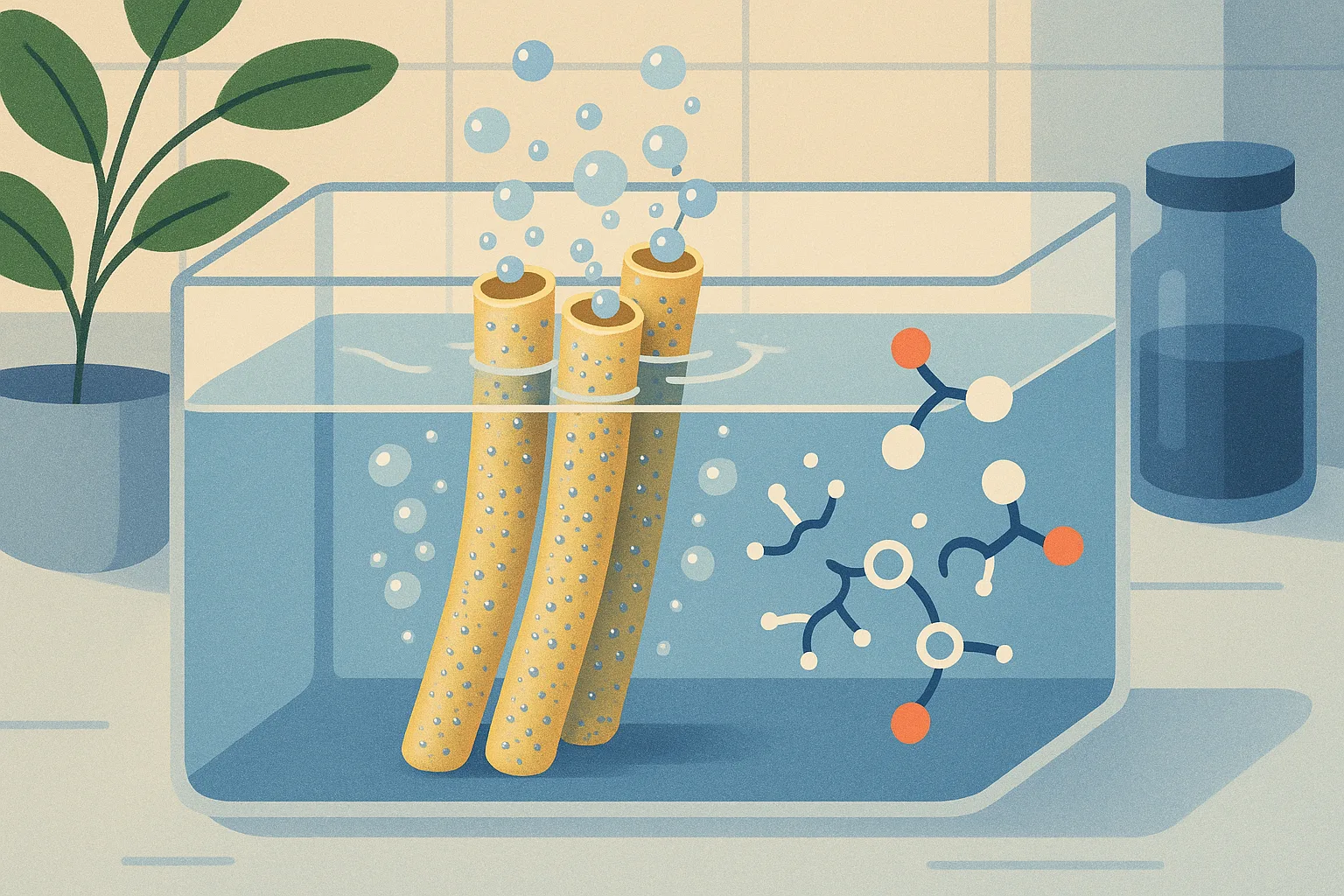
The team coated tiny membrane fibers with palladium nanoparticles, which are specks of metal far too small to see, and fed hydrogen gas through the fibers. The palladium splits the hydrogen into reactive atoms that attack the carbon-fluorine bonds.14 This process of stripping off fluorine is called defluorination.
The palladium also pulls PFAS molecules out of the water, so the two ingredients meet right at the metal’s surface. “The palladium attracts the PFAS molecule, and the palladium attracts the hydrogen and puts them together,” Rittmann said.1
The hydrogen comes from inside the membrane, straight into the base of the palladium layer, rather than being mixed into the water. The release calls this inside-out delivery a key advance of the study.1
The design has a past life. Rittmann’s group originally built this kind of membrane to deliver hydrogen to bacteria that break down pollutants. In the new version, palladium replaces the microbes.1
What the test showed, and what it didn’t
The team ran the system continuously for 58 days on water containing a mix of six PFAS. According to the university’s release, it removed more than 90% of each compound and stripped about 83% of the fluorine overall.12 By those figures, destruction was substantial, though not complete. “We showed that this mechanism worked for all six,” Rittmann said.1
The numbers come from the team’s own lab work, published in the Proceedings of the National Academy of Sciences with collaborators from Rice University, Tongji University, the National University of Singapore and Nanjing University.1
Then there is the bill. “Palladium is expensive,” Rittmann said, a sentence doing a lot of quiet work for a metal that runs about $50,000 per kilogram. Cutting the amount needed is one of the group’s top research priorities, and the release says practical water treatment will need further engineering.1
The membrane wouldn’t have to replace today’s filters to be useful. It could work alongside them: conventional treatment would first concentrate PFAS into a small waste stream, and the catalytic membrane would then destroy that concentrated waste.14
Rittmann’s group is now developing hybrid versions that pair palladium nanoparticles with pollutant-degrading bacteria. He says the hybrid also works.1

Did this make your day? Give it a cheer.
Sources
- New 'hunter-killer' chemistry captures and destroys forever chemicals Phys.org (ASU release, provided by Arizona State University), 2026-10-19
- New 'Hunter-Killer' Chemistry Captures And Destroys Forever Chemicals Eurasia Review, 2026-10-19
- New palladium-coated membrane destroys over 90% of forever chemicals in water Interesting Engineering, 2026-10-20
- Palladium membrane removes and defluorinates six PFAS Bioengineer.org, 2026-10-20
- International research finds way to destroy PFAS Waste Management Review, 2026-10-20