Manhattan’s Barn Owls Only Show Up in Full Dark, Which Makes Binoculars Optimistic
Photographer D. Bruce Yolton tells Hooray News the Upper West Side family of five young and two adults is using its water tank less as the owlets head off.

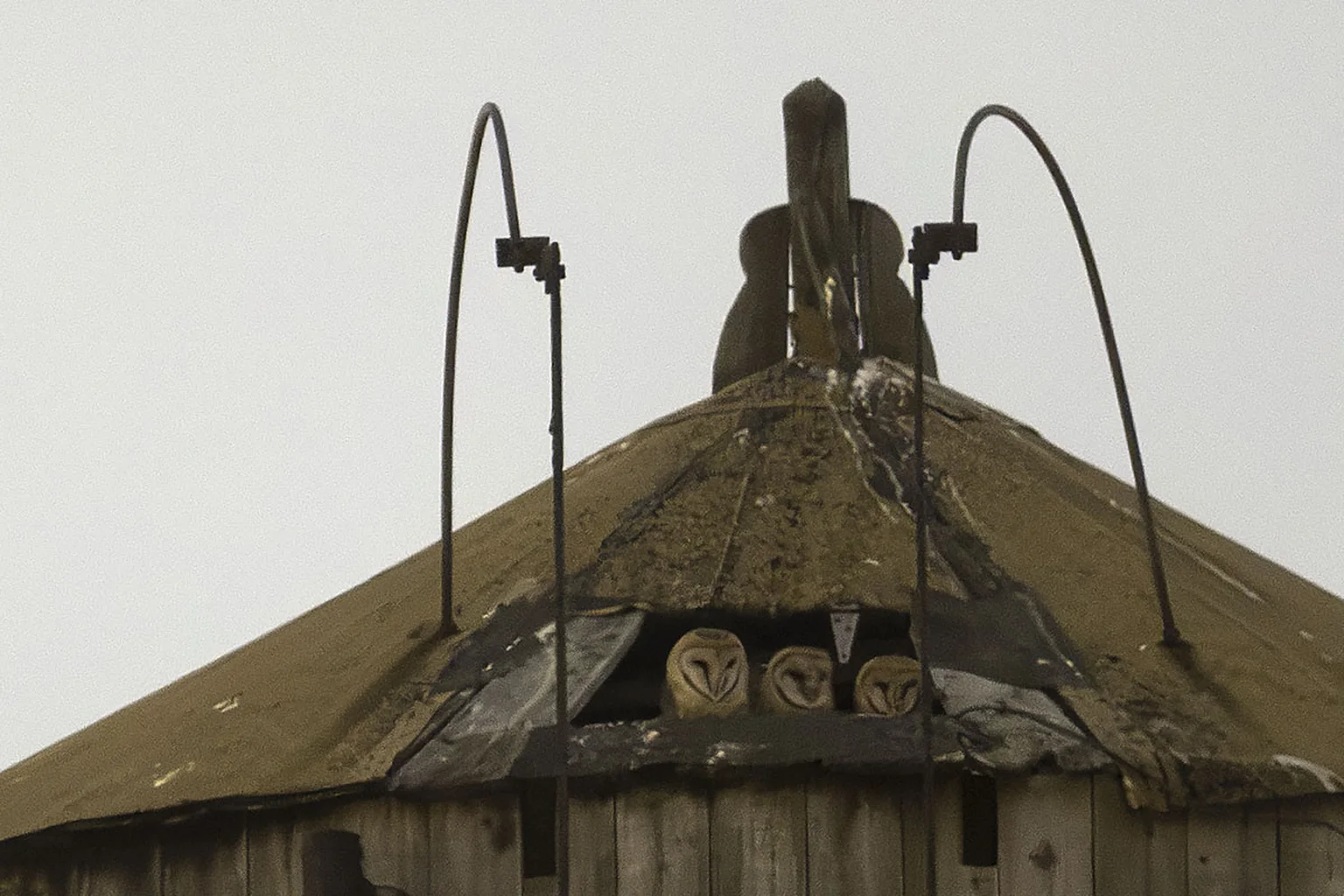
The barn owl family living in a rooftop water tank on Manhattan’s Upper West Side is beginning to spread out. D. Bruce Yolton, a wildlife photographer who documents the city’s raptors on his Urban Hawks site, gave Hooray News an update in an email interview on Oct. 26.2
“The owls are still using the water tank, but less than before. Some of the owls are still using it to roost and the parents are using it as the drop-off place for food deliveries. There are five young and two adults.”
Earlier counts ran a little higher. Yolton had written that there were at least five owlets, possibly six, and CBS New York reported up to six young.13
Why this barn owl nest matters
Hooray News first reported on the family, which nests in a hole in a water tower near Central Park West.8 Experts say it is likely the first known barn owl nest in Manhattan in modern history. Andrew Farnsworth of the Cornell Lab of Ornithology told the AP that, to the best of the birding community’s knowledge, there has been no Manhattan nest in recorded history.47 Yolton wrote that it may be the first record of a nest in Manhattan in the last century.1
Barn owls have declined rapidly in New York over recent decades, so a successful brood in the middle of the city is welcome news.4 “The presence of a nest right in the middle of the country’s biggest city is really exciting,” Jessica Wilson of NYC Bird Alliance told CBS New York.3
The owlets are heading out, quietly
On Oct. 19, Yolton wrote that the fledglings would soon enter Central Park at night to learn to hunt and might eventually roost there during the day. He stopped his daily reports and asked others to stop posting the owls’ locations too.2
He repeated that request to Hooray News. Once the owls leave the nest block, he said, their locations should stay off social media, because crowds around a roosting owl would be harmful. “Owls, being day sleepers, need their privacy,” he said.2
Disturbance has already caused one close call. On Oct. 14, an inexperienced watcher on a roof startled a fledgling, which collided with something and seemed stunned before it flew off.2
How to watch the Upper West Side barn owls without bothering them
While the family still uses the tank, watching from the street takes very little effort to do politely, Yolton said. “No flashlights and keep the noise down are really the only major things that anyone needs to do.”2
Visitors should also know that the owls appear only once it is fully dark, not at dusk, so even binoculars may not help much. The best seat in the house may turn out to be a stranger’s camera screen.2
“There are usually photographers, many with cameras designed for low-light photographing the owls. If you ask politely, many will share their screens and allow you to watch the owls.”
An owl, two coyotes and a New Year’s Eve
Barn owls were around before anyone found the nest. Central Park coyote watchers had been seeing them in the park for 18 months, but where they roosted was a mystery until the water tank nest was found.1
Asked for a moment he would remember, Yolton went back to a New Year’s Eve in the park:2
“One of the parents did not like hearing the park’s coyote pair howl. On New Year’s Eve, the coyotes were on a ball field relaxing. After they heard a siren, and started to howl in response, an American Barn Owl appeared. It perched on a backstop and cried out at the coyotes. It was midnight and fireworks went off and both the coyotes and the owl dispersed.”
A noise dispute settled by an even louder noise is a very Manhattan way to end an argument.
The bigger danger is rat poison
Yolton’s main concern is secondary poisoning, which happens when a hawk or owl eats a rodent that has swallowed poison. “Secondary poisoning from rodenticides is a serious problem for NYC’s hawks and owls, so reducing their use would be most helpful,” he told Hooray News.2
On Urban Hawks, he has called for better sanitation so the city needs less rat poison. He has also urged support for the Wild Bird Fund and NYC Bird Alliance, including nest boxes in the area in case the water tank nest site ever needs repair.1
Did this make your day? Give it a cheer.
Sources
- Upper West Side American Barn Owls - Urban Hawks Urban Hawks (D. Bruce Yolton), 2026-10-12
- Urban Hawks home page (incl. 'American Barn Owl Safety', Oct. 19, and daily UWS barn owl posts) Urban Hawks (D. Bruce Yolton), 2026-10-19
- Family of barn owls on the Upper West Side captivates New York City birders CBS New York, 2026-10-12
- A Family of Barn Owls Has Moved Into New York City's Upper West Side, Perhaps the First to Nest in Manhattan in Modern History Smithsonian Magazine, 2026-10-15
- The Late-Night Birders Flocking to the UWS To Capture a Shot of the Resident Barn Owl Family West Side Rag, 2026-10-09
- Multiple Barn Owls Possibly Spotted in Upper West Side Building Courtyard West Side Rag, 2026-10-07
- A rare family of barn owls moved into Manhattan's Upper West Side. New Yorkers are captivated AP via OPB, 2026-10-15
- Barn Owls Are Raising Up to 6 Owlets in a Manhattan Water Tower Hooray News (our earlier story), 2026-10-24