A Marsupial With a Paintbrush Tail Is Now 3 Species, and One Is Endangered in NSW
Using DNA and 270 museum specimens, a UWA-led team split Australia's kultarr into three species, giving the shrinking eastern one its own conservation case.

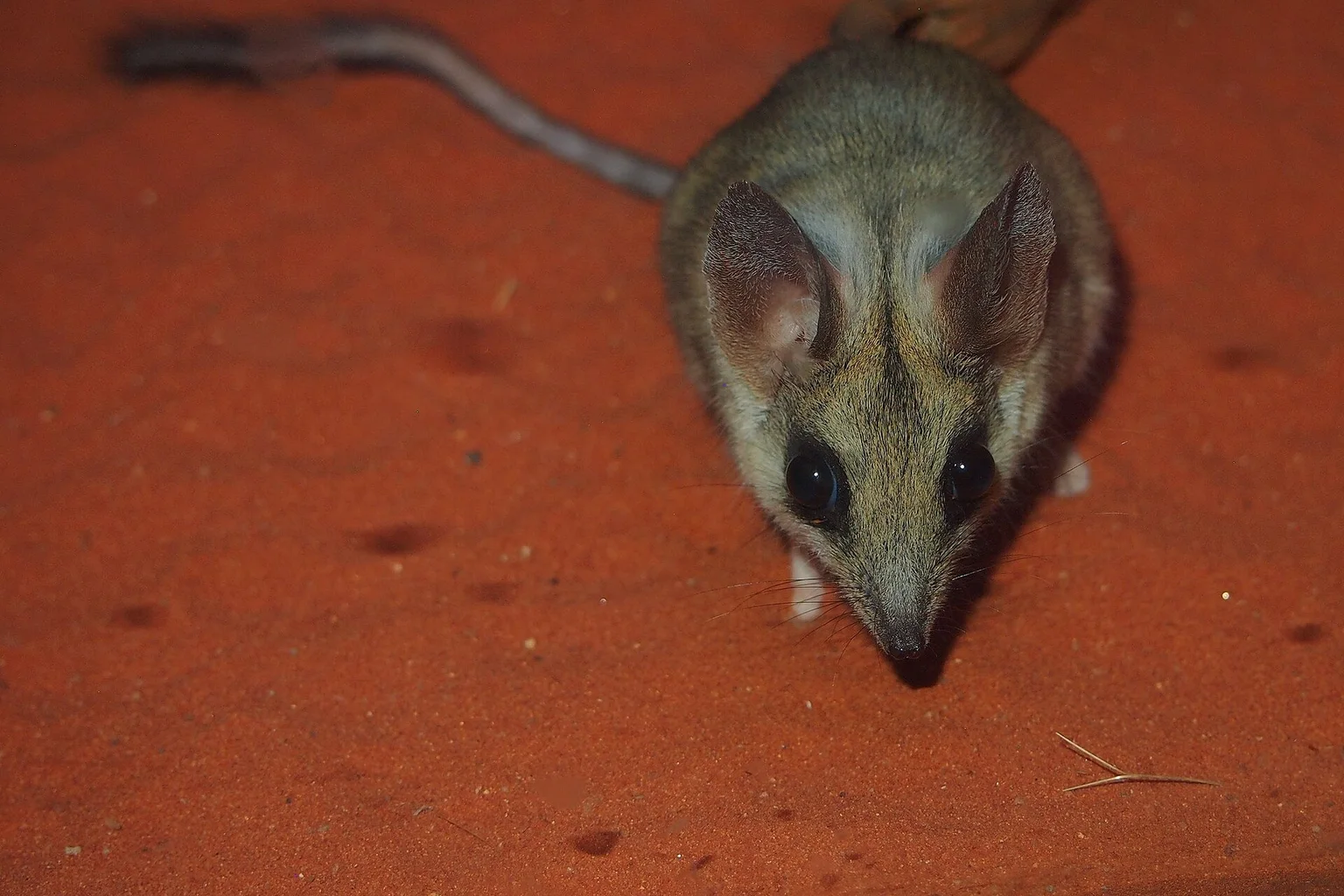
For decades, scientists treated the kultarr as a single species: a small, long-legged carnivorous marsupial of arid Australia. A new study finds that the one name was covering three different animals.2
The research was led by PhD student Cameron Dodd at the University of Western Australia. It appeared on June 26, 2025, in the journal Ecology and Evolution.12 The university’s announcement counted two new species. The paper itself describes one brand-new species, the long-eared kultarr (Antechinomys auritus).2
The second split restores an old name. The gibber kultarr (A. spenceri) was first described by Oldfield Thomas in 1906, then folded into A. laniger in 1977. Now it has been reinstated. The name A. laniger stays with the eastern kultarr.2
The split matters because the eastern kultarr is in trouble. It is listed as Endangered in New South Wales, and the authors say its status needs to be reassessed.12 “Identifying them as different species will allow for more targeted conservation approaches that best suit the unique biology of each species,” Dodd told Mongabay.3
What a kultarr is
“At a glance, kultarr look very similar to hopping mice or jerboas, with very long legs for hopping and a long tail with a brush on the end,” Dodd said in the university’s announcement.1 Up close, the resemblance has limits. Kultarr bound on all four legs rather than hopping on two, and they hunt invertebrates. The tail ends in a dark brush.2
Three kultarrs, three home ranges
- Eastern kultarr (A. laniger): the smallest, with an average body length of about 7.5 centimeters. It once ranged across most of semi-arid eastern Australia. It is now limited to central New South Wales and south-central Queensland.23
- Gibber kultarr (A. spenceri): the largest and stockiest, at about 9 centimeters. It lives on stony “gibber plains” in southwest Queensland and northeast South Australia, and around Lake Eyre to the MacDonnell Ranges.23
- Long-eared kultarr (A. auritus): the one with the biggest ears for the size of its head. It lives in low numbers across much of outback Western Australia and the western arid zone, on flat gibber and sandplain country.123
How the team told them apart
The researchers measured the bodies and skulls of 270 museum specimens by hand. They also compared a stretch of mitochondrial DNA from 37 kultarrs, plus genetic markers from across the genome. The three groups differ in hind foot length, body size, ear size, and the shape of the skull and teeth. They mostly live in separate regions, and where their ranges meet, genetic mixing is under 5 percent.2
Splitting a species is a scientific judgment, and the paper is open about its limits. The genome-wide data strongly support the three groups, but the mitochondrial family tree has only moderate support. One animal’s two kinds of DNA pointed in different directions, and the authors say more sampling is needed.2
The animals can also be hard to tell apart in places. According to the paper, only genetics and a single tooth feature reliably separate a long-eared kultarr from a young gibber kultarr. That makes for a demanding field guide.2
A mixed conservation picture
The eastern kultarr has no federal listing.2 The paper says the gibber and long-eared kultarrs also need conservation assessments. It also says nothing indicates either faces an immediate extinction threat, and historical records suggest their ranges have not shrunk as much as the eastern kultarr’s.2
Museum collections did much of the work. The official reference specimen for the new species is an adult female collected at Elder Creek, Western Australia, in 1963 and kept at the Western Australian Museum.2 Co-author Kenny Travouillon of that museum said the findings show how important museum collections are, both for describing new species and for tracking how their ranges change over time.1
“A lot of people don’t realise that Australia still has many new mammal species that still haven’t been formally discovered and described,” Dodd said in the announcement. As he put it, “if we don’t know all of the species that exist, we can’t know which need the most help.”1
Did this make your day? Give it a cheer.
Sources
- And then there were three: two new species of marsupial discovered The University of Western Australia (UWA News), 2025-06-30
- Cryptic Kultarr: Integrative Taxonomy Reveals Unrecognized Species of Carnivorous Marsupial (Dasyuridae: Antechinomys) in Arid Australia Ecology and Evolution (Wiley / British Ecological Society), via PubMed Central, 2025-06-26
- Small Australian carnivorous marsupial reclassified as 3 species: Study Mongabay, 2025-07-01
- Australia's cutest mammal is now Australia's cutest three mammals Phys.org (apparently republished from The Conversation, written by the study authors), 2025-06-30
- Antechinomys auritus • Long-eared Kultarr Mammal Diversity Database (American Society of Mammalogists), 2025-07-01
- Pint-sized marsupials with 'paintbrush tails' found in deep Australia. They're new species Good Good Good, 2025-07-01