13 Egrets From a Species Victorian Couture Nearly Erased Were Moonlighting as Vole Hunters
A nature writer's count of 13 great egrets at Cambridgeshire's Ouse Fen shows how far the species has come, and how a gravel quarry is becoming wetland.

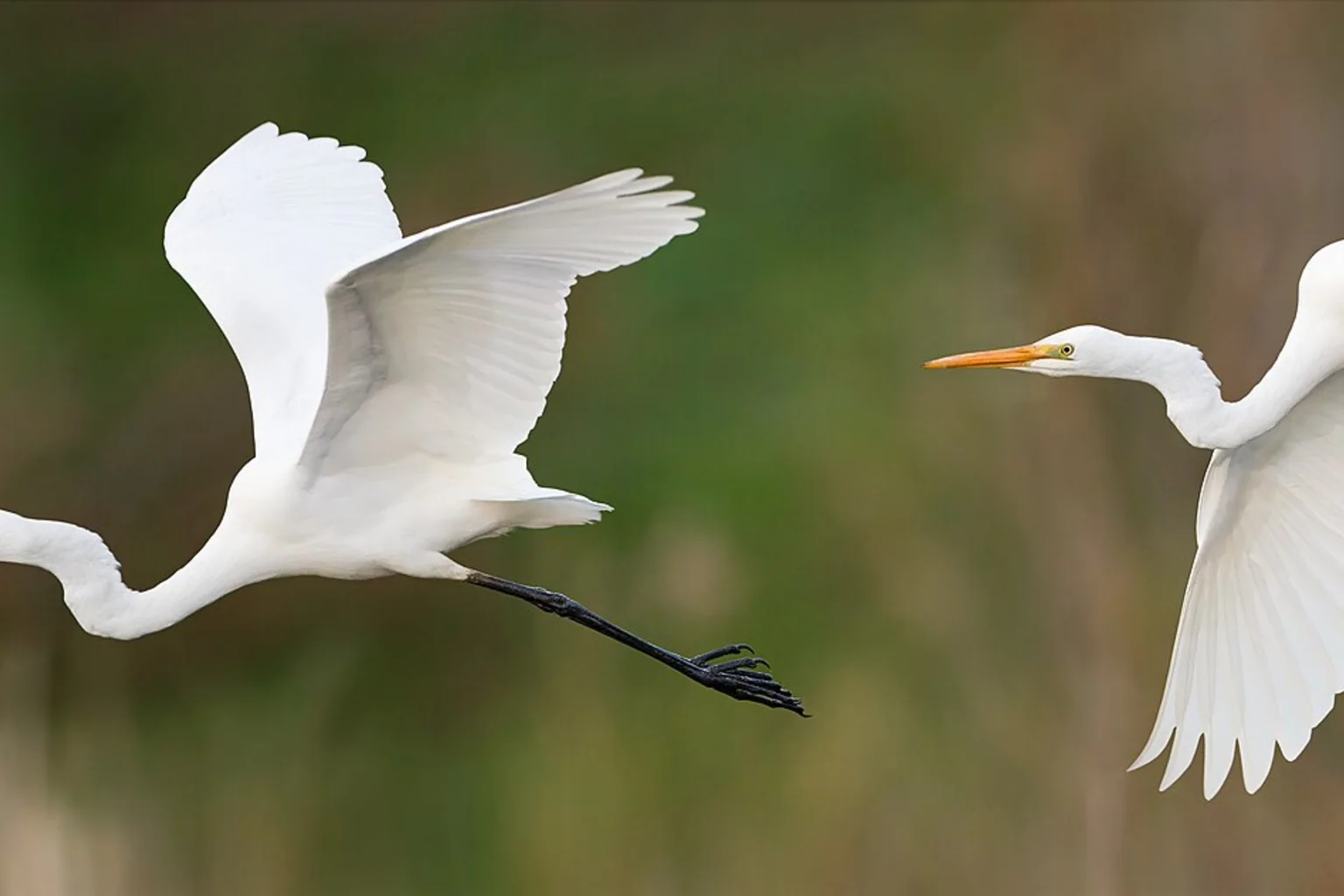
Great egrets are tall white wading birds of freshwater marsh, and they routinely hunt fish. So the nature writer Mark Cocker found it strange to count 13 of them among burnt, dead thistles in a dry field beside a path at Ouse Fen in Cambridgeshire, England. They were hunting voles.1
Cocker described the sighting in his Country Diary column for The Guardian, published Oct. 20, 2026, after a summer of heat and drought. He suggests the birds may well be there as a consequence of the climate crisis. He frames the scene as possibly a good news story, not a certain one.1
What makes it possibly good is the bird’s history. Great egrets were once hunted across Europe for their long white breeding feathers, which went into fashion. Cocker writes that the Victorian feather trade pushed the species to the edge of extinction.14 The Royal Society for the Protection of Birds (RSPB), the charity that helps run Ouse Fen today, was founded to campaign against that plumage trade.4
From near-extinction to a regular sight
The species recovered and expanded massively across Europe, then colonized Britain at the start of this century, according to Cocker.1 It is a newcomer to Britain, not a native bird making a comeback.
According to the RSPB, great egrets first bred in the UK in 2012, on the Avalon Marshes in Somerset, and have since spread north as far as Scotland.4 In summer 2023, Natural England recorded a record 88 chicks fledging from 53 nests in the Avalon Marshes alone, BirdGuides reported.5
Cocker writes that the number of great egrets wintering in Britain may now reach four figures.1 He does not say the birds breed at Ouse Fen. The 13 in the thistle field were simply feeding there.
A quarry turning into wetland
The setting is its own story. Ouse Fen is a partnership between a gravel-extraction business and the RSPB, gradually converting low-quality farmland on a river floodplain into what Cocker calls one of Britain’s richest wetlands.1 The RSPB says it is creating the Ouse Fen reserve in phases from a working sand and gravel quarry with Brice Aggregates.2
In other words, the diggers and the bird charity are sharing the same site, on purpose. The RSPB has worked with the minerals industry at Needingworth Quarry since 1999.3
The plans are large. The reserve is planned at 700 hectares, including a 460-hectare reedbed that will be the UK’s largest.2 It also forms part of a nearly continuous 3,000-hectare wetland that includes the RSPB’s Fen Drayton Lakes and Ouse Washes.3
Wildlife has not waited for the finished version. The site holds up to 12 booming male bitterns and eight nesting marsh harriers, and otters and water voles have settled in, according to Natural Cambridgeshire.3 Cocker adds spined loaches to the list.1
The land has hosted big wetland wildlife before. Cocker writes that archaeological work on other parts of the site found that the most abundant Neolithic bones there belong to beavers and Dalmatian pelicans.1
Did this make your day? Give it a cheer.
Sources
- Country diary: A species brought to the edge of extinction, recovering in the fens The Guardian (read via AOL UK syndicated copy, canonical Guardian URL), 2026-10-20
- Ouse Fen Nature Reserve, Cambridgeshire RSPB
- Ouse Fen Nature Reserve Natural Cambridgeshire
- Great White Egrets successfully fledge in Scotland for the first time RSPB
- Great Egret thriving in Somerset BirdGuides
- Country diary: A species brought to the edge of extinction, recovering in the fens (AOL copy) AOL UK (syndicated from The Guardian), 2026-10-20