
A Reedsnake’s Rear Spins Like a Wheel. Its Head Ignores All of It
Filmed from several angles, dwarf reedsnakes hit peak rolling speeds about four times their top slithering speed while keeping their heads nearly level.

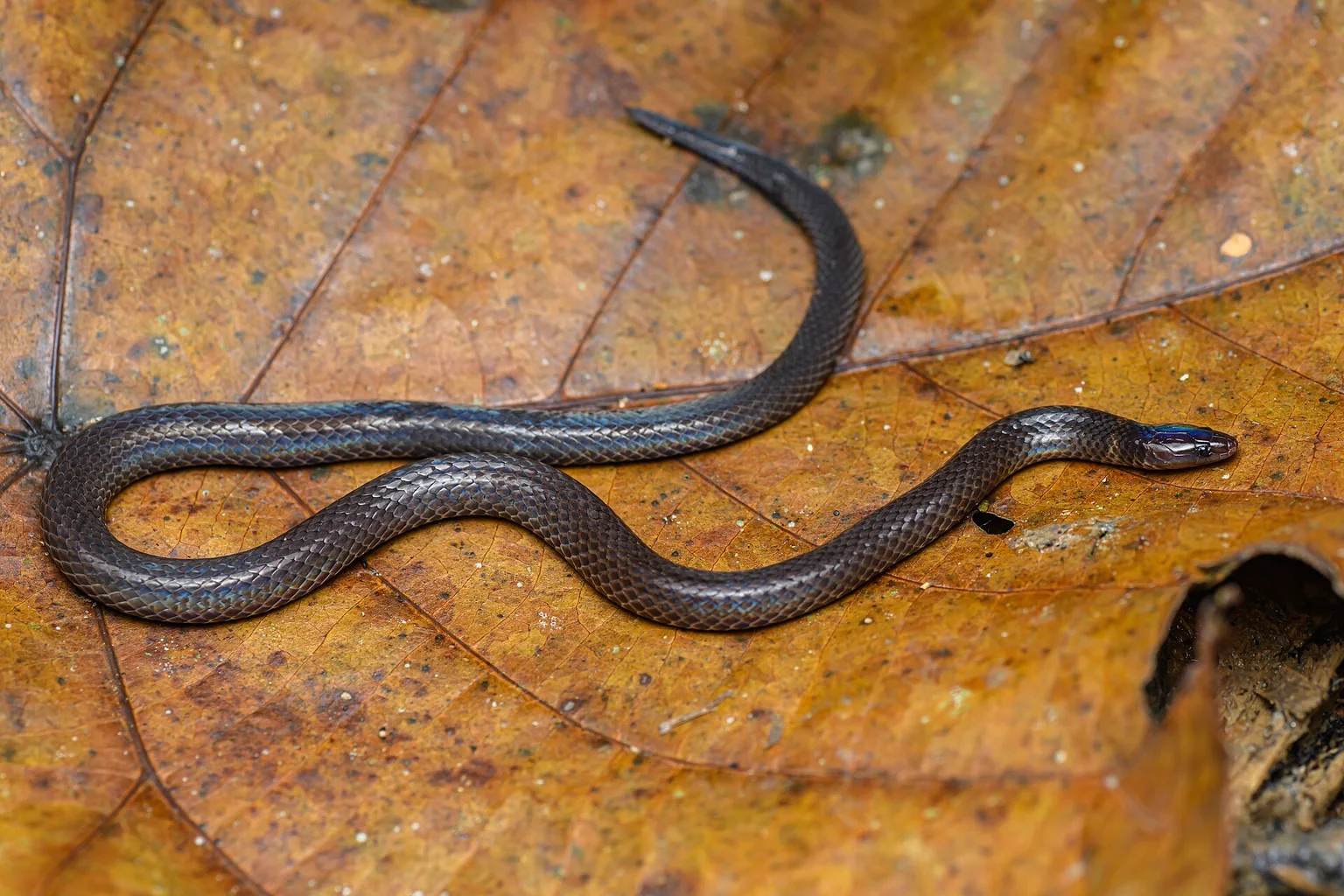
Most snakes leave a bad situation by slithering. Dwarf reedsnakes from Southeast Asia have another option. They roll. Researchers at Toho University in Japan have now filmed the move from several angles and worked out how a legless animal pulls it off.1
The snakes reached peak rolling speeds between 1.72 and 3.69 meters per second. That is about four times their top speed when slithering side to side.1 Both numbers are peak speeds, so the comparison is fastest roll against fastest slither. It is not a comparison of average speeds.3
The fastest of those peaks works out to about 8 mph, from an animal that is usually under 12 inches long as an adult. At that speed a snake covers nearly 15 of its own body lengths per second.45
Very few animals are known to roll on purpose to escape predators. The reedsnakes’ habit shows up in field guides and had been documented once before in the field. Until this study, nobody understood the mechanics behind it.1
A roll, a stroke and a very steady head
The motion comes in two alternating parts. First the snake rolls on one side. Then it swings a curved section of its body downward beside its head, a movement the researchers call a “stroke.” With each cycle, the side touching the ground and the direction of the stroke switch.1
The head does something different. While the back of the body rotates, the head keeps pointing in the direction of travel and stays at a nearly constant height. This is clearest at higher speeds, when the snakes hold their heads up off the ground.13 In other words, the rear of the snake spins like a wheel while the front end carries on as if nothing unusual is happening.
The rolling is not a wild tumble, either. In the lab, the snakes held to a racetrack only 20 centimeters wide while moving at these speeds. That lane is narrower than a sheet of printer paper. The researchers read this as a sign that the snakes are steering, not simply falling end over end.1
From a surprise in the field to a lab racetrack
The team, led by Yosuke Kojima, studied dwarf reedsnakes in Borneo in 2019 and 2022. A paper published in 2023 was the first to formally document the rolling, in a species called Pseudorabdion longiceps that had been observed in northwestern Malaysia in 2019. Kojima’s team saw the same behavior on its own at around the same time in Sarawak, the Malaysian state on Borneo.23
“I had never seen anything like it before, and I immediately wanted to learn more about it,” Kojima said, as quoted in a syndicated science article on Yahoo News.2
For the detailed measurements, the researchers recorded 13 snakes from three species, using cameras placed at different angles. They also saw the snakes rolling in the wild. The speed and movement figures, however, all come from the lab animals.35
The findings appear in the journal Current Biology under the title “Locomotor kinematics and head stabilization in rolling snakes.” Kojima’s co-authors are Ibuki Fukuyama, Mohamad Yazid Hossman, Clement Het Kaliang and Kanto Nishikawa.1
One of the species studied is Pseudorabdion saravacense. It is one of three dwarf reedsnake species now known to roll.12

Did this make your day? Give it a cheer.
Sources
- These tiny snakes roll four times faster than they slither ScienceDaily (Toho University release), 2026-10-24
- Secretive snakes have a surprising trick to evade predators — watch their rapid escape Yahoo News (syndicated science article), 2026-10-23
- These Snakes Escape Danger by Spinning Like Wheels ZME Science, 2026-10-22
- This snake cartwheels to escape danger Popular Science, 2026-10-20
- The Great Snake Escape…via Cartwheel Japan Research Report (Substack), 2026-10-22