A Venomous Loris Feared Extinct Was an Hour’s Flight From Jakarta All Along
A decade of rescue records shows the Bangka slow loris never left its island, though scientists say it remains critically endangered and needs protection.

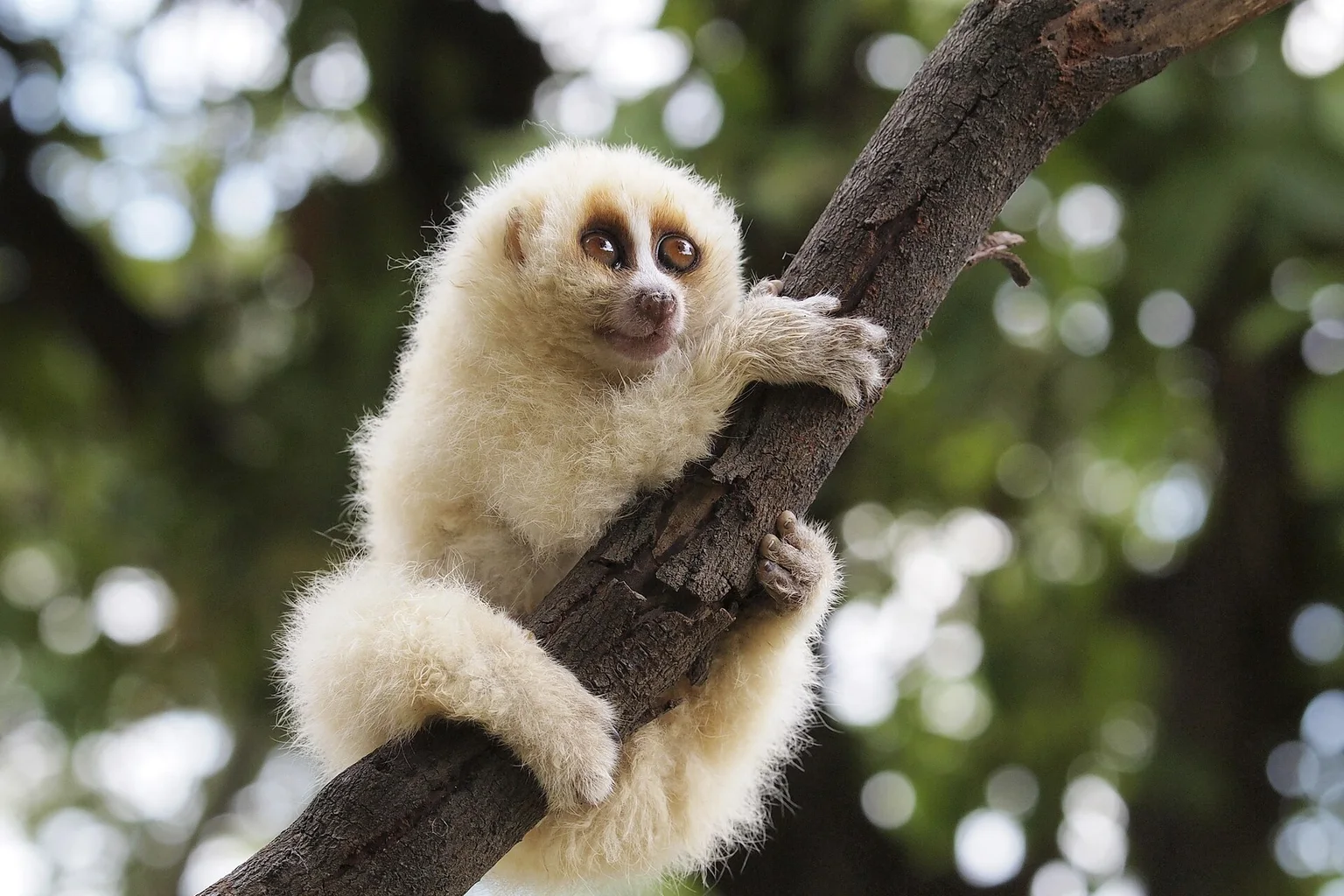
For an animal officially listed as possibly extinct, the Bangka slow loris has turned up in a surprising number of people’s houses and gardens. A new study in the journal Spixiana draws on rescue records from Indonesia’s Alobi Wildlife Rescue Center to show that the venomous primate still lives on Bangka Island.1
The IUCN Red List classes the Bangka slow loris as Critically Endangered (Possibly Extinct). It gives 1937 as the year the animal was last seen, but the paper notes that date has no cited source and the true last record may be earlier.1 Study co-author Timon Glaw told Reuters that the last historical scientific records discussed in the study date to 1930 to 1932.4
Putting the species back on the scientific record matters because it gives conservationists a basis for protecting what is left of its habitat. The authors recommend reassessing the Possibly Extinct tag. The IUCN has not changed it, and the species remains Critically Endangered either way.1
Lost to science, not to the neighbors
This was a rediscovery by records review, not a new expedition. Local people and the rescue center always knew the loris was there, and the paper itself says it was never lost to them.1
“A species can disappear from the scientific record without disappearing from the lives of the people who share its home,” Benji Barca, exploration program manager at the conservation group Re:wild, said in a press release from Alobi and Re:wild.2
Since 2015, Alobi has rescued more than 90 Bangka slow lorises from all four regencies of Bangka and from the city of Pangkal Pinang. Of those, 86 were released at seven sites, chosen as larger forest fragments with some legal or practical protection.12 No one has yet collected data on how the released animals fare.1
Detailed circumstances exist for 43 animals, all rescued since 2021. Of those, 16 were found in houses or gardens, seven had electrical burns, six were recovered from roads, five came from the wildlife trade or captivity, three were in plantations, one was tangled in a fence and one was attacked by a dog. Many were injured, and at least three died.1
The records have real limits. Some animals were kept as pets for days to months before rescue, so where they were found may not be where they were caught. The records lean toward the area around Pangkal Pinang. There is no population estimate or systematic survey, and the authors’ one brief search at Bukit Mangkol in 2023 found no lorises.1
How scientists know which loris it is
The Bangka slow loris was first described in 1906 and recognized as its own species in 2013.2 The skull of an animal that died had only two upper incisors, which fits the Bangka species. Lorises on Sumatra and Java have four, so the paper says it is unlikely the animals were introduced from those islands.1
That identification rests on body features alone, with no genetic confirmation yet. It is also unclear whether slow lorises on nearby Belitung and on Borneo belong to the same species.1
Slow lorises are the only primates known to be venomous, and the delivery system is unusual. They lick a gland on the inside of the upper arm and mix the secretion with saliva.2 According to Reuters, Glaw said the venom can cause severe allergic reactions in humans. In other slow lorises it is thought to be used mainly in conflicts with other lorises.4
Still very close to extinction
The animal science had filed under possibly extinct lives on an island that is, as Glaw noted to Reuters, about an hour’s flight from Jakarta.4 Its habitat is shrinking. The paper names tin mining, oil palm plantations and settlements as causes of habitat loss, and cites a study finding that the species’ forest habitat fell 62% between 2000 and 2012. Roads, power lines and the pet trade add to the danger.12 An opinion piece cited in the paper reports an apparent drop in density from 32.22 to 7.50 animals per square kilometer between 2017 and 2024, though the underlying data are unpublished.1
“We are glad to contribute to the scientific record to show that the Bangka slow loris is not lost, but the species is still very close to extinction,” Alobi director Langka Sani said in the press release.2
The study was co-authored by Alobi, the Haus des Meeres Aqua Terra Zoo in Vienna and the Taman Safari Prigen Conservation Breeding Ark, and its publication coincides with Lost Species Month in October.2 The authors call for targeted surveys, genetic work to confirm the species, a conservation program in the wild with monitored releases, and a breeding program in captivity.1
“Bringing the Bangka slow loris back onto the scientific radar is only the first step,” Glaw said in the release.2 He told Reuters the rediscovery “also offers hope that other species feared to be extinct may still survive in places where scientists have not looked for decades.”4
Did this make your day? Give it a cheer.
Sources
- Neglected but still alive: Further evidence for the continued existence of the Bangka Slow Loris (Nycticebus bancanus) on Bangka Island, Indonesia Spixiana (Verlag Dr. Friedrich Pfeil), 2026-10-01
- Venomous primate thought lost to science for nearly a century turns up in gardens and on roads across Indonesia Phys.org (provided by Alobi Wildlife Rescue Center), 2026-10-21
- Bangka Slow Loris Rediscovered After Nearly 100 Years (Re:wild press release) Re:wild, 2026-10-20
- Feared extinct, Bangka slow loris primate rediscovered in Indonesia Reuters (via Yahoo News), by Will Dunham, 2026-10-20