Artemis II Heat Shield Had 9 Char-Loss Spots, Down From 103 on Artemis I
NASA's post-flight review says a shorter reentry path cut cracking and char loss tenfold, though lab testing of the returned shield is still underway.

When Orion came home from the Moon on April 10, 2026, it hit 39 times the speed of sound, and the air outside its heat shield climbed above 4,000°F. Inside, the cabin stayed in the mid-70s, a temperature most people would call a pleasant spring afternoon.12
Now NASA says a deeper engineering analysis confirms what its first data showed: the heat shield on Artemis II performed as expected.1 This is NASA reviewing its own hardware, and most news coverage so far relays the agency’s findings.
The result matters because of what happened last time. During Artemis I in late 2022, the heat shield unexpectedly lost char, with material chipping off in larger-than-expected pieces. That was the primary safety concern heading into Artemis II, the first crewed flight.4
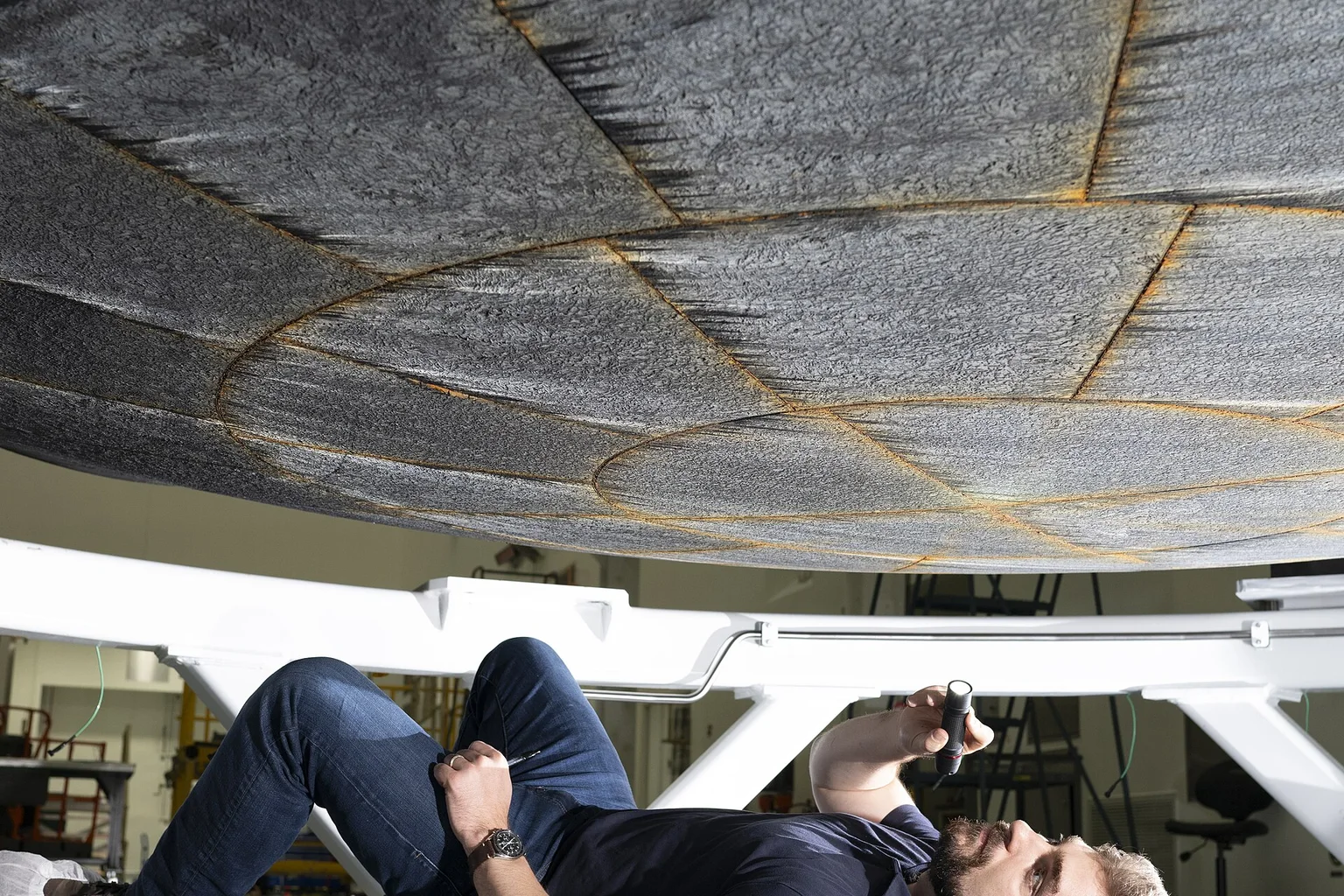
This time, NASA counted nine char-loss spots on the heat shield dish, down from 103 on Artemis I. The agency says cracking and char loss dropped by a factor of ten. “As expected” is not the same as spotless, and those nine spots were part of the result.13
A shorter path home
The fix was about the route. After studying Artemis I and running arc jet tests (ground tests that blast material with extreme heat) at NASA Ames, engineers shortened the maximum downrange distance, meaning how far Orion travels between entering the atmosphere and splashing down in the Pacific.1
Pre-mission analysis showed the shorter path would limit how long the shield spent in the temperature range where the Artemis I problem happened.12
Orion flew that path precisely. It entered the atmosphere within 192 feet of its target point and splashed down 0.59 miles from the predicted landing site off San Diego.1 After a trip to the Moon and back, that is a short walk from the bullseye.
A post-flight review found Orion’s aerodynamic and heating performance matched pre-flight predictions. That covers both the heat shield and the backshell, the capsule’s outer skin made of 1,300 ceramic tiles. The backshell showed no signs of overheating around its windows, vents, thrusters or side hatch.13
Early inspections right after splashdown, using Navy diver images and checks on the recovery ship, had already found the char loss was much smaller in both amount and size.45 In FOX 35 Orlando’s April coverage, Zac Aubert, founder of The Launch Pad Network, put it simply:4
Artemis’s Orion did exactly as we hoped.
Lab testing is still underway
The shield is built from 186 unique blocks of Avcoat, an ablative material, which means it is designed to char and wear away in a controlled way as it absorbs heat. After returning to Kennedy Space Center, the shield went to NASA Marshall in Huntsville, Alabama, where crews began cutting out samples and taking internal x-ray scans in August.1
That work is still going. Engineers are also comparing laser scans of the shield’s surface with pre-flight measurements to learn how much material wore away, and those results have not been published yet.13
What comes next
The next shield already carries changes. NASA upgraded the Artemis III design so the Avcoat blocks are more uniform and have consistent permeability. That shield was attached in early July, and the crew and service modules were joined at the end of July.1
Artemis III is planned for 2027 in low Earth orbit, where it will meet up with human lander test articles from Blue Origin and SpaceX. NASA plans for Moon landings to begin with Artemis IV in 2028.1
Did this make your day? Give it a cheer.
Sources
- Rigorous Analysis Confirms NASA's Artemis II Heat Shield Performance NASA, 2026-10-15
- Rigorous analysis confirms NASA's Artemis II heat shield performance Phys.org, 2026-10-15
- NASA: Artemis II heat shield had 9 char-loss spots, Artemis I 103 Eastern Herald, 2026-10-15
- How did Artemis II's heat shield perform? New image, data released FOX 35 Orlando, 2026-04-23
- So How Did Artemis 2's Heat Shield Hold Up? The First Results Are In Gizmodo, 2026-04-20
- NASA finds Orion's heat shield performed as expected during Artemis I [sic] FlightGlobal, 2026-10-16