The Dugong Was Wearing a Car Fanbelt, and Nobody Knows Where It Got It
A 15-person crew cut the two-meter dugong loose and carried it in a cargo net over a sandbar near Exmouth, in a gulf where every dugong counts.

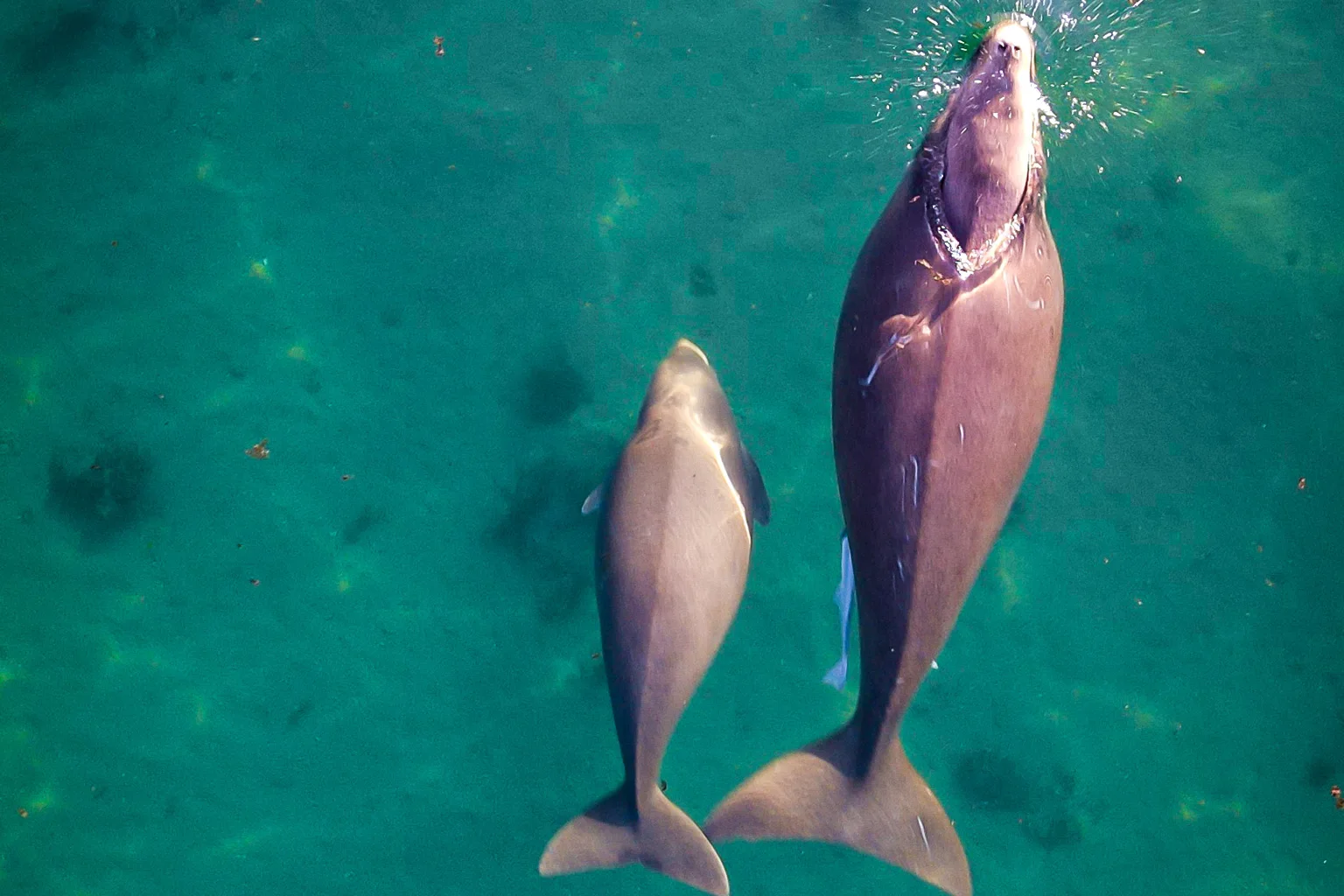
A young dugong was spotted struggling on a Wednesday at Wapet Creek, a tidal estuary near Exmouth in Western Australia, with a car fanbelt wrapped around it. In less than 24 hours, a team of 15 responders had cut it free and carried it back to deeper water, ABC Pilbara reported, based on the account of state wildlife officials from DBCA.1
Each rescue matters here. Exmouth Gulf has Western Australia’s second-highest concentration of dugongs, behind only Shark Bay, and a record marine heatwave in the summer of 2025 devastated some of the gulf’s seagrass.1 The ABC describes the species as globally vulnerable, and DBCA’s Sam Miles called dugongs endangered.1
The fanbelt was new even to the rescuers. Miles, DBCA’s acting marine program coordinator, said they had not seen this kind of entanglement before and did not know where the animal had picked it up.1 Wapet Creek, 1,230 kilometers north of Perth, is popular with flat fishers. It is not known for its auto parts.
How to move a dugong across a sandbar
The responders started by checking the animal’s health and calling experts at Perth Zoo and the Sea World Foundation for advice. Then they restrained the dugong and cut the belt away.1
That left the problem of getting it home. The dugong was roughly two meters long, which sounds manageable for a marine mammal until you consider Miles’s point:
“But even a two-metre dugong can weigh a couple of hundred kilograms.”
The crew wrapped it in a cargo net, hoisted it out of the shallows and carried it over a sandbar to the deeper water of Exmouth Gulf.1 “It took all hands on deck to lift the animal over the sand flats and back into the gulf,” Miles told the ABC.
The crew named the dugong Wapi, after the creek. As it swam off, rescuers called out yadiyarra, the Baiyungu word for dugong, in a video filmed by a DBCA staff member. The ABC also published DBCA-supplied video of the release.12
A good day in a hard year
Miles said the animal came through the ordeal well. “It wasn’t showing any signs of major distress, which was really important,” he said.1 He also credited a quick report from a member of the public with helping to save it.1
Helene Marsh, a professor emeritus in conservation science at James Cook University, said she was delighted to see the dugong move so strongly after its release.1 The last reported sighting is Wapi swimming off into the gulf.
For the rescuers, Miles called it a morale booster after a challenging year of animal entanglements off the Ningaloo coast.1
The wider picture explains why one animal gets this much effort. Aerial surveys in Queensland’s Gulf of Carpentaria recently found its dugong population had dropped by 50 percent in 20 years.1 “Australia’s unquestionably the dugong capital of the world,” Marsh told the ABC.
Miles put it more simply: “Dugongs are endangered and we know that every dugong we save will help the overall population in the Exmouth Gulf.”1
Did this make your day? Give it a cheer.
Sources
- Rescuers hoist entangled dugong to safety off Exmouth in WA ABC News (ABC Pilbara), 2026-10-26
- Rescuers (video): release of dugong into Exmouth Gulf ABC News, 2026-10-26
- Dugong freed from fan belt near Exmouth — ABC News Australia ua.news, 2026-10-26