Himalayan Frog Tanogogo Was Named for Snails, and Snails Appear to Be Lunch
Scientists found five new horned frog species in India's Arunachal Pradesh, including one the team says is India's first known snail-eating frog.

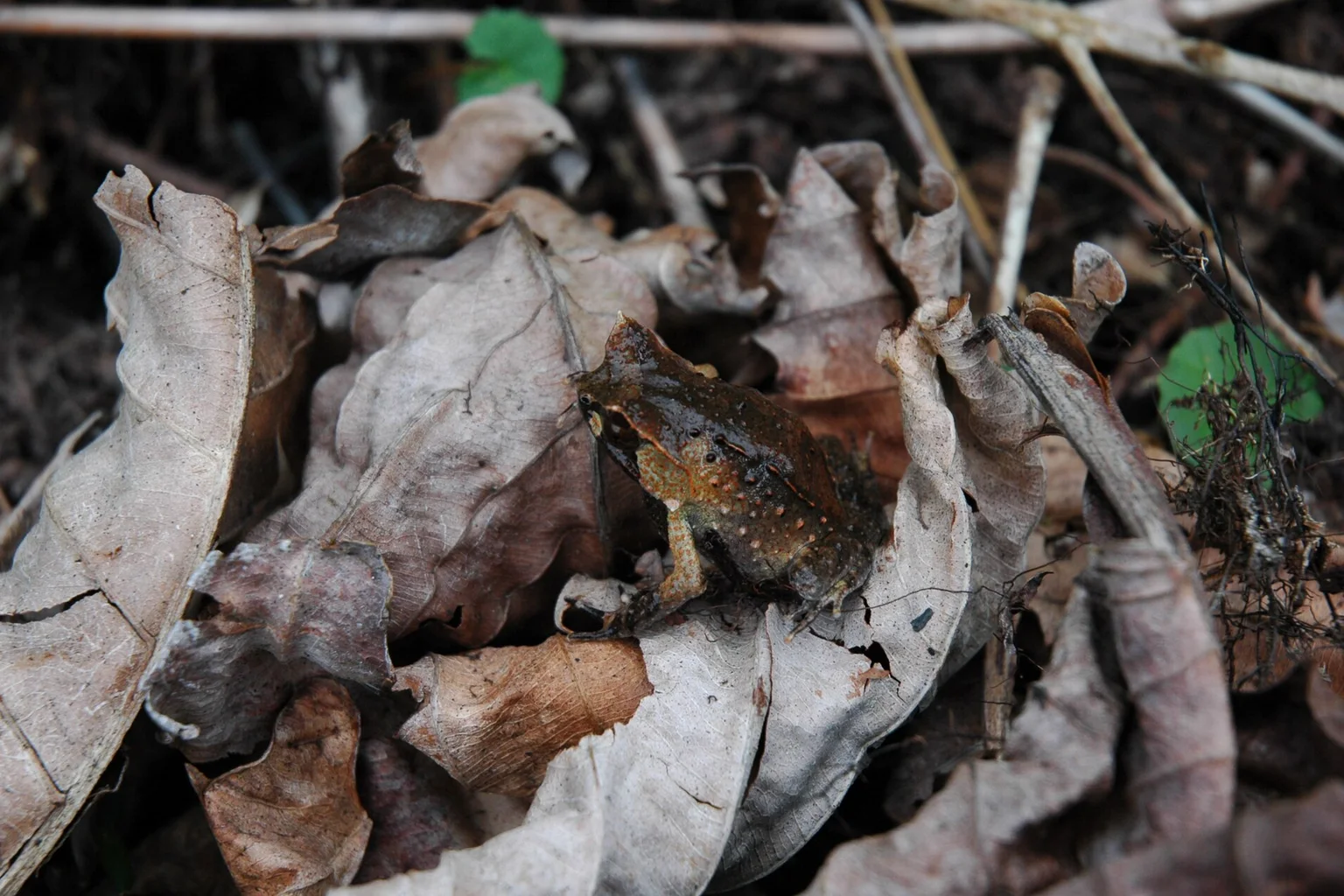
Researchers from the University of Delhi and Harvard University have described five new species of small horned frogs from Arunachal Pradesh, in India’s eastern Himalayas. One of them, the team says, is the first documented snail-eating frog in India. The study, built on five years of fieldwork, was published on Nov. 11 in Royal Society Open Science.123
The frogs belong to a genus called Jingophrys, a group the paper describes as “diminutive” horned frogs. Before this study, the genus had six described species, scattered in separate pockets across the Himalayas and the Indo-Burma region.1 Adding five at once more than doubles the group’s known diversity, and the count of these small horned frog species known from India grew seven-fold, according to NorthEast Now.2
That matters beyond the tally. The work suggests that a corner of the Himalayas already known for rich wildlife still holds a lot nobody had written down, and the researchers use it to make the case for protecting the region’s forests.23
Meet the snail-eater
The standout is Jingophrys tanogogo, the snail-eating horned frog. Using 3D micro-CT imaging, a kind of detailed X-ray scan, the team found whole land snail shells inside its gut.2 The study team says it is the first documented snail-eating frog in India and the first such report for the Asian horned frog family.2
Its name fits with unusual precision. “Tanogogo” is the Apatani word for snails, so the frog is, more or less, named after its lunch.23
The other four are J. taniitatii (the Tanii horned frog), J. siangensis (the Siang horned frog), J. hrdy (Hrdy’s horned frog) and J. wularsoni (Wu-Larson’s horned frog).3 The Tanii horned frog’s name pairs the Tanii tribe with the Apatani word for frog, while the last two honor supporters of herpetological research at Harvard.23
How you find a frog that doesn’t want to be found
These are not frogs that hop onto the trail to say hello.
“Some of the new species are extremely secretive and found in remote forests only during a short breeding season”
That is how S. D. Biju of the University of Delhi described them, in comments reported by BBC News.3 The work was led by Sonali Garg, a Biodiversity Postdoctoral Fellow at Harvard’s Museum of Comparative Zoology. Her co-authors were Biju, Tage Tajo, Radhakrishna Upadhyaya K and James Hanken.13
Because the frogs can look alike, the team sorted them out with three kinds of evidence: DNA, physical features and the males’ mating calls.2 In other words, some species were told apart partly by how they sing.
Shaped by mountains and monsoon
The DNA also points to a backstory. The analysis indicates these horned frogs diversified rapidly in the eastern Himalayas over millions of years, rather than arriving from elsewhere. That burst of new species lines up with the rise of the mountains and the formation and strengthening of the monsoon.23
The paper’s title calls this “overlooked in situ diversification,” meaning species evolving in place, right where they live today.1
Probably not the last of them
The study also adds two new country records for India, and it flags several frog populations the team could not yet identify that may turn out to be additional new species.2
Much is still unknown about the five newcomers. The researchers say more study is needed to understand their biology and what they need to survive, and they stress the importance of protecting Eastern Himalayan forests, where these secretive frogs spend most of the year out of sight.23
Did this make your day? Give it a cheer.
Sources
- Two-fold hidden diversity of diminutive horned frogs (Megophryinae: Jingophrys) highlights overlooked in situ diversification in the Himalayas Royal Society Open Science, 2026-11-11
- India's first snail-eating frog discovered in Arunachal Pradesh NorthEast Now, 2026-11-12
- Five new miniature frog species found in eastern Himalayas (BBC News text, hosted on Yahoo) BBC News via Yahoo, 2026-11-12